Hubble Tracks a New Ten-Sided Wave Forming Around Saturn's South Pole
A giant ten-sided jet pattern is growing around Saturn's south pole, a southern cousin of its famous hexagon, Hubble images going back to 2023 confirm.
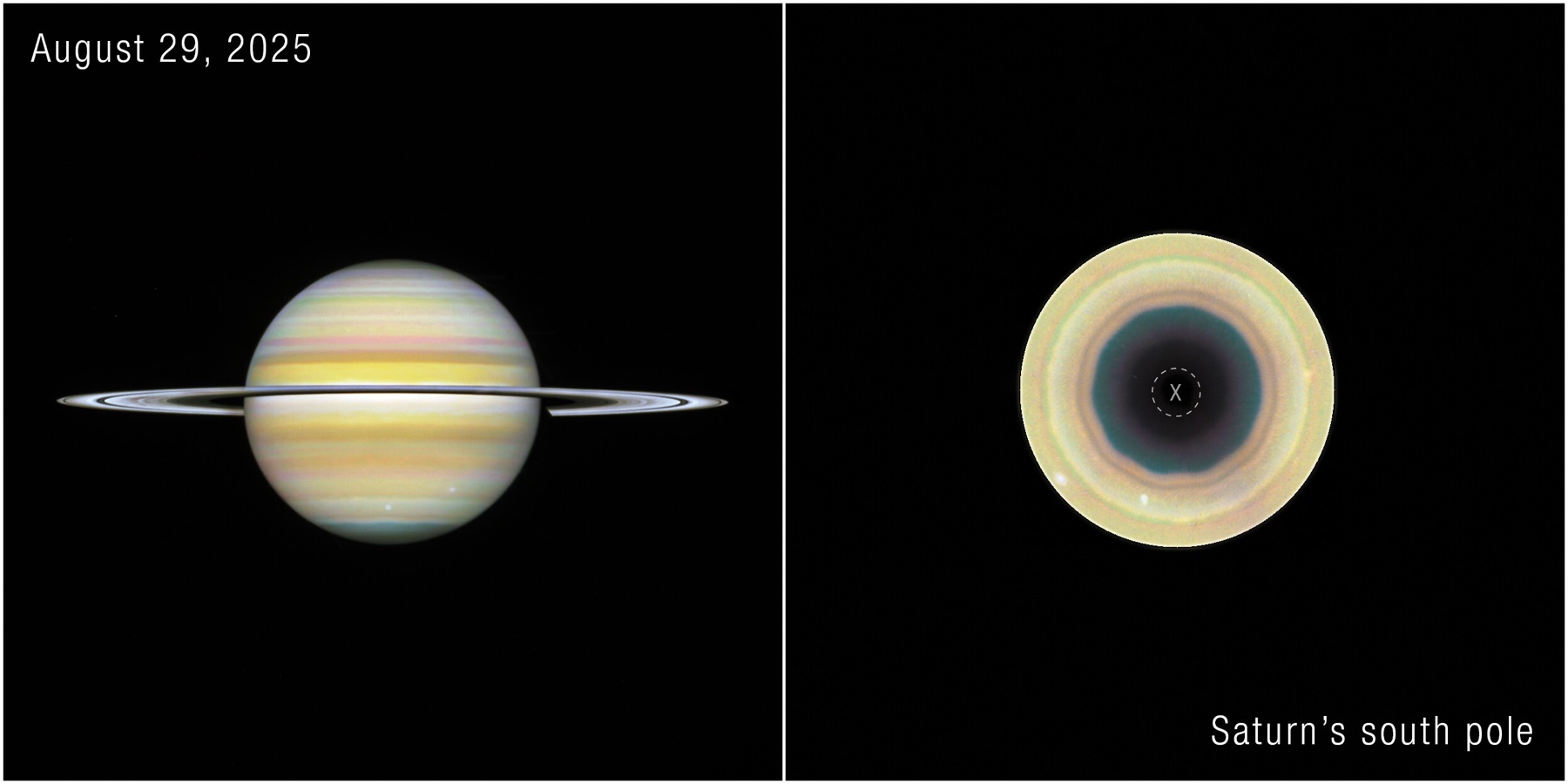
A giant, evolving ten-sided wave now circles Saturn’s south pole, the first large, regular-sided jet pattern seen in the planet’s southern hemisphere. The results, led by Agustín Sánchez-Lavega, appear in Science Advances, and ESA/Hubble announced them on September 2, 2026. The pattern resembles Saturn’s famous northern hexagon, which has been there every time astronomers looked for more than 40 years.
Amateur astronomers spotted it first. An undulating band appeared in ground-based images submitted in 2024 to the Planetary Virtual Observatory Laboratory, an online archive of amateur planetary images, and 2025 images strengthened the case. Hubble’s OPAL program, which images the outer planets every year to track their weather, confirmed the feature in data back to 2023. NASA’s Cassini spacecraft, which orbited Saturn from 2004 to 2017, saw no sign of it.
The wave extends through several layers of Saturn’s atmosphere and appears to be getting stronger. That gives astronomers a rare chance to watch a giant planetary weather pattern form in real time, rather than finding one already in place, as happened with the hexagon. Each stage of its growth is a test for models of how jet streams organize themselves on gas giants. It is not yet known whether the decagon will settle into a stable shape like its northern cousin or fade. More on the giant planets in our Solar System guide.
What to watch next: further Hubble and amateur images will show whether the pattern keeps strengthening.
Primary source
This summary is based on ESA/Hubble and the peer-reviewed paper. Read the original for full details, data and caveats.
This week in papers
The week's most important results, one line each, every week.