The solar system formed about 4.6 billion years ago when a cloud of gas and dust collapsed under its own gravity; most of the material became the Sun and the rest flattened into a disk that built the planets. Meteorites date its first solids to 4.567 billion years ago. The Sun will swell into a red giant in about 5 billion years.
This guide follows the solar system across deep time: how it formed, what lives at its edge, the visitors from other stars, and how it will end. For the far future of everything else, see Deep Time.
The solar system formed from the collapse of a cold cloud of gas and dust, and the planets grew in the flat disk left around the young Sun. Immanuel Kant (1755) and Pierre-Simon Laplace (1796) proposed this “nebular hypothesis” in its first form, and modern observations of planet-forming disks around young stars confirm it. The main steps:
- Collapse. A dense pocket of a molecular cloud, possibly nudged by a nearby supernova, collapses under gravity.
- Disk. Conservation of spin flattens the infalling material into a rotating protoplanetary disk, with the young Sun at its center.
- Planetesimals. Dust grains stick together into pebbles, then into bodies kilometers across called planetesimals, an idea developed by Viktor Safronov in the 1960s.
- Rocky and giant planets. Near the Sun, only rock and metal survive the heat, so small rocky planets form. Beyond the “snow line,” ice is abundant and cores grow large enough to grab hydrogen and helium gas, becoming Jupiter and Saturn.
- Migration and chaos. The giant planets shift their orbits. In the Grand Tack idea, Jupiter moved inward then back out early on; in the Nice model, a later instability rearranged the giant planets and scattered icy bodies (Gomes et al. 2005).
Collisions finished the job. Earth’s Moon probably formed when a Mars-sized body struck the young Earth (the giant impact hypothesis). JWST now sees similar violent eras around other young stars, in dusty disks left by planet-shattering collisions (Webb’s extreme debris disks).
How old is the solar system?
The solar system is 4.567 billion years old. The clock is radioactive decay in the oldest solids we have: calcium- and aluminum-rich inclusions, pale grains inside primitive meteorites that condensed from the hot gas around the newborn Sun. Uranium decays to lead at a known rate, so the ratio of lead isotopes in these grains gives their age. A 2012 study by James Connelly and colleagues dated them to 4,567.3 million years, with an uncertainty of only about 160,000 years.
That is about one third of the age of the universe, 13.8 billion years. The Sun is a latecomer, built from gas already enriched by generations of stars that lived and died before it (how stars make elements).
A tour of the solar system
Eight planets orbit the Sun, in two families: four small rocky worlds and four giants.
| Planet | Type | Average distance from Sun (AU) | One fact |
|---|
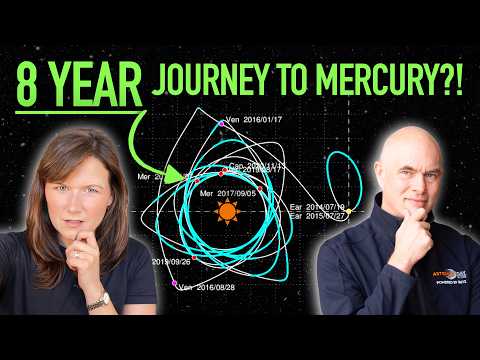
| Mercury | Rocky | 0.39 | BepiColombo, two orbiters in one, arrives in November 2026 |
| Venus | Rocky | 0.72 | Hottest surface of any planet, under a thick carbon dioxide atmosphere |
| Earth | Rocky | 1.00 | The only world known to host life |
| Mars | Rocky | 1.52 | Ancient lake beds now searched for signs of past life |
| Jupiter | Gas giant | 5.2 | Its moon Io is the most volcanic world in the solar system |
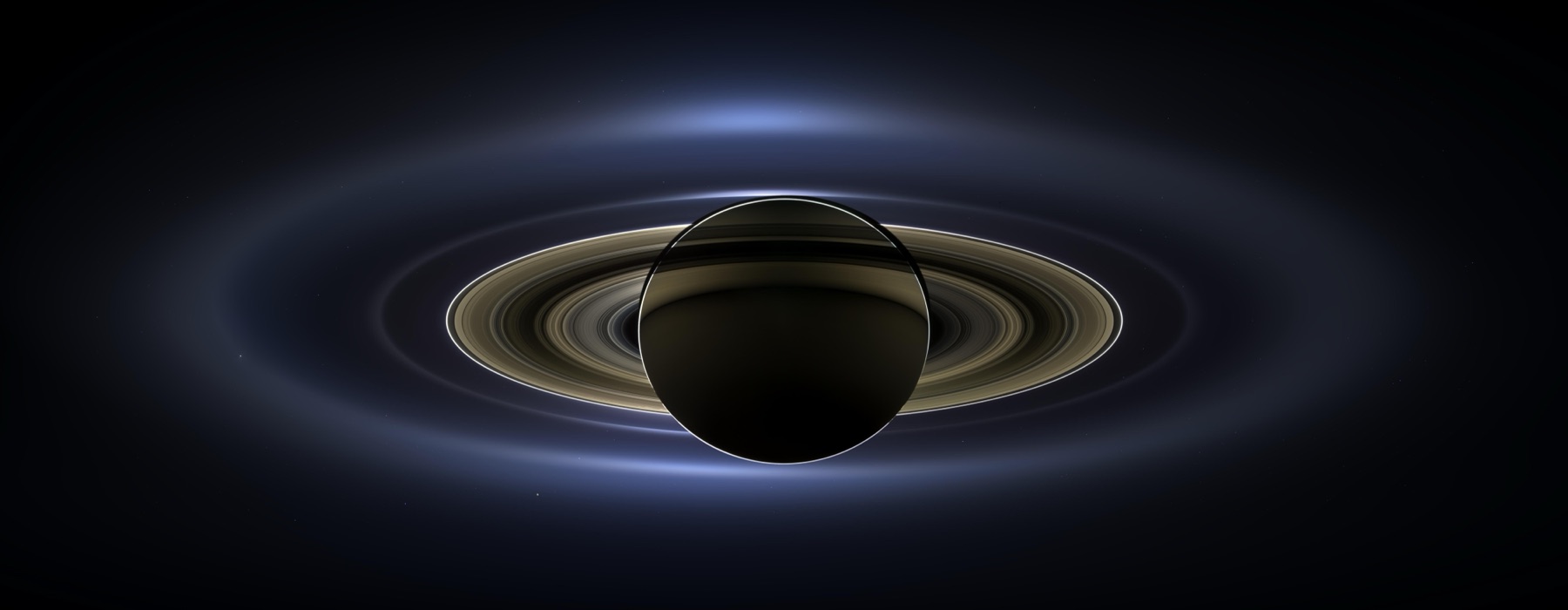
| Saturn | Gas giant | 9.5 | A new ten-sided wave is forming around its south pole |
| Uranus | Ice giant | 19.2 | Spins on its side, tilted about 98 degrees |
| Neptune | Ice giant | 30.1 | Found in 1846 from its pull on Uranus, before it was seen |
An astronomical unit (AU) is Earth’s average distance from the Sun, about 150 million kilometers.
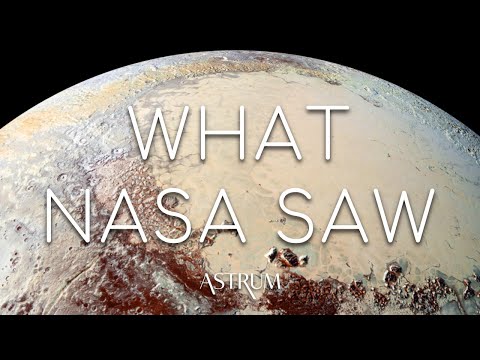
Beyond the planets are the dwarf planets, including Ceres in the asteroid belt and Pluto, Eris, Haumea and Makemake beyond Neptune. NASA’s New Horizons showed in 2015 that Pluto, far from being a dead ice ball, has young plains of nitrogen ice and an active surface (New Horizons at Pluto).
The planets are still surprising us. In 2026 Juno took the first temperature readings beneath the surface of Io (Juno at Io), Hubble tracked a new ten-sided wave forming around Saturn’s south pole (Saturn’s decagon), ESA’s BepiColombo began its arrival at Mercury (BepiColombo’s arrival phase), and in October Solar Orbiter traced a magnetic “switchback” in the solar wind back to the Sun’s surface (Solar Orbiter and the switchbacks).
The edge of the solar system
The solar system has no single edge; there are three boundaries, each farther out than the last.
- The Kuiper belt, a ring of icy bodies from about 30 to 50 AU. Pluto is one of its largest members. David Jewitt and Jane Luu found the first object beyond Pluto there in 1992 (the Kuiper belt discovery); thousands are now known, and the Vera C. Rubin Observatory found 380 new trans-Neptunian objects in its first weeks of tests alone.
- The heliopause, where the Sun’s wind of charged particles gives way to interstellar space. Voyager 1 crossed it on August 25, 2012, at about 122 AU, and Voyager 2 followed in November 2018.
- The Oort cloud, a hypothesized sphere of icy bodies stretching perhaps thousands to tens of thousands of AU, proposed by Jan Oort in 1950 as the source of long-period comets. It has never been seen directly.
Is there a Planet Nine?
Maybe, but it has not been found. In 2016 Konstantin Batygin and Mike Brown showed that several distant objects beyond Neptune have orbits clustered in the same direction, with only a 0.007% chance of happening at random by their analysis. They proposed a planet of roughly 10 Earth masses or more on a distant, eccentric orbit herding them (Batygin and Brown 2016).
As of October 2026 Planet Nine has not been detected. Searches of old infrared survey data produced at least one unconfirmed candidate in 2025, and some astronomers argue the clustering is a bias in where surveys have looked. The Vera C. Rubin Observatory, which began its ten-year survey of the southern sky in mid-2026, is expected to help test the idea by finding many more distant objects.
Visitors from other stars
Three interstellar objects have been seen passing through the solar system, each on a hyperbolic path that proves it came from another star system and will leave forever.
- 1I/’Oumuamua (2017). Found on October 19, 2017, by Pan-STARRS in Hawaii: small, reddish, extremely elongated, with no visible coma (Meech et al. 2017).
- 2I/Borisov (2019). Found by amateur astronomer Gennady Borisov on August 30, 2019, the first clearly cometary interstellar visitor.
- 3I/ATLAS (2025). Found on July 1, 2025, by the ATLAS survey in Chile, a comet rich in carbon dioxide that passed closest to the Sun in late October 2025. In July 2026 ESO reported its chemistry points to formation around a star much older than the Sun (3I/ATLAS older than the Sun). Our dated, evidence-first explainer is 3I/ATLAS explained.
Rubin is expected to find many more, perhaps early enough for a spacecraft to meet one.
When will the Sun die?
The Sun is about halfway through its stable life and will leave the main sequence in about 5 billion years. It brightens by roughly 10% every billion years, which in about a billion years will likely make Earth too hot for liquid oceans. Later it will swell into a red giant about 1.2 AU across in radius, probably engulfing Mercury, Venus and, according to a widely cited 2008 model, Earth (Schröder and Smith 2008).
The Sun will never become a black hole or explode as a supernova; it is far too light. It will shed its outer layers as a planetary nebula and end as a white dwarf of about half a solar mass, roughly the size of Earth. The full timeline, with a table of stages, is in when will the Sun die.
The far future of the solar system
Beyond the Sun’s death, the solar system’s long future is less stable than once thought.
- Chaos. In 1989 Jacques Laskar showed the planets’ orbits are chaotic over hundreds of millions of years (Laskar 1989); there is about a 1% chance that Mercury’s orbit destabilizes before the Sun leaves the main sequence.
- A lumpy death. A September 2026 study, accepted by The Astrophysical Journal Letters, found that uneven mass loss from the dying Sun could break up the outer solar system within a few billion years of the white dwarf forming, not 100 billion as earlier estimated (outer solar system instability).
- Survivors. Some giant planets do survive their star’s death. JWST showed in 2026 how the Jupiter-sized planet WD 1856 b ended up orbiting a white dwarf (WD 1856 b).
- Andromeda. A merger of the Milky Way and Andromeda, once considered certain in about 4 to 5 billion years, now looks like roughly a coin flip over 10 billion years (the Andromeda collision). Either way, stars in a galaxy merger almost never collide.
- The end. The white dwarf Sun will cool and fade over immense spans of time, eventually becoming a cold black dwarf, part of the Degenerate Era of the universe.
For an accessible long-form overview, our video library includes SciShow’s “The Solar System Explained.”
Key papers
Where the research is happening
Sources
- Connelly, J. N. et al. (2012). The absolute chronology and thermal processing of solids in the solar protoplanetary disk. Science 338, 651. https://doi.org/10.1126/science.1226919 [primary]
- Schröder, K.-P. and Smith, R. C. (2008). Distant future of the Sun and Earth revisited. MNRAS. https://doi.org/10.1111/j.1365-2966.2008.13022.x [primary]
- Batygin, K. and Brown, M. E. (2016). Evidence for a Distant Giant Planet in the Solar System. The Astronomical Journal 151, 22. https://doi.org/10.3847/0004-6256/151/2/22 [primary]
- Stone, E. C. et al. (2013). Voyager 1 observes low-energy galactic cosmic rays in a region depleted of heliospheric ions. Science. https://doi.org/10.1126/science.1236408 [primary]
- NASA, Comet 3I/ATLAS. https://science.nasa.gov/solar-system/comets/3i-atlas/ [agency]