The video library
70 of the clearest explanations we have found, from scientists and the best science channels, each with a short summary so you know what you are getting.
Start with this one
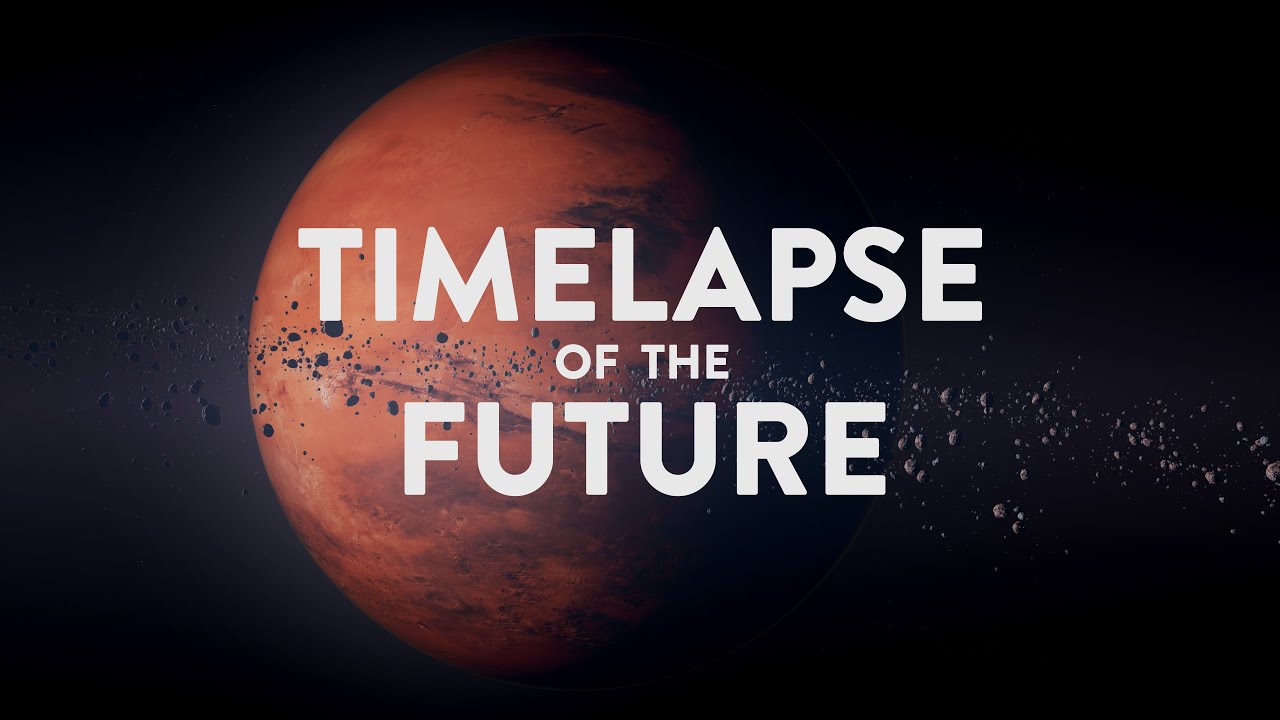
TIMELAPSE OF THE FUTURE: A Journey to the End of Time (4K)
A cinematic timelapse of the future of the universe, jumping forward in ever larger steps from the present to the death of the Sun, the end of all stars and beyond. Pure visuals and music, no prior knowledge needed.
melodysheep, 29 min, March 20, 2019. Future of the universe
Cosmology
6 videos, and the cosmology guide
Kurzgesagt - In a Nutshell, 6 min
The Beginning of Everything: The Big Bang
A short animated introduction to the Big Bang and the evidence that the universe had a beginning, with the open questions it leaves. A quick first step for complete beginners.

melodysheep, 12 min
TIMELAPSE OF THE UNIVERSE: 13 Billion Years in 10 Minutes • Updated and Remastered
Compresses the 13.8-billion-year history of the universe into about ten minutes, with all of human history in the final frame. The 2026 remastered version of a popular visual timeline, no background needed.

PBS Space Time, 7 min
Cosmic Microwave Background Explained
Explains the cosmic microwave background, the leftover light from when the young universe was hot and glowing, and what it tells us about cosmic history. A compact introduction to the key evidence for the Big Bang.
Veritasium, 12 min
What Actually Expands In An Expanding Universe?
Asks what actually expands in an expanding universe: does space stretch atoms, galaxies and people, or only the light between them? Builds on Geraint Lewis's work on redshift and suits viewers ready to rethink the basics.

World Science Festival, 36 min
Cosmology in Crisis? Confronting the Hubble Tension | World Science Festival
Brian Greene talks with astronomer Wendy Freedman about the Hubble tension, the disagreement between methods measuring how fast the universe expands. A clear conversation for anyone following the debate in cosmology.

Kurzgesagt - In a Nutshell, 11 min
Astronomy Is In Crisis...And It's Incredibly Exciting
Surveys the tensions new telescope data have opened in the standard model of cosmology, from early galaxies to the expansion rate and giant cosmic voids. An accessible, animated overview of open problems.
Future of the universe
10 videos, and the future of the universe guide
melodysheep, 29 min
TIMELAPSE OF THE FUTURE: A Journey to the End of Time (4K)
A cinematic timelapse of the future of the universe, jumping forward in ever larger steps from the present to the death of the Sun, the end of all stars and beyond. Pure visuals and music, no prior knowledge needed.
Kurzgesagt - In a Nutshell, 11 min
The Last Thing To Ever Happen In The Universe
An animated look at the far future of the universe that asks what the very last event will be once every star has burned out. A gentle, non-technical introduction to the idea of heat death.

Kurzgesagt - In a Nutshell, 13 min
We Found a Loophole to Survive the End of the Universe
Explains heat death, the slow fading of stars, galaxies and black holes into a cold, empty universe, then explores whether some loophole could let life continue. Animated and aimed at newcomers.
PBS Space Time, 18 min
How Will the Universe End? | Space Time
Covers the long-term future of the universe after the Stelliferous Era of shining stars ends, about 100 trillion years from now, and what can still happen in the dark that follows. Suits viewers comfortable with some physics.
PBS Space Time, 11 min
The Star at the End of Time
Imagines what an observer would see in the far future of our galaxy as stars die, and how long life might hold on. A thoughtful companion to the eras of deep time, pitched at curious non-specialists.

Kurzgesagt - In a Nutshell, 6 min
The Last Light Before Eternal Darkness: White Dwarfs & Black Dwarfs
Explains white dwarfs, the dead cores of stars that will be the last lights in the universe, and how they will cool into black dwarfs. Short, animated and easy to follow.

PBS Space Time, 16 min
The Supernova At The End of Time
Starts from the heat death of the universe and walks through calculations predicting one final kind of supernova that can only occur near the end of time. A detailed episode for viewers who like the theory.
PBS Space Time, 18 min
What Happens After the Universe Ends?
Explains Roger Penrose's Conformal Cyclic Cosmology, the idea that the end of our universe could become the Big Bang of the next one. Physics-heavy and best for viewers who already know the basics of cosmology.
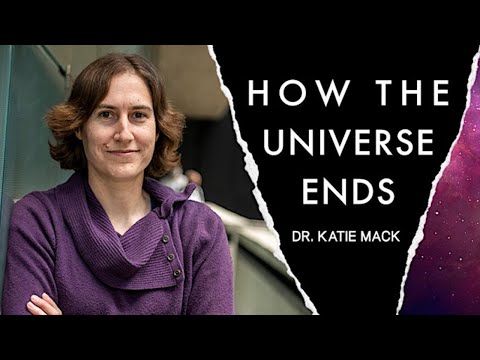
Perimeter Institute for Theoretical Physics, 59 min
Katie Mack on How the Universe Ends | Perimeter Institute Public Lecture
Theoretical astrophysicist Katie Mack's public lecture on how the universe could end, from heat death to more abrupt scenarios, and what each would look like. Clear and engaging for a general audience over an hour.

Dr. Becky, 15 min
The heat death of the Universe might not be inevitable…
Astrophysicist Becky Smethurst explains how the fate of the universe depends on the contest between gravity and cosmic expansion, and why recent results question whether heat death is certain. Good for following current research.
Black holes
5 videos, and the black holes guide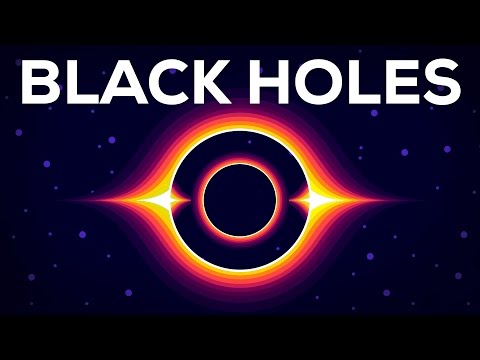
Kurzgesagt - In a Nutshell, 6 min
Black Holes Explained: From Birth to Death
An animated overview of black holes from birth to death: how they form, what happens near the event horizon and how they eventually evaporate. A solid six-minute starting point for beginners.
Veritasium, 9 min
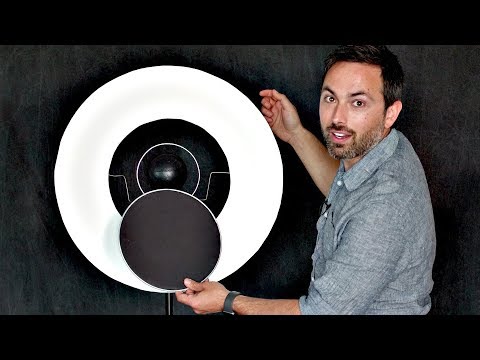
How to Understand What Black Holes Look Like
Explains what the first image of a black hole, M87*, actually shows, using J.P. Luminet's 1979 simulation of how a black hole with a thin disk should look. Great for understanding the famous ring.
Kurzgesagt - In a Nutshell, 10 min
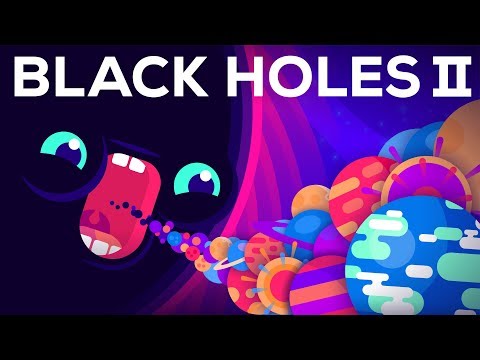
Why Black Holes Could Delete The Universe: The Information Paradox
Explains the black hole information paradox: whether information that falls into a black hole is truly lost, and why the answer matters for physics. Animated and beginner-friendly, made with physicist Alessandro Sfondrini.
PBS Space Time, 98 min
Black Holes. Explained. For 1.5 Hours.
A 98-minute deep dive into black holes: how they form, how physicists draw them with spacetime diagrams and where they force general relativity and quantum physics into conflict. For viewers who want the full theory.

New Scientist, 60 min
We’ve Been Wrong About Black Holes
New Scientist interviews Oxford astrophysicist Becky Smethurst about what black holes are, how supermassive black holes reach billions of solar masses and how they shape their galaxies. A long, conversational overview.
Gravitational waves
5 videos, and the gravitational waves guide
caltech, 4 min
LIGO: The First Observation of Gravitational Waves
Caltech's short account of LIGO's first observation of gravitational waves on September 14, 2015, and the science behind it. A quick introduction to the discovery from the people who made it.

Veritasium, 9 min
The Absurdity of Detecting Gravitational Waves
Explains how LIGO's laser interferometers detect gravitational waves that stretch space by far less than the width of a proton, with LIGO physicist Rana Adhikari. Makes an extreme measurement easy to grasp.

Veritasium, 5 min
Neutron Star Merger Gravitational Waves and Gamma Rays
Covers the 2017 neutron star merger seen both in gravitational waves and by telescopes across the spectrum, including a gamma-ray burst. A short introduction to multi-messenger astronomy.
PBS Space Time, 17 min
Was the Gravitational Wave Background Finally Discovered?!?
Explains the 2023 announcement, by a large team of gravitational-wave astronomers, of moderately confident evidence for a background of gravitational waves filling the universe, and what could produce it. Detailed and technical.
Scott Manley, 18 min
How To Build A Million Mile Wide Telescope- Europe's Groundbreaking LISA Mission
Scott Manley explains LISA, the planned trio of spacecraft forming a gravitational-wave detector millions of kilometers across, able to hear supermassive black hole mergers months in advance. Strong on the engineering.
Dark matter
5 videos, and the dark matter guide
Dr. Becky, 30 min
All the evidence we have for dark matter | A century's worth of science history
Astrophysicist Becky Smethurst walks through the evidence for dark matter gathered since 1884, with the history behind each key result. A thorough half-hour overview for curious viewers.
SciShow Space, 5 min
How Vera Rubin Found the First Direct Evidence for Dark Matter | Great Minds
Profiles Vera Rubin and the galaxy rotation measurements that gave some of the first solid evidence for dark matter. A short biography that pairs well with her original papers.

Veritasium, 17 min
The Absurd Search For Dark Matter
Follows the decades-long experimental hunt for dark matter, thought to be about five times more abundant than ordinary matter, and the one experiment that claims a signal. A good account of how detectors work.
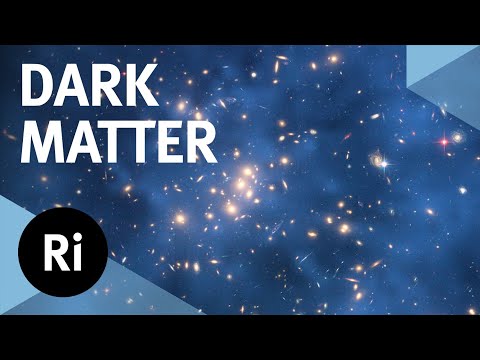
The Royal Institution, 57 min
What is dark matter? - with Peter Fisher
Particle physicist Peter Fisher's Royal Institution lecture on how dark matter is inferred from its gravity in galaxies, and how researchers are trying to learn what it is. A careful, hour-long public lecture.

The Royal Institution, 51 min
Is Dark Matter Real? - with Sabine Hossenfelder
Sabine Hossenfelder's Royal Institution lecture weighing the evidence for dark matter and arguing for a superfluid model mixing dark matter with modified gravity. A minority view in cosmology, best watched after the basics.
Dark energy
6 videos, and the dark energy guide
Kurzgesagt - In a Nutshell, 6 min
What is Dark Matter and Dark Energy?
A short animated introduction to dark energy and dark matter, which together make up most of the universe, and how much remains unknown about both. A clear starting point for beginners.

minutephysics, 3 min
How Do We Know The Universe Is ACCELERATING?
A three-minute explanation of how astronomers discovered that the expansion of the universe is accelerating, using Type Ia supernovae as distance markers. Quick and clear, with simple drawings.

The Royal Institution, 38 min
The Dark Universe - with Adam Riess
Nobel laureate Adam Riess joins cosmologists Renee Hlozek, Risa Wechsler and Lucie Green at the Royal Institution to discuss dark energy and dark matter. A panel that adds firsthand context to the 1998 discovery.

World Science Festival, 70 min
Is Dark Energy Decaying? | World Science Festival
Brian Greene and physicist Michael Levi discuss the DESI results hinting that dark energy may be weakening over time, and what that would mean for the cosmos. A long, accessible conversation.

PBS Space Time, 21 min
The Universe Is Racing Apart. We May Finally Know Why.
Reviews recent evidence that dark energy may not have a constant density, and how that could help explain disagreements in measurements of the expansion rate. Suits viewers following the DESI results.

PBS Space Time, 19 min
The Universe Has Been Expanding Since the Big Bang. Just Not How We Thought.
Compares DESI's hint of evolving dark energy with the final Dark Energy Survey results, and explains why independent measurements are far stronger combined. Detailed and best for viewers who know the basics.
Exoplanets
5 videos, and the exoplanets guide
NASA, 5 min
What Is an Exoplanet?
NASA's short introduction to exoplanets, planets around other stars: why we study them and what their variety reveals about how planets form. A good first video on the topic.

Vox, 11 min
How to find a planet you can’t see
Explains how astronomers find exoplanets they cannot see, by measuring tiny stellar wobbles and faint dips in starlight. Clear graphics make the two main detection methods easy to follow.
Cool Worlds, 39 min
Why We Haven't Found Any Earth-Like Planets
Astronomer David Kipping explains why Kepler did not deliver the dozens of truly Earth-like planets once predicted, and what the gap teaches us. A careful look at the limits of exoplanet surveys.

Astrum, 30 min
Why You Should Pay Attention to TRAPPIST-1
A long Astrum episode on TRAPPIST-1, a nearby red dwarf with seven roughly Earth-sized planets, and why it is a prime target in the search for habitable worlds. Good for viewers who like detail.

Dr. Becky, 20 min
Have we FINALLY found a rocky exoplanet with an atmosphere?! | Night Sky News August 2026
Becky Smethurst's August 2026 news roundup on evidence for an atmosphere around a rocky planet in its star's habitable zone, plus new close-up images of the Sun and the Roman Space Telescope launch.
Astrobiology
5 videos, and the astrobiology guide
Kurzgesagt - In a Nutshell, 6 min
The Fermi Paradox: Where Are All The Aliens? (1/2)
Introduces the Fermi paradox: with so many stars and planets, why have we seen no sign of aliens, and what might that mean for us? A short animated primer on the search for life.

Dr. Becky, 17 min
Did JWST find a MARKER OF LIFE in an exoplanet atmosphere?
Becky Smethurst assesses the claim that JWST found dimethyl sulfide, a possible marker of life, in the atmosphere of K2-18b, and how strong that evidence really is. A useful lesson in weighing biosignature claims.

Veritasium, 18 min
We Might Find Alien Life In 1,688 Days
Explains how NASA's Europa Clipper will study whether Jupiter's moon Europa could host life despite its intense radiation, with planetary scientist Robert Pappalardo. An engaging introduction to ocean worlds.

Dr. Becky, 30 min
Strongest evidence yet for past life on Mars from Perseverance rover | Night Sky News September 2025
Becky Smethurst's September 2025 news roundup on the Perseverance rock samples offering the strongest evidence yet for possible past life on Mars, plus JWST on TRAPPIST-1e and interstellar comet 3I/ATLAS.

Astrum, 21 min
We Found New Evidence of Life on Saturn's Moon Enceladus
Covers evidence that the ocean under Enceladus's ice is more active than thought, including the largest plume yet seen in JWST images, and what it means for the chances of life there. Accessible and detailed.
Galaxies
5 videos, and the galaxies guide
European Space Agency, ESA, 2 min
The best Milky Way animation, by Gaia
An animation of the Milky Way based on Gaia data, showing a galaxy with more than two, less prominent spiral arms and a central bar unlike earlier models. Two minutes, no background needed.
DeepSkyVideos, 9 min
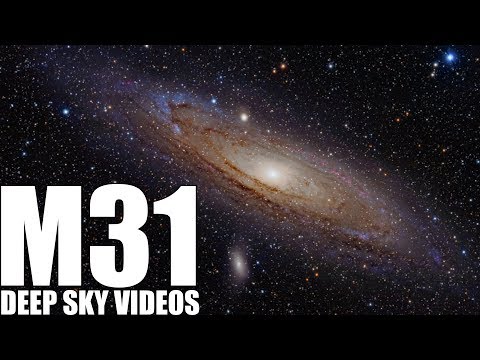
M31 - Andromeda Galaxy - Deep Sky Videos
University of Nottingham astronomers Meghan Gray and Mike Merrifield, with astrophotographer Nik Szymanek, introduce the Andromeda Galaxy, the Milky Way's nearest large neighbor. A friendly short introduction.
PBS Space Time, 20 min
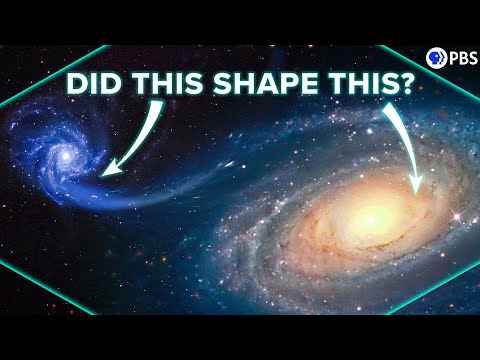
The Evolution of the Modern Milky Way Galaxy
Traces how the Milky Way was assembled by swallowing smaller galaxies, mergers we can still see frozen in progress across the universe. A good companion to the latest findings in galactic archaeology.

Kurzgesagt - In a Nutshell, 11 min
The Black Hole That Kills Galaxies - Quasars
Explains quasars, the blazing centers of galaxies powered by feeding supermassive black holes, and why their energy can shut down star formation in their hosts. Animated and beginner-friendly.

PBS Space Time, 20 min
We Found Galaxies Too Old for the Universe
Examines JWST's discoveries of galaxies that look too mature for the young universe, and the competing explanations for how they formed so fast. Suits viewers following early-universe research.

Kurzgesagt - In a Nutshell, 12 min
The Largest Star in the Universe: Size Comparison
A size comparison of stars up to the largest known, with an explanation of why some stars swell to enormous sizes. A visual introduction to the range of stars, no background needed.

Kurzgesagt - In a Nutshell, 6 min
The Last Star in the Universe: Red Dwarfs Explained
Explains red dwarfs, the small, long-lived stars that will be the last to shine in the universe, and why they may be good places to look for life. Short and animated.
Kurzgesagt - In a Nutshell, 7 min
Neutron Stars: The Most Extreme Things that are not Black Holes
Explains neutron stars, collapsed stellar cores only a few kilometers across but as massive as a star, born when massive stars die. A short, animated introduction to the densest objects short of black holes.

Cool Worlds, 29 min
Betelgeuse Explained
Astronomer David Kipping explains how massive stars like Betelgeuse work and what likely caused its dramatic dimming in early 2020. A detailed half hour for viewers who want the stellar physics.
Perimeter Institute for Theoretical Physics, 69 min
Emily Levesque Public Lecture: The Weirdest Stars in the Universe
Astronomer Emily Levesque's Perimeter Institute public lecture on the history of stellar astronomy, modern observing techniques and some of the strangest stars known. An engaging hour for a general audience.
PBS Space Time, 15 min
JWST May Have Discovered a New Cosmic Object: The Black Hole Star
Explains why giant black holes so soon after the Big Bang are a puzzle, and the JWST observations that may point to a new kind of object, a black hole star. Detailed and current.
Solar System
5 videos, and the solar system guide
SciShow, 36 min
The Solar System Explained | SciShow Goes to Space
Hank Green leads a 35-minute tour of the Solar System, its planets and moons and its unsolved questions. A friendly, wide-ranging introduction for all ages.

PBS Space Time, 21 min
The NEW SCIENCE of Moon Formation
Covers recent simulations suggesting the Moon may have formed within hours of the giant collision that created it. A good update on the giant impact theory for viewers who know the basics.
Astrum, 14 min
What did NASA's New Horizons discover around Pluto?
Follows NASA's New Horizons to its 2015 Pluto flyby and what it revealed about Pluto's surface, moons and atmosphere. An accessible recap of the first close look at the dwarf planet.
Dr. Becky, 19 min
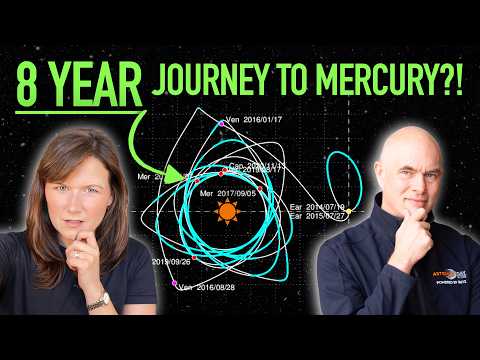
Why it’s so hard to get to Mercury (ft. Scott Manley!)
Becky Smethurst and Scott Manley explain why BepiColombo needed about eight years to reach Mercury when Juno took five to reach Jupiter, and the orbital mechanics behind it. Clear and beginner-friendly.

Kurzgesagt - In a Nutshell, 8 min
Could Solar Storms Destroy Civilization? Solar Flares & Coronal Mass Ejections
Explains solar flares and coronal mass ejections, and what a major solar storm could do to our technology-dependent civilization. A short, animated introduction to space weather.
Telescopes and missions
7 videos, and the telescopes and missions guide
Scott Manley, 17 min
How NASA's $10 Billion Origami Telescope Will Unfold The Early Universe
Recorded hours before launch, Scott Manley explains the James Webb Space Telescope, why it cost so much, why it was delayed and how its folded design unfolds in space. Strong on engineering detail.

Veritasium, 20 min
How did they actually take this picture? (Very Long Baseline Interferometry)
Explains very long baseline interferometry, the technique the Event Horizon Telescope used to link radio dishes worldwide and image Sagittarius A*, the black hole at the Milky Way's center. A clear guide to the method.

Tom Scott, 29 min
The largest telescope that will ever be built*
Tom Scott visits ESO's Extremely Large Telescope in Chile, likely the largest optical telescope that will ever be built, and explains the asterisk in that claim. Light, engaging and well filmed.

ESO Chasing Starlight, 10 min
Inside the world's largest telescope: it's progressing fast!
ESO's own 2026 tour of the Extremely Large Telescope under construction, from the structure inside the dome to the facility that coats its mirror segments with silver. A short look behind the scenes.

Dr. Becky, 20 min
The FIRST images from the RUBIN observatory!
Becky Smethurst walks through the first images from the Vera C. Rubin Observatory, first proposed in 2001 and built over about 15 years, and why astronomers waited so long for them. Accessible and enthusiastic.

European Space Agency, ESA, 3 min
Euclid’s 208-Gigapixel glimpse into the Universe
A zoom through Euclid's first 208-gigapixel mosaic, covering more than 500 times the area of the full Moon and some 14 million galaxies. Three minutes of pure visuals from ESA's dark universe mission.

Dr. Becky, 19 min
Can we take a picture of an Earth-like planet?! | Habitable Worlds Observatory 2040s
Explains the Habitable Worlds Observatory, a large space telescope planned for the 2040s to directly image Earth-like planets around Sun-like stars in visible light. A good look at the next big exoplanet mission.