Rubin Observatory Finds 2026 ED138, a Dwarf Planet Candidate Beyond Pluto
Rubin Observatory spotted 2026 ED138, a trans-Neptunian object roughly 600 to 1,500 km across that could become the sixth recognized dwarf planet.
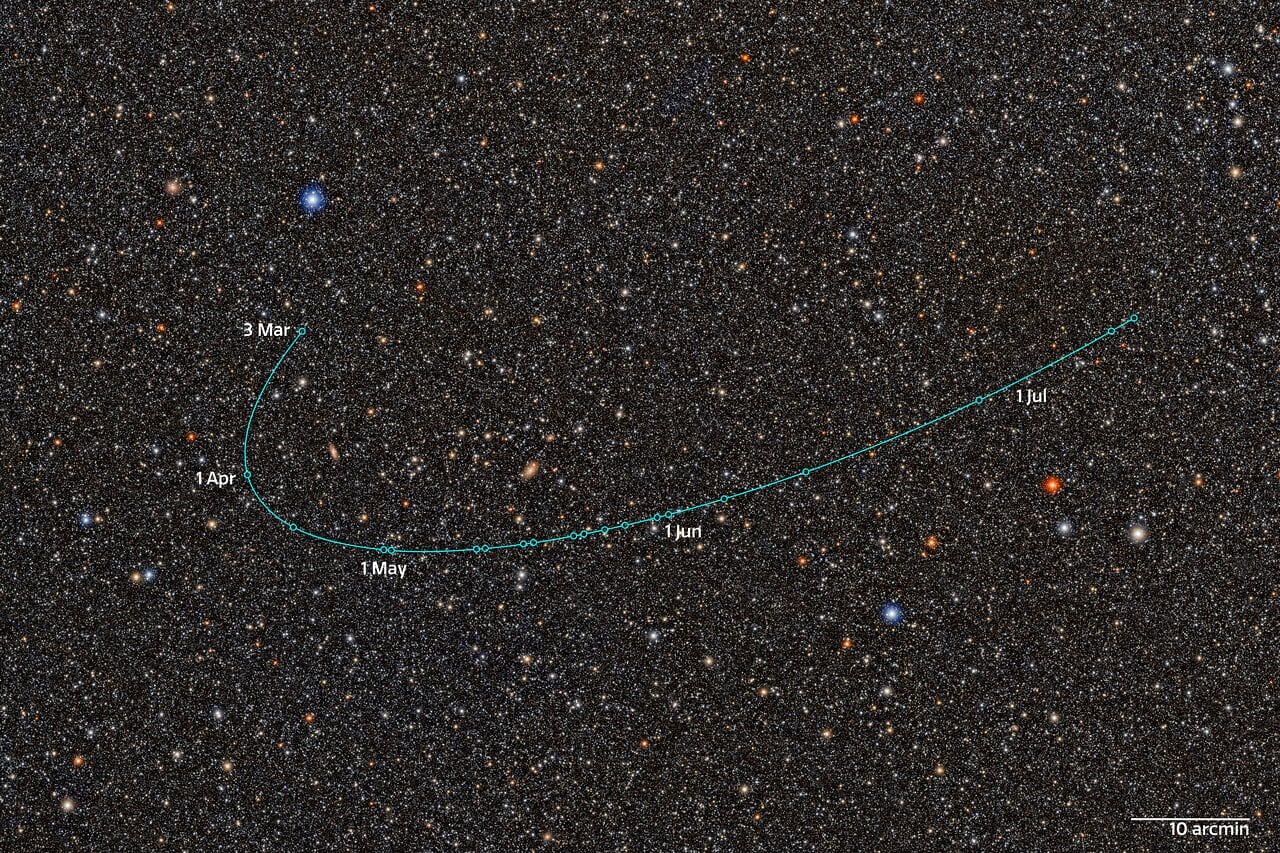
NSF-DOE Vera C. Rubin Observatory has found a new dwarf planet candidate beyond the orbit of Pluto. The object, provisionally named 2026 ED138 (ED138 for short), was spotted by Matthew Holman of the Center for Astrophysics | Harvard & Smithsonian, a member of the Rubin Operations team. The International Astronomical Union’s Minor Planet Center announced it, and NOIRLab described the discovery on October 27, 2026. Mario Jurić of the University of Washington and Holman presented the results at the Division for Planetary Sciences meeting in Spokane, Washington. The release points to no peer-reviewed paper.
Holman found the object on the evening of October 13, while running Rubin data from earlier in 2026 through a search code he built with colleague Kevin Napier. The code compares billions of detections of moving objects and links those that belong to the same body. Its brightness and distance suggested something unusually large, and Holman says he first suspected an error. Jurić then found 20 more observations in Rubin’s catalogs. In total, Rubin’s Simonyi Survey Telescope saw ED138 30 times on 20 nights between March 4 and July 11, 2026. Archival images from the Dark Energy Camera, recovered by the Asteroid Institute’s ADAM Precovery service, extend the record back to 2016, letting the team trace more than 10 years of its orbit.
ED138 is now about 46 astronomical units (au) from the Sun, where 1 au is the Earth-Sun distance. Pluto averages 40 au. That makes ED138 a trans-Neptunian object, one that orbits farther out than Neptune. Its orbit is tilted almost 25 degrees from the plane of the Solar System, which classes it as a hot-classical object and suggests Neptune’s gravity disturbed it long ago.
From its distance, brightness and estimated reflectivity, the team puts its size at 600 to 1,500 kilometers. Icy bodies that large should be round, one requirement for a dwarf planet. Infrared observations are still needed to pin down the size and confirm its nature. If confirmed, it would join the five dwarf planets the IAU recognizes: Pluto, Ceres, Eris, Haumea and Makemake.
ED138 lies near the plane of the Milky Way, a crowded field of millions of stars where it likely hid from other surveys. Rubin’s repeated monitoring of the southern sky and its search algorithms made the difference. Tracking objects like this helps researchers study how the Solar System formed and how the giant planets migrated. More in our solar system guide and our report on Rubin beginning its 10-year survey.
What to watch next: follow-up observations by scientists worldwide, especially in the infrared, to measure ED138’s size and decide whether it qualifies as a dwarf planet.
Primary source
This summary is based on NSF NOIRLab. Read the original for full details, data and caveats.
This week in papers
The week's most important results, one line each, every week.