Hubble and Webb Find Omega Centauri's First Stellar-Mass Black Hole
A star circling an unseen 4.46-solar-mass companion every 94 years reveals Omega Centauri's first stellar black hole, where models predict thousands.
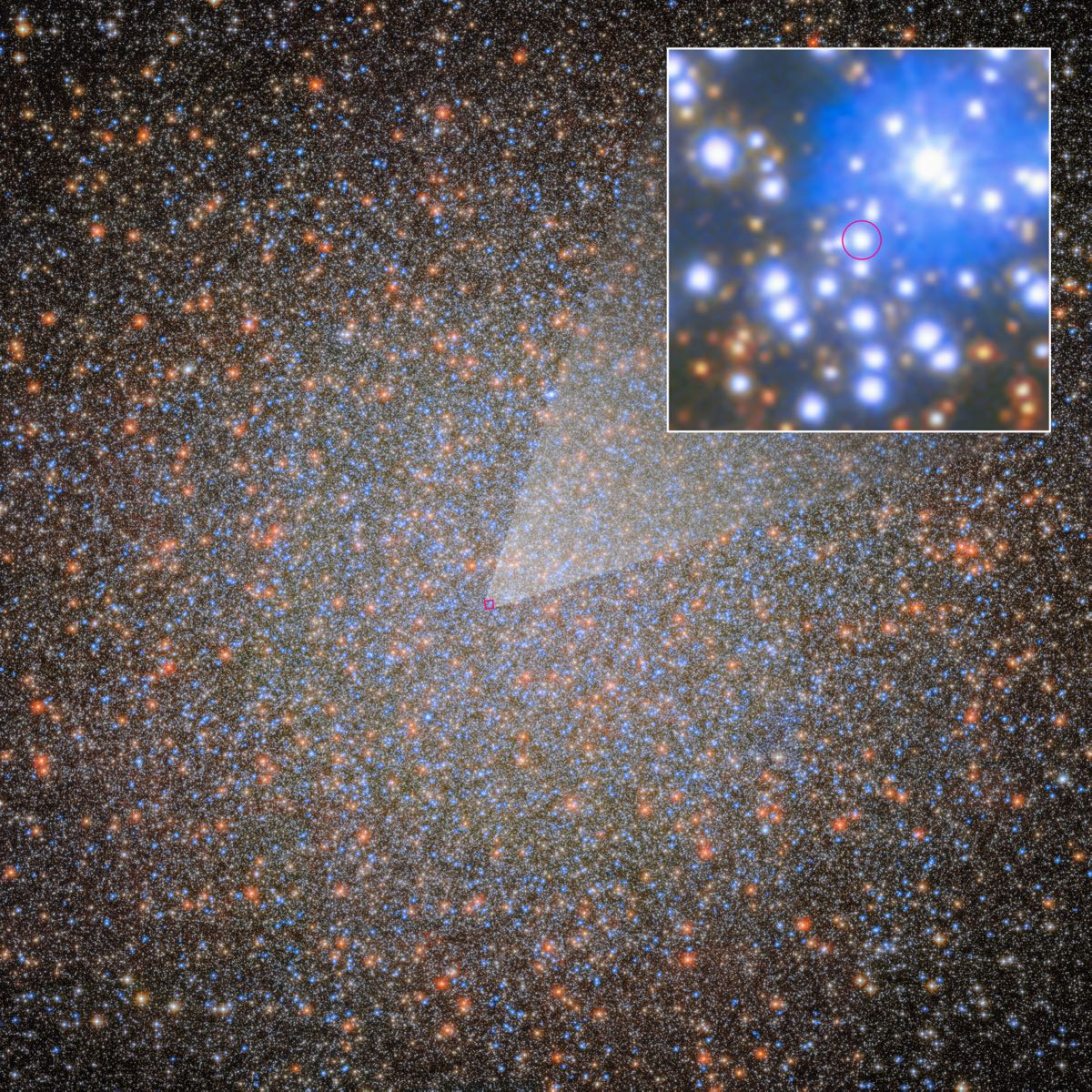
Astronomers have found the first stellar-mass black hole in Omega Centauri, the giant star cluster about 18,000 light-years away. The black hole, called oMEGACat BH-2, has 4.46 times the mass of the Sun. The study, led by Matthew Whitaker of the University of Utah, was published in The Astrophysical Journal Letters, and ESA/Hubble announced it on July 13, 2026.
Omega Centauri holds about 10 million stars, and models predict about 10,000 stellar-mass black holes inside it, yet none had been found. The team used astrometry, precise measurements of star positions, from Hubble data spanning 2002 to 2023, refined with near-infrared data from Webb. One star was moving around an invisible partner. The partner is too heavy to be a neutron star, so it must be a black hole, though it is lighter than expected for a cluster poor in heavy elements.
The pair has an orbital period of 94 years, the longest of any known black hole binary. The system is also fragile: it should survive less than a billion years before close encounters with other stars break it apart, compared with the cluster’s age of about 12 billion years.
Why it matters: black holes are expected to sink toward the center of dense clusters and shape how those clusters evolve, but they are hard to see because they give off no light of their own. This detection is a first glimpse of that hidden population. One black hole is a start, and the predicted thousands remain unseen. More in our black holes guide.
What to watch next: continued astrometry of Omega Centauri may reveal more stars orbiting hidden companions.
Primary source
This summary is based on ESA/Hubble and the peer-reviewed paper. Read the original for full details, data and caveats.
This week in papers
The week's most important results, one line each, every week.