A black hole is a region of space where gravity is so strong that nothing, not even light, can escape once it crosses the event horizon. Most form when massive stars collapse; supermassive ones, millions to billions of times the Sun’s mass, grow at galaxy centers. We have photographed two: M87* in 2019 and Sagittarius A* in 2022.
Black holes are the most extreme prediction of Einstein’s general relativity, and in the last ten years they went from inferred to imaged, heard and weighed. This guide covers what they are, how they form, how we find them and the open questions, with links to the papers that built the field.
What is a black hole?
A black hole is matter compressed so much that the escape velocity at its boundary exceeds the speed of light. That boundary is the event horizon: not a surface you could stand on, but a point of no return. Inside it, every possible path leads further in.
Here is one way to picture it. Escape velocity from Earth is about 11 kilometers per second. Squeeze Earth smaller and its surface gravity rises, so the escape velocity rises too. Squeeze it to the size of a marble and the escape velocity reaches the speed of light. That is a black hole.
The size of the horizon for a non-rotating black hole is the Schwarzschild radius, 2GM/c2, about 3 kilometers for every solar mass. It is named after Karl Schwarzschild, who found the first exact solution of Einstein’s field equations in December 1915, weeks after the theory was published, while serving on the Russian front (Schwarzschild’s 1916 solution). At the center, the theory predicts a singularity, a point of infinite density.
Real black holes spin. Roy Kerr found the solution for a rotating black hole in 1963 (the Kerr solution), and it shows that every uncharged black hole in nature is described by just two numbers: its mass and its spin.
Black holes form in three main ways: from collapsing stars, by growing at the centers of galaxies, and possibly from the dense early universe.
Stellar-mass black holes
When a very massive star runs out of fuel, its core can no longer hold itself up and collapses in a fraction of a second. If the core is below about 1.4 solar masses, the Chandrasekhar limit, it becomes a white dwarf (Chandrasekhar’s mass limit). Heavier cores become neutron stars, and if the remnant is heavier still, roughly above two to three solar masses, nothing stops the collapse.
J. Robert Oppenheimer and Hartland Snyder worked out the process in 1939 (Oppenheimer and Snyder’s collapse). Their paper appeared on September 1, 1939, the day Germany invaded Poland, and the subject sat largely untouched for two decades. Stellar black holes weigh a few to a few tens of solar masses; the heaviest known in the Milky Way, Gaia BH3, has 32.7.
Supermassive black holes
At the center of almost every large galaxy sits a black hole of millions to billions of solar masses. They power quasars, the brightest steady objects in the universe, first identified by Maarten Schmidt in 1963 (the discovery of quasars).
How they grew so large, so early, is one of the biggest open questions. In 2024 Roberto Maiolino and colleagues used JWST to find a black hole of about 1.6 million solar masses in the galaxy GN-z11, at redshift 10.6, feeding at roughly five times the theoretical limit (GN-z11’s early black hole). In July 2026 Euclid and Keck doubled the known number of quasars beyond redshift 7, with the most distant at redshift 7.77 (the earliest quasars).
Intermediate-mass black holes, between about a hundred and a hundred thousand solar masses, should be the seeds of supermassive ones, but convincing examples are rare. Primordial black holes might have formed directly from dense regions in the first second of the universe, an idea Bernard Carr and Stephen Hawking explored in 1974. None has been confirmed, and they remain a candidate for part of dark matter.
Types of black holes
Black holes span more than ten orders of magnitude in mass. Here are the main types:
| Type | Mass (Suns) | Example | How detected |
|---|
| Stellar-mass | About 3 to over 100 | Cygnus X-1; Gaia BH1 (9.6) | X-rays from stolen gas, wobbling companion stars, gravitational waves |
| Intermediate-mass | About 100 to 100,000 | Few confirmed candidates | Gravitational waves, star clusters, flares |
| Supermassive | Millions to billions | Sagittarius A* (4.3 million); M87* (6.5 billion) | Stellar orbits, quasars, Event Horizon Telescope images |
| Primordial (hypothetical) | Could be tiny or large | None confirmed | Microlensing, evaporation bursts, gravitational waves |
What is inside a black hole?
General relativity predicts that matter crossing the event horizon is inevitably crushed into a singularity. Roger Penrose proved in 1965 that, once a “trapped surface” forms, a singularity follows under very general conditions (Penrose’s singularity theorem). The result earned him half of the 2020 Nobel Prize in Physics.
But a singularity is where the theory fails, not a description of reality. At the center, the density predicted is infinite, and general relativity must give way to a quantum theory of gravity nobody has completed. So the honest answer is that we know what happens at the horizon and just inside it, and we do not know what is at the center.
What would you experience falling in? For a stellar-mass black hole, tides would stretch you apart well before you reached the horizon. For a supermassive one, the horizon is so large that tides there are gentle, and you would cross it without noticing anything special. Seen from outside, you would appear to slow down and fade at the horizon, never quite crossing it.
How do we find black holes?
Black holes emit no light of their own, so astronomers find them through their effect on their surroundings:
- X-rays from stolen gas. Gas pulled from a companion star heats to millions of degrees and glows in X-rays, as in Cygnus X-1. The Chandra X-ray Observatory has studied many such systems.
- Orbiting stars. A star circling an invisible companion reveals its mass. This is how Gaia BH1, BH2 and BH3 were found, and how a 4.46-solar-mass black hole was found in the star cluster Omega Centauri in 2026 (the first stellar black hole in Omega Centauri).
- Gravitational waves. Merging black holes shake spacetime. LIGO first detected a merger on September 14, 2015, two black holes of 36 and 29 solar masses (the first gravitational wave detection). As of the GWTC-5.0 catalog (May 2026), the LIGO-Virgo-KAGRA network has confirmed 390 events. See our gravitational waves guide.
- Direct imaging. The Event Horizon Telescope resolves the shadow of the nearest supermassive black holes.
The first images of a black hole
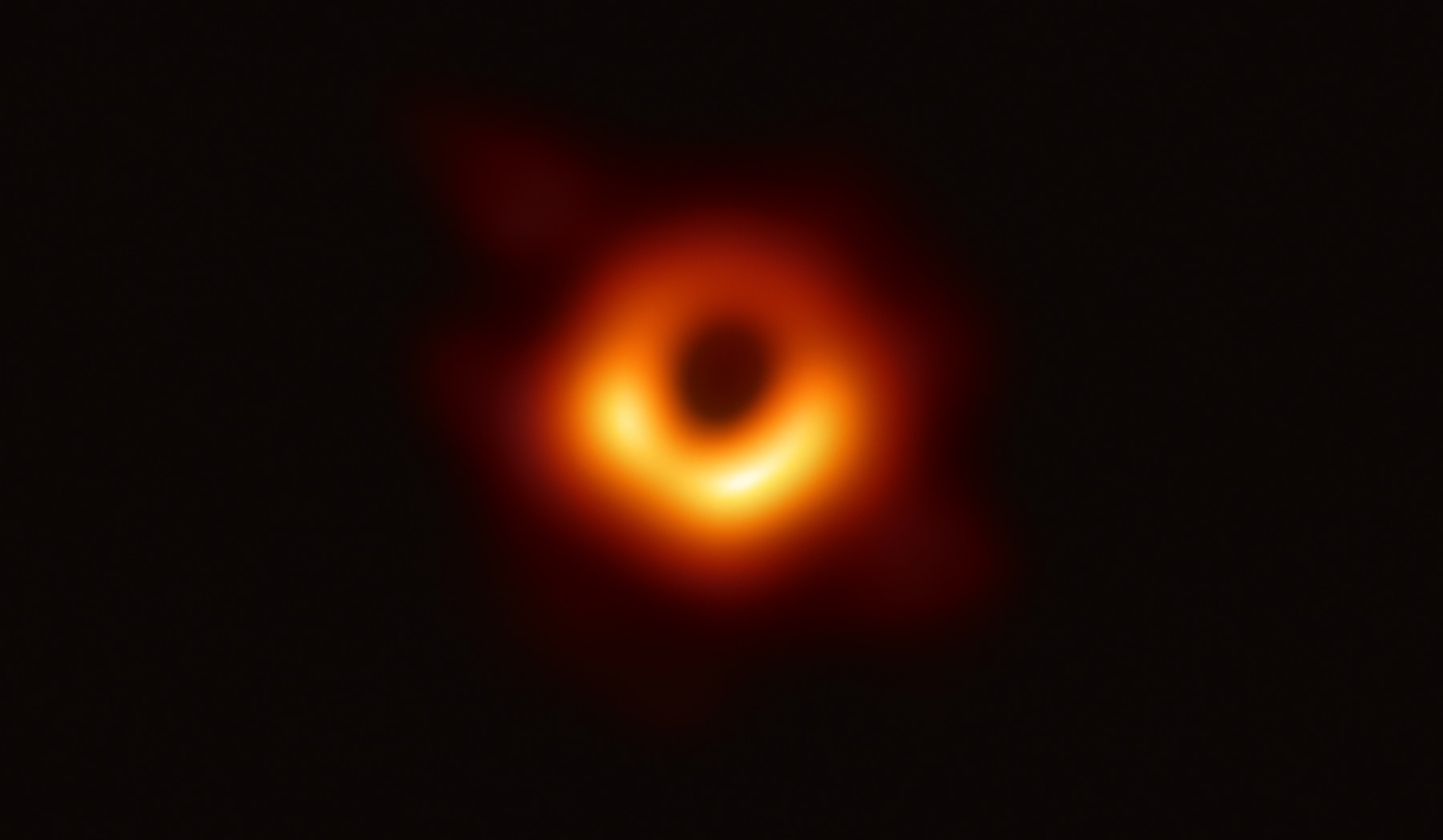
The first image of a black hole was released on April 10, 2019: the shadow of M87*, in the giant galaxy Messier 87, 55 million light-years away, with a mass of about 6.5 billion Suns (the first image of a black hole). The second, of Sagittarius A* at the center of our own galaxy, followed on May 12, 2022 (the image of Sagittarius A*).
How was it captured? The Event Horizon Telescope links radio dishes across the planet so they act as one Earth-sized telescope, observing at a wavelength of 1.3 millimeters. Eight telescopes observed together in April 2017, and their data were combined by supercomputers into a single image. The result is a bright ring of hot gas, bent by gravity around a dark central shadow: 42 microarcseconds across for M87*, far finer detail than any single telescope on Earth could resolve.
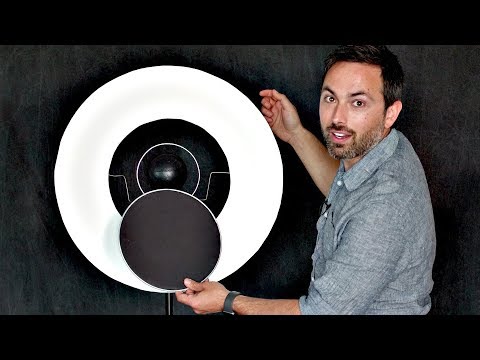
The Sagittarius A* image was harder because the gas around it changes within an hour. Both rings match what general relativity predicts for spinning Kerr black holes. If you want to see why the images look the way they do, Veritasium’s “How to Understand What Black Holes Look Like” in our video library is the clearest visual guide.
The black hole at the center of the Milky Way
Sagittarius A* is a supermassive black hole of about 4.3 million solar masses (GRAVITY collaboration, 2022), about 26,000 light-years from Earth. It is quiet compared with quasars, sipping gas rather than feasting.
The proof came from watching stars. For decades, Andrea Ghez’s team at the W. M. Keck Observatory and Reinhard Genzel’s team using ESO telescopes tracked individual stars whipping around an invisible point. In 2008 Ghez’s team used the orbit of the star S0-2 to measure an enclosed mass of about 4.1 million Suns at a distance of about 8 kiloparsecs (stellar orbits around the Milky Way’s black hole). Ghez and Genzel shared half of the 2020 Nobel Prize in Physics.
The work continues. In August 2026 the GRAVITY instrument on ESO’s Very Large Telescope Interferometer reported S301, the fastest known star in the galaxy, reaching about 25,000 kilometers per second, over 8% of the speed of light, on an 8.7-year orbit (S301, the fastest known star). Tracking two full orbits could reveal how fast Sagittarius A* spins within about a decade.
Who discovered black holes?
Black holes were discovered in stages over two centuries, by many people:
- 1784: John Michell described “dark stars” so massive light could not escape them, in a letter published by the Royal Society.
- 1916: Karl Schwarzschild found the exact solution of Einstein’s equations that describes a black hole.
- 1931: Subrahmanyan Chandrasekhar showed white dwarfs have a maximum mass, so heavier stellar cores must collapse further.
- 1939: Oppenheimer and Snyder described a star collapsing into what we now call a black hole.
- 1963 and 1965: Roy Kerr and Roger Penrose described rotating black holes and proved singularities are unavoidable.
- 1967: John Wheeler popularized the name “black hole” in a public lecture (the term had circulated a few years earlier).
- Early 1970s: Cygnus X-1 was identified by Louise Webster and Paul Murdin, and independently by Thomas Bolton, as the first widely accepted real black hole.
Can black holes die? Hawking radiation
Black holes can die, very slowly. In 1974 Stephen Hawking applied quantum theory near the event horizon and found that black holes should glow faintly, as if they had a temperature, and gradually lose mass (Hawking’s “Black hole explosions?”). The smaller the black hole, the hotter it is and the faster it evaporates; at the very end, it would release its remaining energy in a burst.
For real black holes the effect is tiny. A black hole with the Sun’s mass has a temperature of about a millionth of a kelvin, far colder than the 2.7-kelvin cosmic microwave background, so today it absorbs more than it emits. It would take around 1067 years to evaporate. Don Page turned Hawking’s prediction into precise rates in 1976 (Page’s evaporation rates). Hawking radiation has never been observed from any astrophysical black hole.
Black holes and the end of the universe
Black holes will probably be the last large objects in the universe. Long after the last stars fade, in about 100 trillion (1014) years, and after even dead stellar remnants decay, black holes will remain. Fred Adams and Gregory Laughlin called this stretch, from about 1040 to 10100 years, the Black Hole Era (Adams and Laughlin’s “A dying universe”). The largest supermassive black holes will be the last to evaporate, after roughly a googol (10100) years. Explore it in the Black Hole Era.
Open questions
If a black hole evaporates into featureless heat, what happens to the information about everything that fell in? Quantum mechanics says information cannot be destroyed; Hawking’s calculation suggests it is. Resolving the paradox is one of the main goals of quantum gravity research, and there is still no consensus answer.
Little red dots and early black holes seen by JWST
Since 2023, JWST has found hundreds of compact, very red objects in the early universe. A Nature paper published in January 2026 argued that they are young supermassive black holes buried in dense cocoons of ionized gas, about 100 times less massive than first thought. It is the leading explanation, not a settled one. Read the full story in our explainer on little red dots.
How supermassive black holes grew so fast
Black holes of a billion solar masses existed less than a billion years after the Big Bang. Either they started as unusually heavy “seeds”, perhaps from collapsing gas clouds, or they grew faster than the standard limit allows. JWST and Euclid are now finding enough early black holes to test both ideas.
Key papers
Where the research is happening