1916
Landmark paper
Karl Schwarzschild, Sitzungsberichte der Königlich Preussischen Akademie der Wissenschaften zu Berlin, 189-196, 1916
Schwarzschild's Solution (1916): The Birth of the Black Hole
Found in 1916 the first exact solution of Einstein's equations, with the radius now known as a black hole's horizon. Karl Schwarzschild's paper, explained.
Karl Schwarzschild found the first exact solution of Einstein’s general relativity in 1916, describing the gravity outside a single point mass. Hidden in it is a special distance, the Schwarzschild radius, later understood as the event horizon of a black hole. He worked it out while serving as a soldier on the Russian front.
The question before the paper
In November 1915 Albert Einstein published the final field equations of general relativity, which describe gravity as the curvature of spacetime. The equations are notoriously hard to solve exactly. Could anyone find an exact solution, even for the simplest case: the gravitational field around a single, non-rotating mass?
What the paper found
- The first exact solution. Schwarzschild found a formula, now called the Schwarzschild metric, that gives the precise geometry of spacetime outside a point mass, and later, outside any spherical, non-rotating body such as a star.
- A special radius. The solution contains a characteristic distance, r = 2GM/c², where G is the gravitational constant, M the mass and c the speed of light. For a mass like the Sun’s it is about 3 kilometers.
- A puzzle for later. At that radius the formula behaves strangely. Decades later physicists understood it as the event horizon of a non-rotating black hole: the boundary from which not even light can escape.
How he did it
Schwarzschild used the symmetry of the problem. A single mass at rest looks the same from every direction and does not change with time, which reduces Einstein’s equations to a much simpler set. He solved those exactly and wrote to Einstein about the result on December 22, 1915, about a month after Einstein had published his final equations. Einstein presented the paper to the Prussian Academy of Sciences, where it was submitted on January 13, 1916.
Why it mattered
Written within weeks of general relativity itself, this solution is the mathematical birth of the black hole. Its strange radius would take decades to be understood. In 1939 Oppenheimer and Snyder showed that a collapsing star shrinks inside it and cuts itself off from the outside universe. In 1963 Roy Kerr found the solution for a spinning black hole, and in 1965 Roger Penrose proved that collapse to a singularity is unavoidable once a horizon-like surface forms.
What we know now
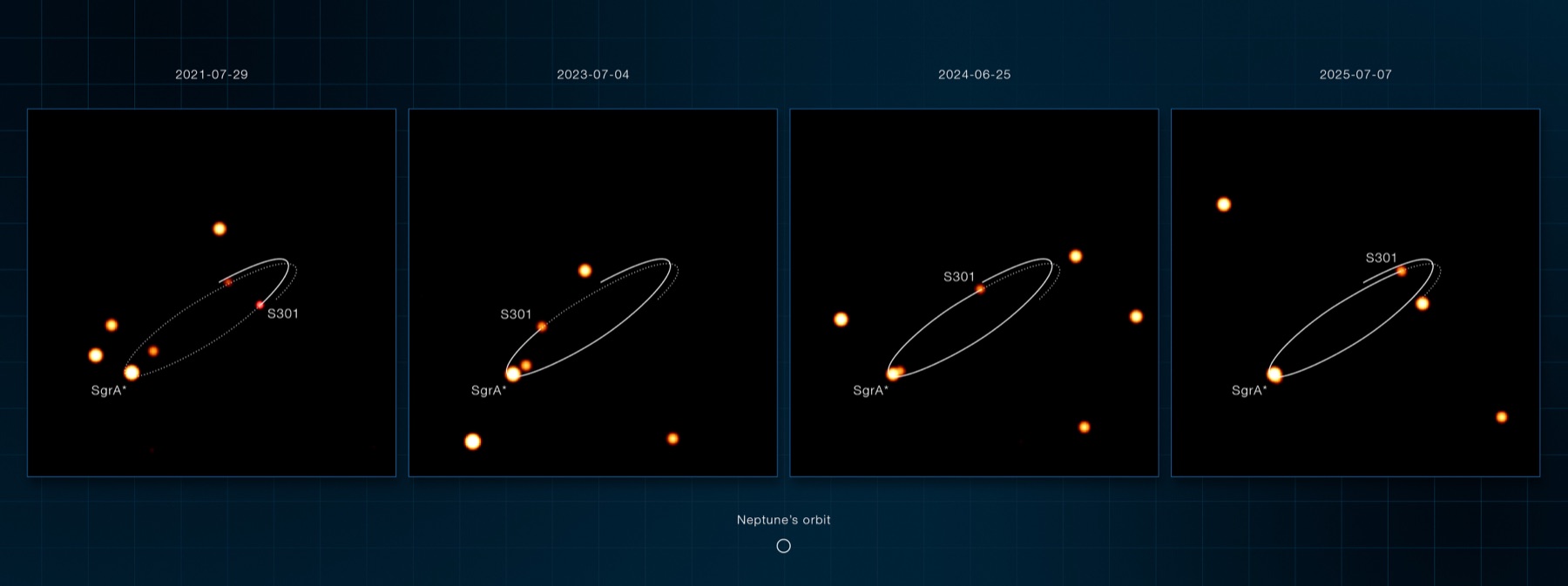
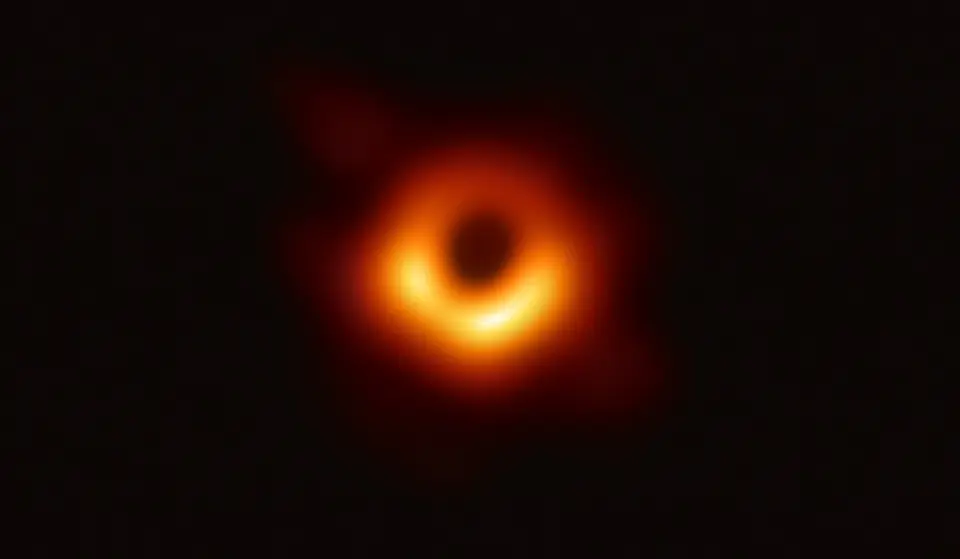
Black holes are now observed directly. The Event Horizon Telescope imaged the shadow of the black hole in M87 in 2019 and of Sagittarius A* in 2022, at the scale Schwarzschild’s radius predicts. Every black hole image, merger signal and evaporation estimate goes back to this metric. See our black holes guide.
Who wrote it
Karl Schwarzschild was a German astronomer serving in the German army during World War I. He did this work at the front, where he fell ill with pemphigus, a rare skin disease. He died on May 11, 1916, aged 42, only months after the paper appeared.
Read the original
Schwarzschild, K. (1916). “Über das Gravitationsfeld eines Massenpunktes nach der Einsteinschen Theorie.” Sitzungsberichte der Königlich Preussischen Akademie der Wissenschaften zu Berlin, 189-196. A free English translation by S. Antoci and A. Loinger, “On the gravitational field of a mass point according to Einstein’s theory”, is on arXiv: physics/9905030.
Questions people ask
Who first proposed black holes?
In general relativity, Karl Schwarzschild’s 1916 solution was the first to contain a black hole, though nobody recognized it then. Oppenheimer and Snyder showed in 1939 that a collapsing star can form one, and Roger Penrose proved in 1965 that black hole formation is a robust prediction of the theory.
What is the Schwarzschild radius?
The Schwarzschild radius is the size of the event horizon of a non-rotating black hole, given by 2GM/c². Squeeze any mass inside it and nothing, not even light, can escape. It is about 3 kilometers for the Sun’s mass and scales in direct proportion to mass.
This week in papers
Five new results in one line each, plus one landmark like this one. Weekly.
Keep reading
Oppenheimer and Snyder, Physical Review, 56, 455-459, 1939
Oppenheimer and Snyder: How a Star Collapses to a Black Hole
Showed in 1939 that a heavy dead star collapses forever and cuts itself off from the universe. Oppenheimer and Snyder's first black hole formation.
Kerr, Physical Review Letters, 11, 237, 1963
The Kerr Black Hole: The Exact Math of a Spinning Black Hole
Found in 1963 the exact solution of Einstein's equations for a spinning mass, describing real black holes by mass and spin alone. Roy Kerr's letter.
Schmidt, Nature, 197, 1040, 1963
The First Quasar: How Maarten Schmidt Decoded 3C 273
Identified in 1963 the star-like radio source 3C 273 as a distant, enormously luminous object: the first quasar. Maarten Schmidt's Nature paper, explained.
Topic guide
Black holes
Recent news in black holes