Lensed 'Shadow Blaster' Galaxy Likely Source of an IceCube Neutrino
A dusty galaxy 11 billion light-years away, magnified by a gravitational lens, is the proposed source of the IceCube neutrino event IC 210922A.
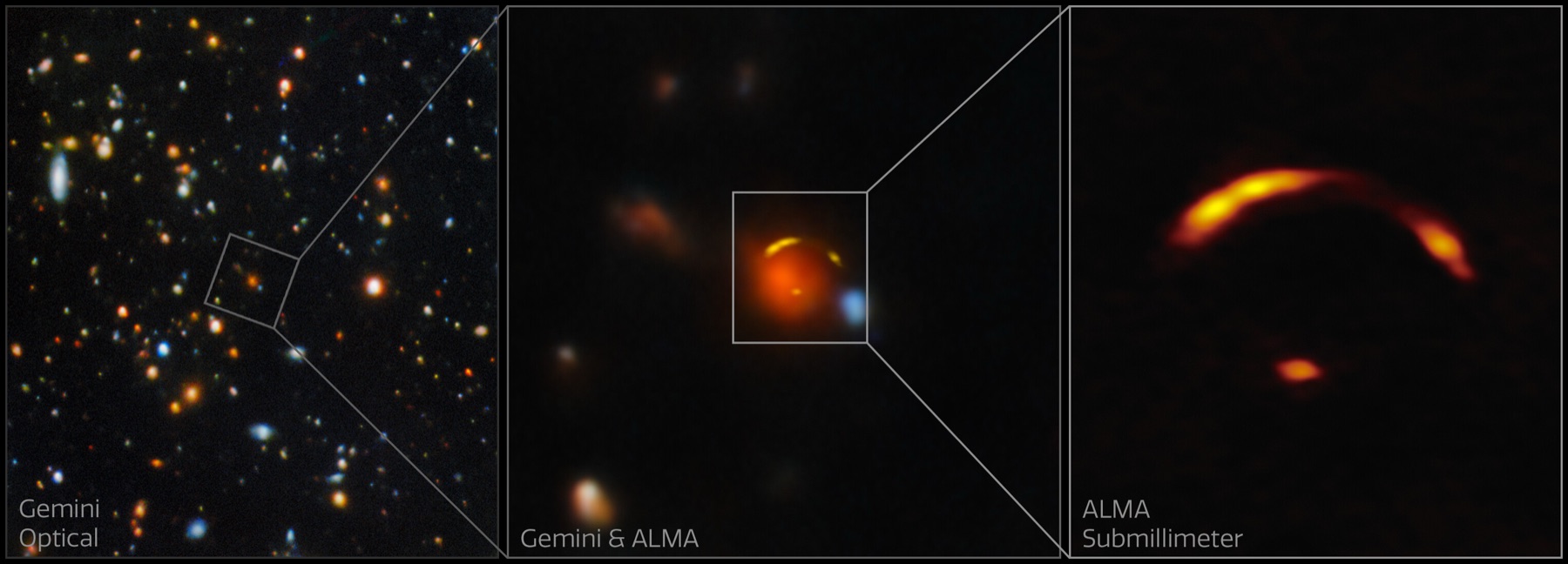
A distant galaxy nicknamed “Shadow Blaster” is the likely source of a high-energy neutrino detected by IceCube in 2021, according to a study led by Yuji Urata in Nature Astronomy. NSF NOIRLab announced the result on June 17, 2026. The galaxy, JCMT0402-0424, lies about 11 billion light-years away and shines with trillions of times the Sun’s luminosity in infrared light.
The neutrino event, IC 210922A, was recorded by the IceCube Neutrino Observatory at the South Pole. Days after the alert, the team searched the area with the James Clerk Maxwell Telescope (JCMT) and the Submillimeter Array and found the galaxy. ALMA then showed that it sits behind a strong gravitational lens, a foreground galaxy whose gravity bends and magnifies the light from the one behind it. The GMOS and GNIRS spectrographs on Gemini North were used to characterize that foreground lens. Other follow-up teams had found no gamma-ray, X-ray or optical counterpart.
High-energy neutrinos from space were first confirmed by IceCube in 2013, work recognized by the 2026 Nobel Prize in Physics. Their sources are still largely unknown. This is the most concrete evidence yet that distant star-forming galaxies help produce the cosmic neutrino background. The link rests on one neutrino and a position match, so it is a strong candidate, not a proven source. More in our guide to galaxies.
What to watch next: whether future IceCube events also line up with dusty, lensed galaxies like this one.
Primary source
This summary is based on NSF NOIRLab and the peer-reviewed paper. Read the original for full details, data and caveats.
This week in papers
The week's most important results, one line each, every week.