Astronomers Find the Most Distant Proto-Supercluster, COSMOS-z3.1-A
COSMOS-z3.1-A, seen when the universe was 2.1 billion years old, is the earliest proto-supercluster known, with about 5,000 times the Milky Way's mass.
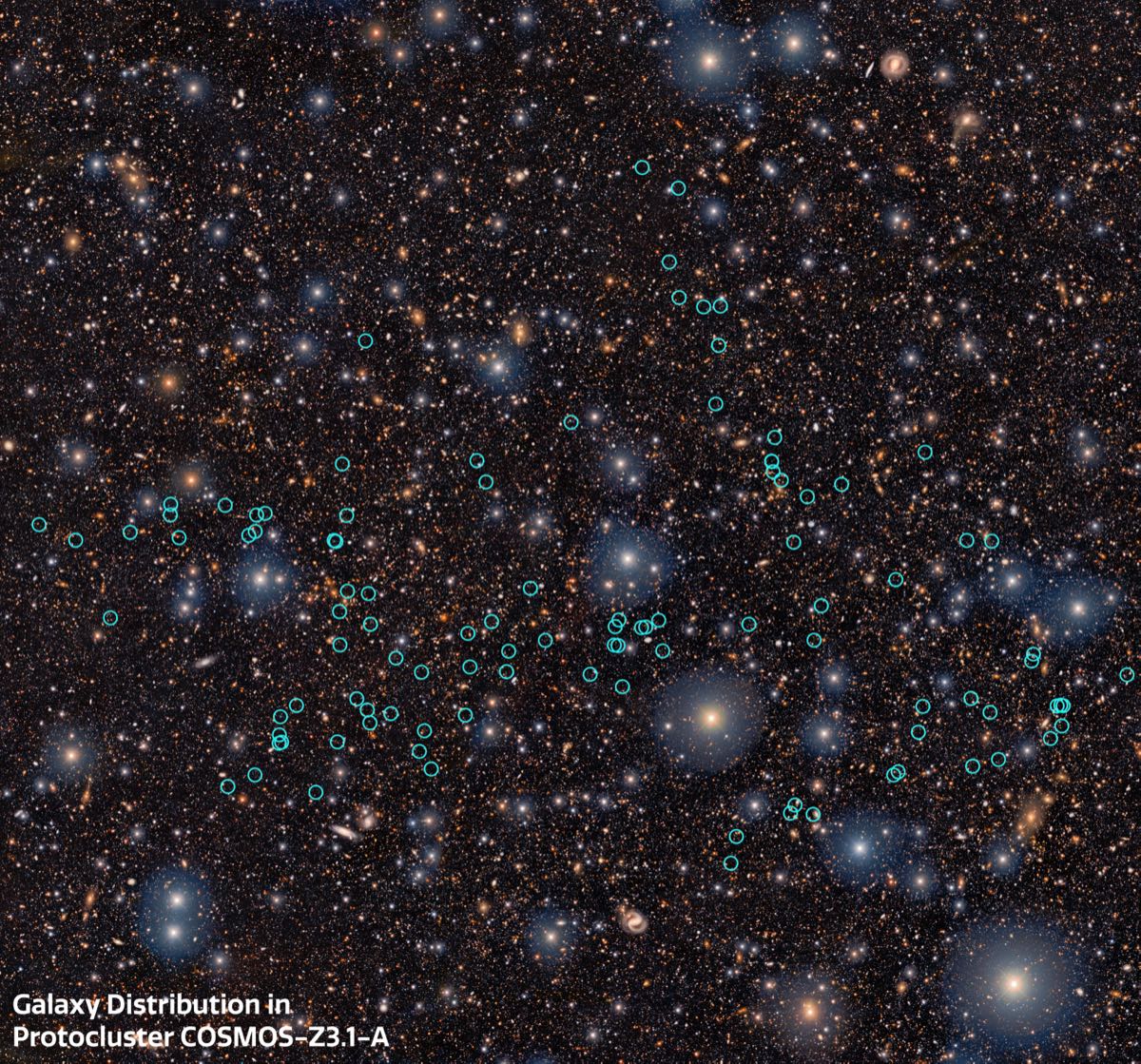
Astronomers have found COSMOS-z3.1-A, the earliest and most distant proto-supercluster ever identified, the young ancestor of a cluster of galaxy clusters. It is seen as it was when the universe was only 2.1 billion years old, and it already holds about 5,000 times the mass of the Milky Way. The study, led by Vandana Ramakrishnan of Purdue University, is in The Astrophysical Journal, and NSF NOIRLab announced it on September 8, 2026.
The find came out of the ODIN survey, which used the Dark Energy Camera on the 4-meter Blanco telescope in Chile for more than 100 nights and turned up 150 distant protoclusters. To see the structures in three dimensions, the team added spectra from DESI, from the GMOS instrument on Gemini South and from DEIMOS at the Keck Observatory. The structures studied in detail are predicted to grow more massive than the Coma Cluster, one of the richest clusters in the nearby universe. The team estimates there is fewer than one such object per 10,000 galaxy clusters.
Why it matters: in the standard picture, structure grows “bottom up”. Dark matter halos assemble first, small ones merging into larger ones, and galaxies form inside them, the two-stage process proposed by White and Rees in 1978. Catching a supercluster assembling where filaments of the cosmic web meet is a direct test of that model. Very rare objects are also the most sensitive to how fast structure can grow, so their numbers matter. More in our guide to galaxies and cosmology guide.
What to watch next: deeper spectroscopy of the other ODIN protoclusters will show how many similar giants existed this early.
Primary source
This summary is based on NSF NOIRLab and the peer-reviewed paper. Read the original for full details, data and caveats.
This week in papers
The week's most important results, one line each, every week.