A galaxy is a gravitationally bound system of stars, gas, dust and dark matter, ranging from a few million to more than a trillion stars. The Milky Way is one of hundreds of billions, perhaps two trillion, galaxies in the observable universe, and Edwin Hubble showed in the 1920s that they are separate worlds.
This guide covers what galaxies are, how many there are, how they formed, and where the frontier sits in October 2026, from the coming encounter with Andromeda to the earliest galaxies the James Webb Space Telescope has found.
What is a galaxy?
A galaxy is an island of stars held together by its own gravity, most of it supplied by an invisible halo of dark matter. The stars, gas and dust we can see are only the bright core of that halo. In the 1970s Vera Rubin and Kent Ford measured how fast gas clouds orbit in Andromeda and found the outer parts moving far too fast for the visible mass alone, one of the first strong signs of dark matter (see Rubin and Ford’s 1970 Andromeda rotation curve).
Galaxies span a huge range. Ultra-faint dwarfs contain a few thousand to a few million stars. Giant ellipticals at the centers of clusters can hold more than a trillion. Almost every large galaxy has a supermassive black hole at its center, from about 4.3 million solar masses in the Milky Way to billions in giant ellipticals.
How many galaxies are in the universe?
The best answer is a range: from a few hundred billion galaxies we could in principle detect to about two trillion when faint, unseen ones are included. Nobody counts them one by one. Astronomers count galaxies in deep images of tiny patches of sky and scale up.
- The Hubble Deep Field (1995). Hubble stared at a seemingly empty speck of sky for ten days and found about 3,000 galaxies (the Hubble Deep Field paper). Scaled to the whole sky, that pointed to well over 100 billion galaxies.
- The two trillion estimate (2016). Christopher Conselice and colleagues modeled how many faint galaxies lie below the detection limit of deep surveys and arrived at about two trillion out to a redshift of 8, most of them small and distant. That is an extrapolation, not a count.
- Why the range is so wide. Most galaxies by number are tiny dwarfs too faint to see at great distances, so any total depends on how small a galaxy you count. A 2021 New Horizons measurement of the faint background glow of the sky was at first reported as pointing to fewer galaxies, but NASA later clarified that it does not constrain the total number.
Types of galaxies
Galaxies come in a handful of shapes, first sorted by Edwin Hubble in 1926 into what became the “tuning fork” diagram (Hubble’s 1926 classification of extragalactic nebulae). In his sample of 400 galaxies, about 97% were regular and only about 3% irregular.
| Type | What it looks like | Stars and gas | Example |
|---|
| Spiral | Flat disk with spiral arms and a central bulge | Young and old stars, plenty of gas | Whirlpool Galaxy (M51) |
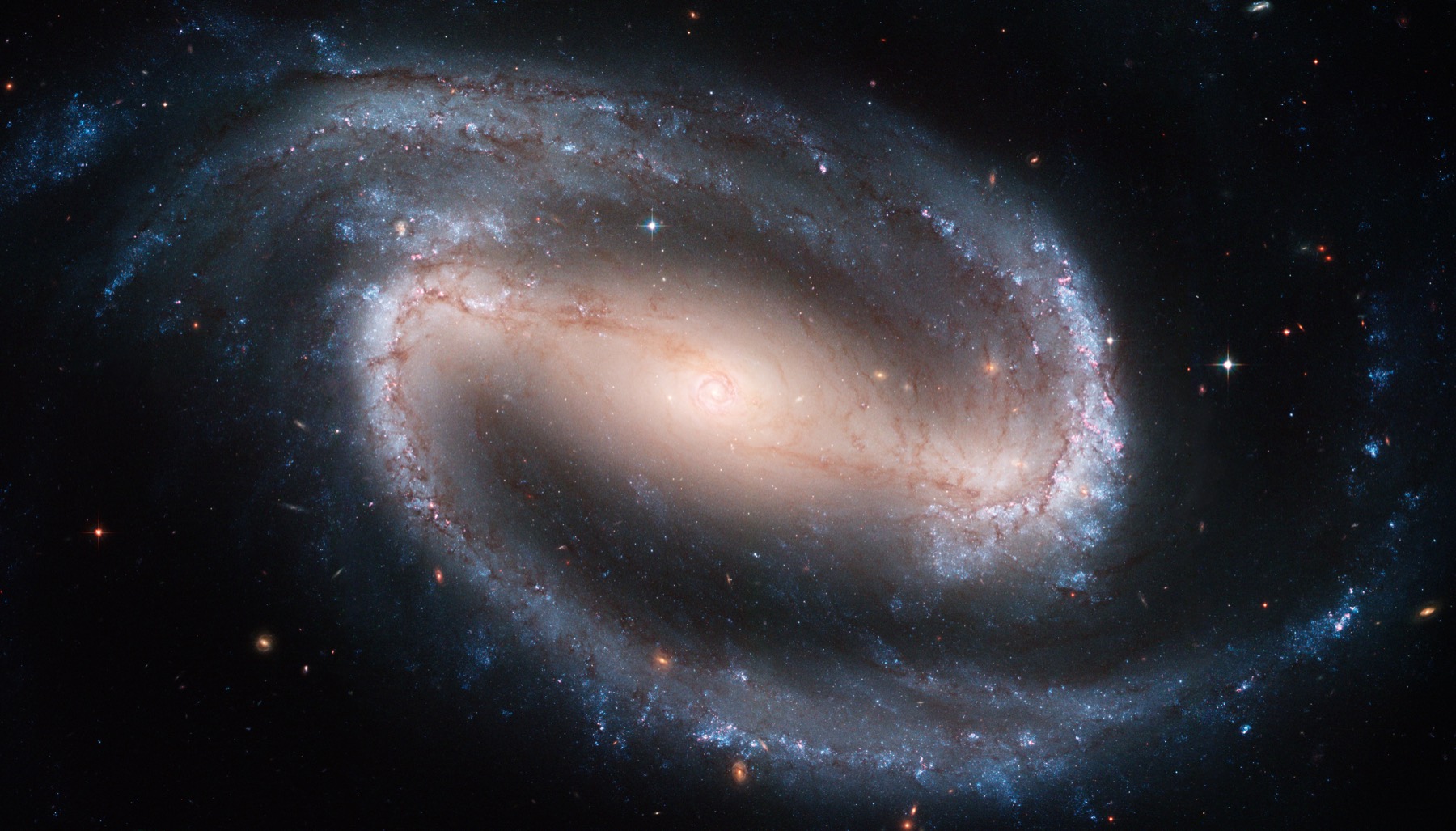
| Barred spiral | Spiral arms that start from a straight bar of stars | Like spirals; bars funnel gas inward | NGC 1300, the Milky Way |
| Elliptical | Smooth, round to elongated ball of stars | Mostly old stars, little cold gas | M87 in the Virgo Cluster |
| Lenticular | Disk and bulge but no arms | Old stars, little star formation | Spindle Galaxy (NGC 5866) |
| Irregular | No clear shape | Often gas-rich and forming stars | Large Magellanic Cloud |
| Dwarf | Small, faint; can be any of the above shapes | Millions to a few billion stars | Sagittarius Dwarf |
The pattern is not random. Spirals tend to be blue and still making stars; giant ellipticals tend to be red and quiet. Collisions are a big part of the reason, as the section on formation explains.
The Milky Way
The Milky Way is a barred spiral galaxy about 100,000 light-years across, holding an estimated 100 billion to 400 billion stars. The Sun sits in a minor spiral arm about 27,000 light-years from the center and takes roughly 200 to 250 million years to complete one orbit.
At the center lies Sagittarius A*, a black hole of about 4.3 million solar masses. Andrea Ghez and Reinhard Genzel proved it was there by tracking stars on tight orbits around it (Ghez and colleagues’ 2008 stellar-orbit measurement), and the Event Horizon Telescope imaged its shadow in 2022.
Our galaxy was built by mergers. ESA’s Gaia mission revealed that the inner halo is dominated by debris from one large collision, Gaia-Enceladus, about 10 billion years ago (Helmi et al. 2018). In August 2026 a Hubble study of globular clusters pushed the record back further, to a merger with a dwarf galaxy named LKH about 11.8 billion years ago (Hubble finds the Milky Way’s earliest known merger).
The Andromeda Galaxy and the coming collision
The Andromeda Galaxy (M31) is the nearest large spiral, about 2.5 million light-years away, and it is approaching the Milky Way at roughly 110 kilometers per second. For more than a decade the standard forecast, based on Hubble measurements published in 2012, was a first close pass in about 4 billion years and a merger about 2 billion years later.
In June 2025 a team led by Till Sawala revised that forecast using updated Hubble and Gaia data and the pull of the Large Magellanic Cloud and the Triangulum Galaxy (M33). They found only about a 50% chance that the two galaxies merge within the next 10 billion years, and only about a 2% chance of a collision in the next 5 billion (Sawala et al. 2025). The answer is still moving: a 2026 analysis using corrected Gaia data, accepted by The Astrophysical Journal Letters, put the merger odds back up to about 90%. The full story, with the numbers, is in our explainer on the Andromeda-Milky Way collision.
Who discovered that galaxies exist?
Edwin Hubble proved in the 1920s that the spiral “nebulae” are galaxies far outside our own. Before that, astronomers disagreed sharply. On April 26, 1920, Harlow Shapley and Heber Curtis argued the question in public in what became known as the Great Debate: Shapley held that the Milky Way was essentially the whole universe, Curtis that spirals were separate “island universes.”
The key came from Henrietta Swan Leavitt. In 1912 she showed that Cepheid variable stars that pulse more slowly are intrinsically brighter (Leavitt’s period-luminosity relation). A Cepheid’s period therefore gives its true brightness, and comparing that with how bright it looks gives its distance.
In 1923 Hubble found a Cepheid, now called V1, in the Andromeda nebula using the 100-inch telescope on Mount Wilson. Its distance put Andromeda far beyond the edge of the Milky Way. The result was read in his absence at a meeting of the American Astronomical Society on January 1, 1925, and the known universe grew enormously. Four years later Hubble used the same method to show that galaxies recede faster the farther away they are (Hubble’s 1929 discovery of cosmic expansion).
Galaxies formed when gas cooled and collected at the centers of dark matter halos, which grew by merging over billions of years. Simon White and Martin Rees set out this two-stage picture in 1978 (White and Rees 1978), and it still frames every simulation.
The main steps, as far as we understand them:
- Seeds. Tiny density ripples left over from the early universe grow under gravity, mostly in dark matter.
- Halos. Dark matter collapses into halos, small ones first, which then merge into bigger ones.
- Gas and stars. Hydrogen and helium fall into the halos, cool, and form the first stars and small galaxies within a few hundred million years of the Big Bang.
- Mergers. Galaxies collide and combine. Alar and Juri Toomre showed in 1972 that gravity alone can draw out the long tails seen in colliding pairs (Toomre and Toomre 1972), and mergers of disks can produce ellipticals.
- Feedback. Exploding stars and feeding black holes heat and blow out gas, which eventually shuts star formation down in many galaxies.
The universe’s most productive period is long past. Star formation peaked about 3.5 billion years after the Big Bang, roughly 10 billion years ago, an epoch astronomers call “cosmic noon,” and it has declined ever since (Madau and Dickinson 2014).
The earliest galaxies: what JWST found
The earliest galaxies confirmed so far shone less than 300 million years after the Big Bang, and they are brighter than many models predicted. In 2024 the JADES team confirmed JADES-GS-z14-0 at a redshift of 14.32 (Carniani et al. 2024). In 2025 the record passed to MoM-z14 at redshift 14.44, seen about 280 million years after the Big Bang, according to the James Webb Space Telescope team.
Redshift measures how much the expanding universe has stretched a galaxy’s light. The higher it is, the farther back in time we are looking. JWST’s infrared vision is what makes these galaxies visible at all, because their ultraviolet light now arrives stretched into the infrared.
Two puzzles came with the new data. First, early galaxies are “too bright, too early”: there are more luminous galaxies at cosmic dawn than many models expected. Second, JWST found a population of compact red sources, now called little red dots, first flagged among candidate massive galaxies in early JWST images (Labbé et al. 2023). Many appear to be growing black holes wrapped in gas. A broader roundup is in what JWST has discovered.
Quasars and active galaxies
A quasar is the blazing center of a galaxy whose supermassive black hole is swallowing gas so fast that the surrounding disk outshines all the galaxy’s stars. The first was identified in 1963, when Maarten Schmidt recognized that the spectrum of the star-like radio source 3C 273 was shifted to a redshift of 0.158 (Schmidt’s 1963 identification of 3C 273). At that distance it had to be far more luminous than any normal galaxy.
Quasars are the brightest members of a wider family called active galactic nuclei. They are also among the most distant objects we can see. In July 2026 ESA’s Euclid mission and Keck Observatory reported 12 new quasars above redshift 7, including a new record holder at redshift 7.77, shining within the universe’s first 670 million years (Euclid and Keck double the earliest quasars).
The cosmic web: groups, clusters and superclusters
Galaxies are not scattered at random; they gather in groups and clusters strung along a web of filaments around vast empty voids. The Milky Way belongs to the Local Group, dominated by the Milky Way and Andromeda, with the Triangulum Galaxy and dozens of dwarfs. The nearest big cluster, the Virgo Cluster, holds more than a thousand galaxies about 54 million light-years away.
On the largest scale, R. Brent Tully and colleagues mapped galaxy motions in 2014 and defined our home supercluster, Laniakea, Hawaiian for “immeasurable heaven.” It spans about 520 million light-years and holds roughly 1017 solar masses in about 100,000 galaxies, all flowing toward a region called the Great Attractor.
Superclusters were assembling early. In September 2026 a team reported COSMOS-z3.1-A, the most distant proto-supercluster known, seen when the universe was 2.1 billion years old (the most distant proto-supercluster). Surveys like the Vera C. Rubin Observatory, which began its ten-year sky survey in June 2026, and Euclid are now mapping this web over billions of light-years.
The future of galaxies
Galaxies are slowly running out of fuel. Star formation is already far below its peak, and as gas is used up or heated, more galaxies will fade from blue to red. Some quiet galaxies are switched off in other ways: in October 2026 a student reported three isolated dwarf galaxies that stopped forming stars, possibly after being flung through a giant neighbor (three “dead” backsplash dwarf galaxies).
Closer to home, the Milky Way will almost certainly absorb the Large Magellanic Cloud within about 1 to 2 billion years. A merger with Andromeda, nicknamed “Milkomeda,” is somewhere between a coin flip and likely over the next 10 billion years, depending on which analysis you trust. Beyond the Local Group, accelerating cosmic expansion will carry every other galaxy out of view on a timescale of order 100 billion years, leaving future observers with a single lonely galaxy (Krauss and Scherrer 2007). Long after that, the last stars fade. Follow that timeline in Deep Time.
For a visual sense of scale, our video library includes ESA’s Gaia animation of the Milky Way.
Key papers
Where the research is happening
Sources
- Hubble, E. (1926). Extra-galactic nebulae. The Astrophysical Journal 64, 321. https://doi.org/10.1086/143018 [primary]
- Carniani, S. et al. (2024). Spectroscopic confirmation of two luminous galaxies at a redshift of 14. Nature. https://doi.org/10.1038/s41586-024-07860-9 [primary]
- Sawala, T. et al. (2025). No certainty of a Milky Way-Andromeda collision. Nature Astronomy. https://doi.org/10.1038/s41550-025-02563-1 [primary]
- Madau, P. and Dickinson, M. (2014). Cosmic Star-Formation History. Annual Review of Astronomy and Astrophysics. https://doi.org/10.1146/annurev-astro-081811-125615 [primary]
- ESA/Webb (28 January 2026). MoM-z14 record release. https://esawebb.org/news/weic2603/ [press]
- Conselice, C. J. et al. (2016). The Evolution of Galaxy Number Density at z < 8. The Astrophysical Journal 830, 83. https://arxiv.org/abs/1607.03909 [primary]
- NASA (2021, updated 2023). New Horizons spacecraft answers the question: how dark is space? https://science.nasa.gov/missions/hubble/new-horizons-spacecraft-answers-question-how-dark-is-space/ [agency]
- Tully, R. B. et al. (2014). The Laniakea supercluster of galaxies. Nature 513, 71. https://arxiv.org/abs/1409.0880 [primary]