1934
W. Baade and F. Zwicky, Proceedings of the National Academy of Sciences, 20, 254-259, 1934
Baade and Zwicky (1934): Supernovae and the Neutron Star Idea
Named supernovae in 1934 as a distinct class of stellar explosion. Walter Baade and Fritz Zwicky also proposed that supernovae create neutron stars.
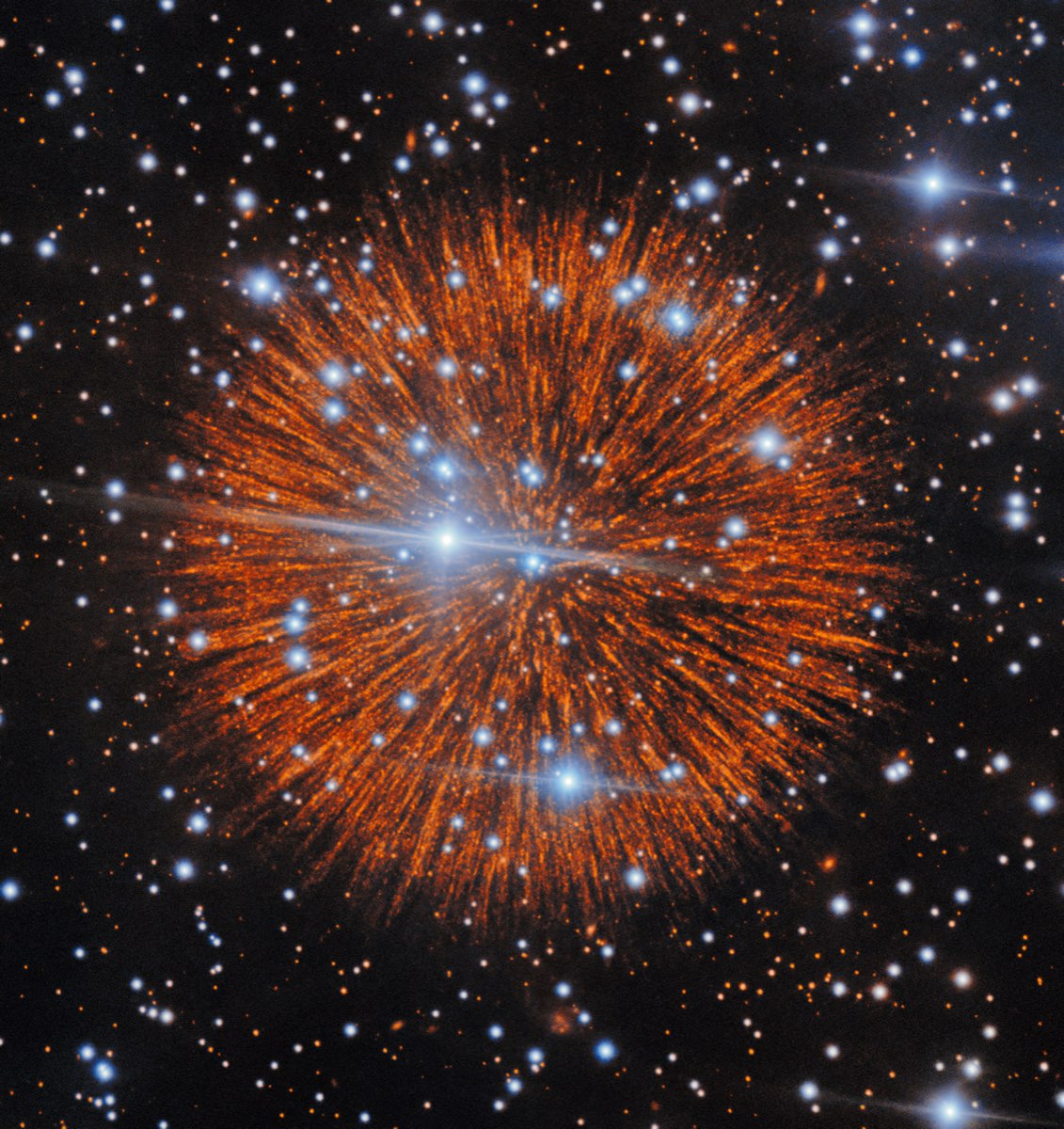
Walter Baade and Fritz Zwicky identified supernovae in 1934 as a separate, vastly more powerful kind of stellar explosion, and coined the word. In a companion paper the same year they proposed that a supernova turns an ordinary star into a neutron star and accelerates cosmic rays. All three ideas were later confirmed.
The question
Astronomers had long seen “novae”, stars that suddenly flare up. Some of them appeared in the spiral nebulae, and once Edwin Hubble showed in the 1920s that those nebulae are distant galaxies, the brightest outbursts implied enormous energies. Were they just big novae, or something different? And what could release that much energy?
What the paper found
- “Super-novae” are a distinct class of explosion, far more energetic than ordinary novae. The paper introduced the term.
- The energy released is enormous: a significant fraction of the star’s rest-mass energy, the energy locked in its mass by E = mc2.
- In a companion paper in the same issue (“Cosmic Rays from Super-novae”, vol. 20, p. 259) they proposed supernovae as the source of cosmic rays.
- There they also wrote, “with all reserve”, that a supernova represents the transition of an ordinary star into a neutron star.
How they did it
The argument combined observation and bold physics. Baade and Zwicky took the record of exceptionally bright novae in other galaxies and, using the new distances to those galaxies, turned their brightness into energy. The result was too large for any ordinary nova. The neutron star idea came from nuclear physics: the neutron had been discovered only about two years earlier. A star that collapsed until its matter became mostly tightly packed neutrons would release a huge amount of gravitational energy, enough to power the explosion.
Why it mattered
In a few pages the two astronomers anticipated three major results: supernovae as a class, neutron stars, and the link between supernovae and cosmic rays. The neutron star idea built on the limit for white dwarfs found by Chandrasekhar in 1931: stellar cores too heavy to stay white dwarfs need somewhere to go.
Supernovae went on to become essential tools. They forge and scatter heavy elements, the subject of the B2FH paper on stellar nucleosynthesis, and one type of supernova became the standard candle behind the 1998 discovery of the accelerating universe.
What we know now
Neutron stars were confirmed with the discovery of pulsars in 1967 and 1968, described in Jocelyn Bell and Antony Hewish’s pulsar paper. The guide to stars explains how massive stars end their lives, and what may happen when the nearby red supergiant Betelgeuse finally explodes.
Who wrote it
Walter Baade and Fritz Zwicky worked in Pasadena, California; the paper lists the Mount Wilson Observatory of the Carnegie Institution of Washington and the California Institute of Technology. Mount Wilson is now part of Carnegie Science’s observatories. A year earlier Zwicky had published his Coma cluster study, usually cited as the first evidence for dark matter.
Read the original
Baade, W. and Zwicky, F. (1934). “On Super-Novae.” Proceedings of the National Academy of Sciences 20, 254-259. doi:10.1073/pnas.20.5.254
The paper is free to read on the PNAS website. The companion paper is “Cosmic Rays from Super-novae,” PNAS 20, 259 (doi:10.1073/pnas.20.5.259).
This week in papers
Five new results in one line each, plus one landmark like this one. Weekly.
Keep reading
Chandrasekhar, The Astrophysical Journal, 74, 81, 1931
The Chandrasekhar Limit: How Massive a White Dwarf Can Be
Showed in 1931 that white dwarfs have a maximum mass. Subrahmanyan Chandrasekhar's limit, now about 1.4 Suns, decides which dead stars collapse further.
Bethe, Physical Review, 55, 434-456, 1939
Hans Bethe: How Nuclear Fusion Makes the Stars Shine
Explained in 1939 why stars shine: Hans Bethe worked out the fusion reactions, the proton-proton chain and the CNO cycle, that turn hydrogen into helium.
Payne, Harvard Observatory Monographs No. 1 (PhD thesis, Radcliffe College), 1925
Cecilia Payne's Thesis: Stars Are Made of Hydrogen
Showed in 1925 that stars are mostly hydrogen and helium. Cecilia Payne's PhD thesis decoded stellar spectra and revealed what the universe is made of.