Betelgeuse
Betelgeuse is a dying red supergiant about 550 light-years away. When it may explode, what the Great Dimming was, and what we know of its companion.
By The Orbital Record editorial teamPublished Last reviewed
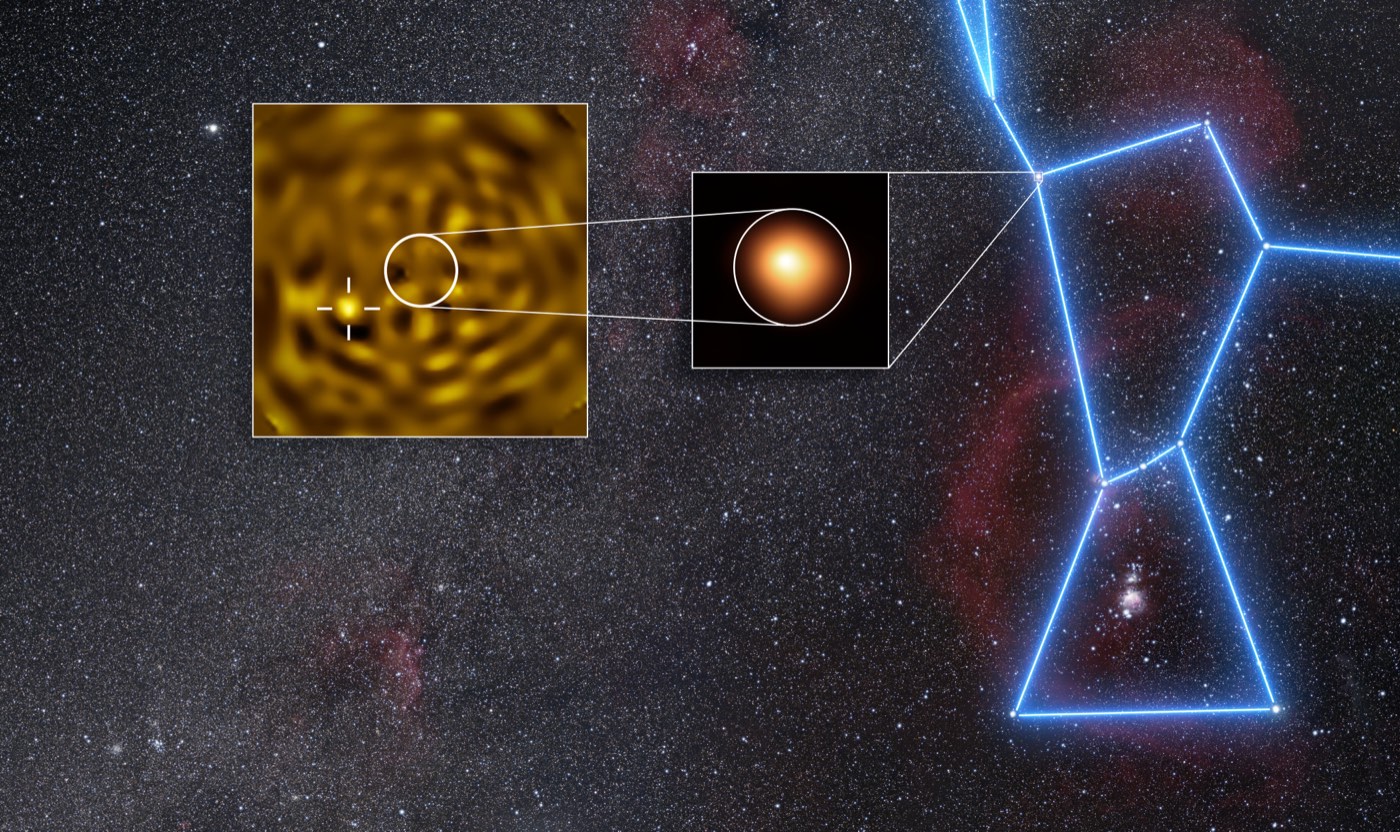
Betelgeuse is a red supergiant in Orion, about 550 light-years away, that will one day explode as a supernova, but almost certainly not soon. Most models give it roughly 100,000 years. It made headlines twice recently: for its Great Dimming in 2019 to 2020, and for a long-suspected companion star, glimpsed in 2025 and imaged more clearly in 2026.
Betelgeuse is a massive star near the end of its life, and it is the nearest star of its kind. For the full picture of how stars live and die, see our guide to the life cycle of a star.
Betelgeuse at a glance
| Property | Value | Source |
|---|---|---|
| Type | Red supergiant (spectral type M1 to M2) | Standard classification |
| Distance | About 550 light-years, 168 parsecs (range roughly 500 to 640) | Joyce et al. 2020 |
| Radius | About 764 times the Sun’s (estimates range from about 640) | Joyce et al. 2020 |
| Mass | About 16.5 to 19 times the Sun’s | Joyce et al. 2020 |
| Stage | Burning helium in its core | Joyce et al. 2020 |
| Companion | Betelgeuse B (Siwarha), mass debated | Howell et al. 2025; Montargès et al. 2026 |
Put Betelgeuse where the Sun is and its surface would reach well beyond the orbit of Mars, most of the way to Jupiter. It is so large and puffy that it does not have a sharp edge, which is one reason its distance is hard to pin down.
When will Betelgeuse explode?
Probably in about 100,000 years, which is the lifetime left for a star of its mass that is still burning helium in its core. That is the conclusion of a 2020 study led by Meridith Joyce, which matched Betelgeuse’s pulsations to stellar evolution models (Joyce et al. 2020).
In 2023 Hideyuki Saio and colleagues proposed that Betelgeuse had already moved on to burning carbon, which would bring the end much closer: core collapse within a few centuries at most (Saio et al. 2023). A reply by László Molnár, Joyce and Shing-Chi Leung pointed out that those models require a radius that conflicts with the star’s measured angular size (Molnár et al. 2023). Most astronomers favor the helium-burning picture, though the question is not formally closed.
When it does go, Betelgeuse will be a core-collapse supernova, the explosion described in Baade and Zwicky’s 1934 paper on supernovae, leaving a neutron star or possibly a black hole.
Would it harm Earth?
No. Damage to Earth’s ozone layer would require a supernova within roughly 50 light-years. Simulations reported in 2020 suggest a Betelgeuse supernova would rival a half Moon in brightness for about three months and stay visible in daylight for around a year, a spectacular but harmless sight.
What was the Great Dimming?
Between December 2019 and February 2020 Betelgeuse dropped to about magnitude 1.6, its faintest in more than a century, before recovering by April 2020. Many people wondered whether it was about to explode. It was not.
- ESO’s Very Large Telescope imaged the star’s surface in December 2019, January 2020 and March 2020. A team led by Miguel Montargès concluded in Nature in June 2021 that a patch of the surface cooled and gas thrown off by the star condensed into dust, veiling part of the star (ESO release, June 2021).
- Hubble observations analyzed by Andrea Dupree’s team showed a “surface mass ejection,” a blob of material about 400 billion times more massive than a typical solar coronal mass ejection (NASA, August 2022).
The dimming was a reminder that red supergiants are restless, boiling with giant convection cells and shedding mass long before they die.
Betelgeuse’s companion star: what we know
Betelgeuse has a second brightness cycle of about six years, longer than its pulsations, that has puzzled astronomers for a century. A companion star tugging on it was one of the leading explanations. Here is how the evidence built up, in order:
- 2024, the prediction. Two independent teams modeled the six-year cycle as the signature of an orbiting companion. Jared Goldberg and colleagues estimated about 1.2 solar masses on a period of about 2,170 days (Goldberg et al. 2024). Morgan MacLeod and colleagues found a period of about 2,110 days (5.78 years) and a companion of less than one solar mass, which would spiral into Betelgeuse within about 10,000 years (MacLeod et al. 2024).
- May 2025, two non-detections. Chandra saw no X-rays from the companion’s expected position, ruling out a feeding white dwarf or neutron star and favoring a young star (O’Grady et al. 2025). Hubble’s ultraviolet spectrograph also saw nothing, which argued against a companion heavier than about 1.5 solar masses (Goldberg et al. 2025).
- July 2025, a first glimpse. Steve Howell of NASA Ames and colleagues used the ‘Alopeke speckle imager on Gemini North, with images from December 2024, to spot a faint source 52 milliarcseconds from Betelgeuse, about six magnitudes fainter. The detection was only at about 1.5 sigma, so the team called it probable (Howell et al. 2025; NASA JPL, 23 July 2025).
- 2025, a name. The companion became known as Siwarha, usually translated as “her bracelet.”
- January 2026, a wake. Dupree’s team reported signs of the companion’s wake in about eight years of Hubble and ground-based spectra, as the small star plows through Betelgeuse’s extended atmosphere (NASA, 5 January 2026).
- July 2026, the clearest image. Montargès and colleagues analyzed ESO’s VLT/SPHERE images taken on 3 and 6 December 2024 and found the companion at 52.3 milliarcseconds with a significance of about 6 sigma. If the two stars formed together, its brightness implies about 2.6 to 3.1 solar masses, more than the earlier predictions (VLT images Betelgeuse’s companion; ESO release, 28 July 2026).
Is the companion confirmed?
Not fully. The SPHERE team says a second observation, with the companion on the other side of Betelgeuse, is needed to prove it is bound in orbit. And the mass is disputed: in an August 2026 preprint (not yet peer reviewed), Goldberg and colleagues argue that some of the light seen by the VLT may be Betelgeuse’s own light reflected by dust around the companion, which would allow a lighter star consistent with the Hubble limit (Goldberg et al. 2026, preprint). The next good chance to see the companion at its widest separation comes around November 2027.
Why the companion matters
A companion changes how a massive star sheds mass and spins, and so how it dies. If MacLeod’s estimate holds, the small star will eventually be swallowed by Betelgeuse long before the supernova. It also explains the six-year cycle that puzzled observers for a century without any change to the supernova forecast.
Where Betelgeuse is studied
The key data come from the ESO Very Large Telescope (SPHERE and other high-resolution instruments), the Hubble Space Telescope, Gemini North and the Chandra X-ray Observatory. For an accessible long-form overview, our video library includes Cool Worlds’ “Betelgeuse Explained.”
Sources
- Joyce, M. et al. (2020). Standing on the Shoulders of Giants: New Mass and Distance Estimates for Betelgeuse. The Astrophysical Journal 902, 63. https://arxiv.org/abs/2006.09837 [primary]
- Howell, S. B. et al. (2025). The Probable Direct-imaging Detection of the Stellar Companion to Betelgeuse. The Astrophysical Journal Letters 988, L47. https://doi.org/10.3847/2041-8213/adeaaf [primary]
- Montargès, M. et al. (2026). VLT/SPHERE imaging of the candidate companion of Betelgeuse. Astronomy & Astrophysics 711, L12. https://doi.org/10.1051/0004-6361/202661023 [primary]
- MacLeod, M. et al. (2024). Radial Velocity and Astrometric Evidence for a Close Companion to Betelgeuse. https://arxiv.org/abs/2409.11332 [primary]
- Goldberg, J. A. et al. (2024). A Buddy for Betelgeuse. https://arxiv.org/abs/2408.09089 [primary]
- NASA (5 January 2026). Hubble helps detect wake of Betelgeuse’s companion. [press]
Questions people ask
When will Betelgeuse explode?
Probably not for a long time. Most models place Betelgeuse in its core helium-burning phase, which implies roughly 100,000 years before it collapses and explodes. A 2023 study argued for a much later stage and an explosion within a few centuries, but follow-up work found its models conflict with the star's measured size.
Does Betelgeuse have a companion star?
Very probably. A small companion was predicted in 2024 from a six-year brightness cycle, glimpsed at low significance by Gemini North in 2025, and imaged more clearly by ESO's Very Large Telescope in a study published in 2026. Proof that it is truly orbiting Betelgeuse awaits a second observation, expected around November 2027.
Would a Betelgeuse supernova be dangerous to Earth?
No. A supernova would need to be within roughly 50 light-years to damage Earth's ozone layer, and Betelgeuse is about ten times farther away. Simulations suggest it would shine about as brightly as a half Moon for about three months and stay visible in daylight for around a year, a spectacular but harmless sight.
What was the Great Dimming of Betelgeuse?
Between late 2019 and early 2020 Betelgeuse faded to roughly a third of its usual brightness, its faintest in more than a century of measurements. Images from ESO's Very Large Telescope and Hubble showed the star had thrown off a huge bubble of gas that cooled into a dust cloud, temporarily blocking part of its light.
How far away is Betelgeuse?
About 550 light-years, according to a 2020 study that combined brightness variations with stellar models, with an uncertainty of roughly 50 to 90 light-years. Older estimates of around 650 to 700 light-years still appear on many websites. Betelgeuse is too large and variable for a precise parallax distance.
What is Betelgeuse's companion called?
The companion, also called Betelgeuse B, has been given the name Siwarha, announced alongside the 2025 Gemini North detection. The name is usually translated as her bracelet, drawn from the Arabic tradition that also gave Betelgeuse its own name. Its mass is still debated, with estimates from under one to about three times the Sun's.