A star is a giant ball of hot plasma held together by its own gravity and powered by nuclear fusion in its core. The life cycle of a star depends on its mass: Sun-like stars swell into red giants and end as white dwarfs, while stars above about eight solar masses explode as supernovae, leaving neutron stars or black holes.
The life cycle of a star, step by step
Every star follows the same opening stages, then takes one of two endings decided by its mass.
- Molecular cloud. A cold, dense cloud of hydrogen gas and dust, often many light-years across, begins to fragment.
- Protostar. A clump collapses under gravity and heats up, surrounded by a spinning disk where planets may form.
- Main sequence. Hydrogen fusion ignites in the core. The star settles into a long, stable life, about 90% of its total lifetime.
- Red giant or red supergiant. The core runs out of hydrogen, contracts and heats up, and the outer layers swell enormously.
- Planetary nebula or supernova. A Sun-like star gently sheds its envelope as a glowing shell. A massive star’s core collapses and the star explodes.
- Remnant. What remains is a white dwarf (low-mass stars), a neutron star, or a black hole (the most massive stars).
The two branches in one line: low mass goes cloud, protostar, main sequence, red giant, planetary nebula, white dwarf; high mass goes cloud, protostar, main sequence, red supergiant, supernova, neutron star or black hole.
What is a star?
A star is a balance between gravity pulling in and pressure pushing out. Gravity tries to crush the gas; the heat released by fusion in the core keeps it puffed up. Astronomers call that balance hydrostatic equilibrium, and a star spends most of its life in it.
Why stars shine was answered in 1939, when Hans Bethe worked out the nuclear reactions that turn hydrogen into helium: the proton-proton chain in the Sun and the carbon-nitrogen-oxygen cycle in heavier stars (Bethe’s 1939 paper on energy production in stars). A few years earlier, in 1925, Cecilia Payne had shown that stars are made overwhelmingly of hydrogen and helium (Payne’s 1925 thesis).
A star’s color tells its surface temperature: red stars are around 3,000 degrees Celsius, the Sun about 5,500, blue-white stars 10,000 to over 30,000. Its brightness depends mainly on mass. A star twice the Sun’s mass is roughly ten times more luminous.
Stars form when a dense pocket of a cold gas cloud becomes too heavy to hold itself up and collapses. The threshold is called the Jeans mass, after the physicist James Jeans: below it, the gas pressure wins; above it, gravity wins. A passing shock wave from a supernova or a collision between clouds can tip a clump over the edge.
As the clump falls inward it spins faster and flattens into a disk around a hot central protostar. Jets blast out along its poles. When the core reaches about 10 million degrees, hydrogen fusion begins and the new star reaches the main sequence. Stars are usually born in clusters, dozens to thousands at a time.
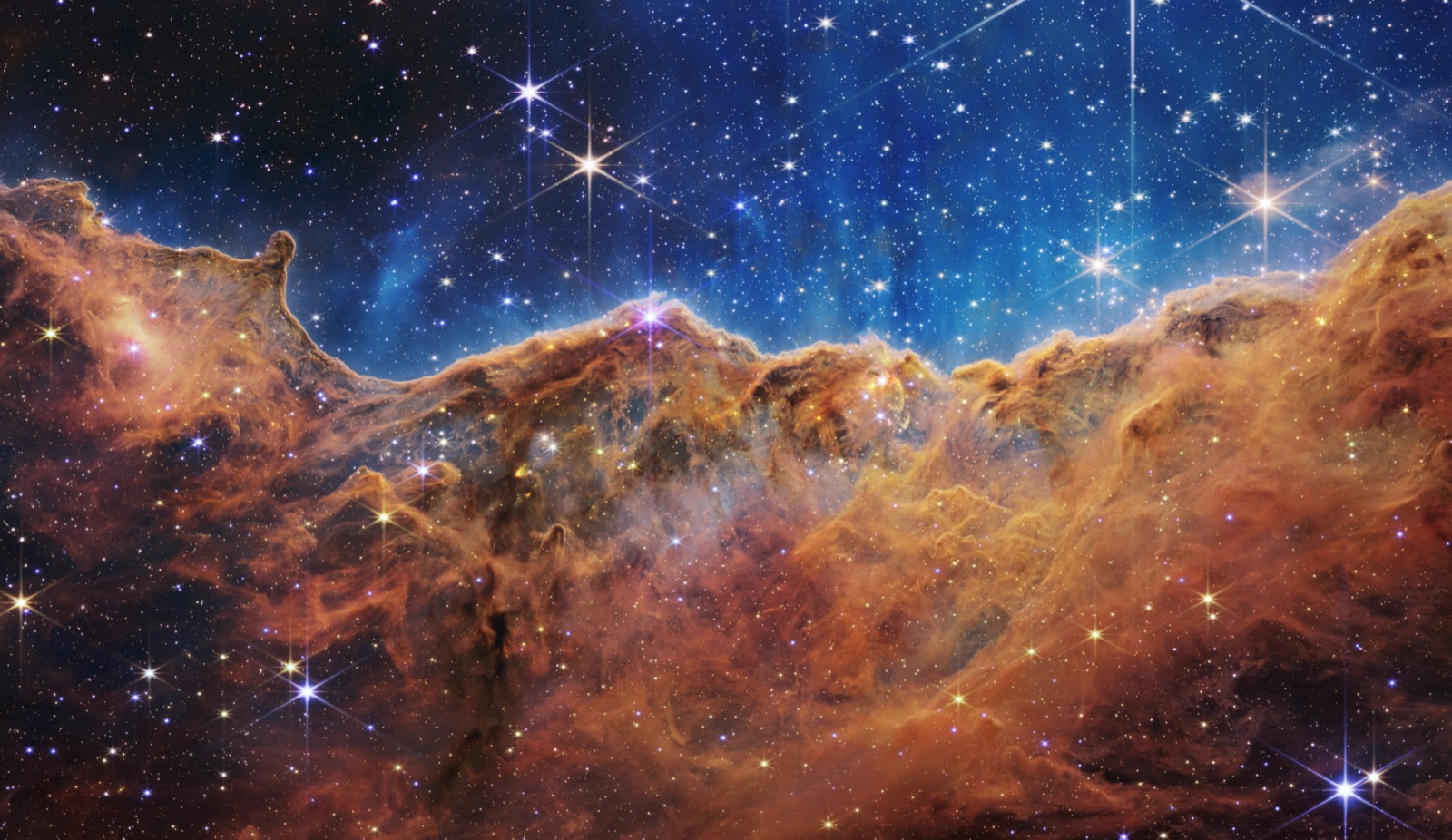
The Pillars of Creation in the Eagle Nebula and the Cosmic Cliffs in the Carina Nebula (pictured above) are star nurseries caught in the act. The James Webb Space Telescope sees through their dust in infrared light, revealing protostars that were hidden from Hubble.
How long do stars live?
The heavier a star is, the shorter it lives, because it burns its fuel disproportionately fast. Approximate main-sequence lifetimes from standard stellar models:
| Mass (Sun = 1) | Main-sequence lifetime | Example |
|---|
| 0.1 | Trillions of years | Proxima Centauri (about 0.12) |
| 1 | About 10 billion years | The Sun |
| 10 | About 20 million years | Many stars in Orion |
| 50 | A few million years | The most massive young stars |
The Sun is about 4.6 billion years old, so it is roughly halfway through its main-sequence life. Find out what comes next in when will the Sun die.
The Hertzsprung-Russell diagram and the main sequence
The Hertzsprung-Russell diagram plots stars by temperature and luminosity, and most fall along a diagonal band called the main sequence. Ejnar Hertzsprung (1911) and Henry Norris Russell (1913) built it independently. Hot, bright blue stars sit at the upper left; cool, dim red dwarfs at the lower right. Red giants and supergiants sit above the band, white dwarfs below it.
A star’s position on the main sequence is set by its mass. The Sun is a fairly ordinary G-type star in the middle of the band, but it is not average in one sense: most stars in the galaxy are red dwarfs, smaller and dimmer than the Sun.
How stars die
How a star dies depends on how much mass it has when it runs out of fuel.
White dwarfs and the Chandrasekhar limit
A Sun-like star ends as a white dwarf: a core about the size of Earth, holding roughly half the Sun’s mass, supported by the pressure of tightly packed electrons. In 1931 Subrahmanyan Chandrasekhar showed that this support fails above a maximum mass, now put at about 1.4 solar masses (the Chandrasekhar limit). Arthur Eddington publicly rejected the idea, but Chandrasekhar shared the 1983 Nobel Prize in Physics.
Supernovae
Supernovae come in two main kinds. A core-collapse supernova happens when a star of more than about eight solar masses builds an iron core that cannot fuse further; the core collapses in under a second and the rebound blows the star apart. A Type Ia supernova happens when a white dwarf in a binary is pushed past the Chandrasekhar limit and detonates. Walter Baade and Fritz Zwicky coined the word “super-novae” in 1934 and proposed that they leave neutron stars behind (Baade and Zwicky 1934).
New surveys catch explosions earlier than ever. In March 2026 the Einstein Probe recorded the X-ray flash of a supernova’s shock breakout, the first light of the explosion (Einstein Probe catches a shock breakout). And some supernovae are seen across centuries: Gemini North has mapped the remnant of the supernova recorded in 1181 (the knots of SN 1181).
Neutron stars and pulsars
A neutron star packs more than the Sun’s mass into a sphere about 20 kilometers across. Some spin rapidly and sweep beams of radio waves across Earth like a lighthouse: these are pulsars. Jocelyn Bell found the first in 1967, a source pulsing every 1.337 seconds (the discovery of pulsars). Neutron stars with extreme magnetic fields are called magnetars, and in October 2026 JWST found the young host galaxy of the most distant fast radio burst yet, evidence that some bursts come from young magnetars (Webb and the most distant fast radio burst).
Pulsars became precision clocks. In 1974 Russell Hulse and Joseph Taylor found a pulsar orbiting another neutron star, and its shrinking orbit gave the first evidence of gravitational waves (the Hulse-Taylor binary pulsar).
Black holes
The most massive stars leave cores too heavy even for neutron pressure, and they collapse into black holes. Some may skip the explosion entirely: in February 2026 a Flatiron Institute team reported a supergiant in Andromeda that faded away without a supernova, apparently collapsing directly into a black hole. More in our black holes guide.
We are made of star stuff: how elements are made
Nearly every element heavier than helium was forged in stars or stellar explosions. The 1957 paper by Margaret and Geoffrey Burbidge, William Fowler and Fred Hoyle, known as B2FH, laid out the processes (B2FH, synthesis of the elements in stars).
- Fusion in stellar cores builds carbon, oxygen, neon, magnesium, silicon and finally iron. Fusing iron consumes energy instead of releasing it, which is why massive stars collapse once their cores turn to iron.
- The slow neutron-capture process in aging giant stars makes about half of the elements heavier than iron, such as barium and lead.
- The rapid neutron-capture process needs extreme neutron floods. In 2017 the neutron star collision GW170817 produced a kilonova whose light showed freshly made heavy elements, confirming mergers as a major source of gold and platinum (GW170817).
The calcium in your bones and the iron in your blood were made in stars that died before the Sun was born.
Famous stars
Betelgeuse
Betelgeuse, the red shoulder of Orion, is a red supergiant roughly 550 light-years away, though the distance is uncertain. It dimmed dramatically in 2019 to 2020 when it ejected a dust cloud, and it will end as a supernova, which most astronomers expect within roughly the next 100,000 years rather than in our lifetimes. A long-predicted companion star was tentatively spotted in 2025, and in July 2026 ESO’s Very Large Telescope delivered the clearest image of it yet (VLT images Betelgeuse’s companion). Full story in our Betelgeuse explainer.
Sirius
Sirius is the brightest star in the night sky, about 8.6 light-years away. It has a hidden partner, Sirius B, one of the first white dwarfs ever identified: a star with roughly the Sun’s mass squeezed into a body about the size of Earth.
Polaris
Polaris, the North Star, sits almost exactly above Earth’s north pole, which is why it seems to stay still while the sky turns. It is a yellow supergiant several hundred light-years away and also a Cepheid variable, the kind of pulsating star Henrietta Leavitt turned into a cosmic yardstick in 1912 (Leavitt’s law).
Proxima Centauri
Proxima Centauri, about 4.2 light-years away, is the closest star to the Sun. It is a red dwarf with about 12% of the Sun’s mass and only 0.15% of its luminosity, prone to violent flares, and it hosts at least one Earth-mass planet, Proxima b.
The last stars in the universe
The last stars will be red dwarfs, which burn so slowly that the smallest should shine for trillions of years, around 1013 years. No red dwarf has yet left the main sequence; the universe is too young. Star formation in galaxies is expected to end around a hundred trillion (1014) years from now, when usable gas runs out, closing what Fred Adams and Gregory Laughlin called the Stelliferous Era, the age of stars we live in today (Adams and Laughlin 1997).
After that comes the Degenerate Era, a universe of cooling white dwarfs, neutron stars and brown dwarfs. A white dwarf needs an immense time, often estimated at around a quadrillion (1015) years, to cool into a cold, dark black dwarf, so none exist yet. That is one way of seeing why the universe is still young. Follow the whole timeline in Deep Time.
For a short, student-friendly visual, our video library includes Kurzgesagt’s explainer on red dwarfs as the last stars in the universe.
Key papers
Where the research is happening
Latest from the field: NASA’s SPHEREx reveals the atmospheres of dozens of brown dwarfs, the objects that sit between stars and planets.
Sources
- Chandrasekhar, S. (1931). The Maximum Mass of Ideal White Dwarfs. The Astrophysical Journal 74, 81. https://doi.org/10.1086/143324 [primary]
- Hewish, A., Bell, S. J. et al. (1968). Observation of a Rapidly Pulsating Radio Source. Nature 217, 709. https://doi.org/10.1038/217709a0 [primary]
- Burbidge, E. M. et al. (1957). Synthesis of the Elements in Stars. Reviews of Modern Physics 29, 547. https://doi.org/10.1103/RevModPhys.29.547 [primary]
- Adams, F. C. and Laughlin, G. (1997). A dying universe. Reviews of Modern Physics 69, 337. https://doi.org/10.1103/RevModPhys.69.337 [primary]
- ESO (28 July 2026). VLT/SPHERE images Betelgeuse’s companion. https://www.eso.org/public/news/eso2611/ [press]