Dark matter is a form of matter that does not emit, absorb or reflect light but reveals itself through gravity. It makes up about 85% of the matter in the universe and about 27% of its total energy. Fritz Zwicky first inferred it in 1933; Vera Rubin’s galaxy measurements in the 1970s made it unavoidable. Its nature is still unknown.
In physics and astronomy, “dark matter” is not a metaphor and not a TV series. It is a measured amount of unseen mass, and finding out what it is ranks among the biggest unsolved problems in science. This guide covers the evidence, the candidates and the hunt, with links to the papers behind each step.
What is dark matter?
Dark matter is mass that we detect only through its gravitational pull. “Dark” here means transparent rather than black: it does not shine, absorb or block light, so it is invisible at every wavelength.
According to the Planck satellite’s 2018 analysis, the universe is about 5% ordinary matter (atoms of every kind), 27% dark matter and 68% dark energy. So for every kilogram of ordinary matter there are roughly five kilograms of dark matter.
Dark matter is not dark energy. Dark matter pulls things together and builds galaxies; dark energy pushes the universe apart. They share only the word “dark”, which signals that we do not know what they are. Our explainer on dark matter vs dark energy compares them side by side.
Is dark matter real? The evidence
The case for dark matter rests on several independent observations, at very different scales, that all point the same way:
- Galaxy clusters move too fast to be held together by their visible mass.
- Galaxies spin too fast at their edges.
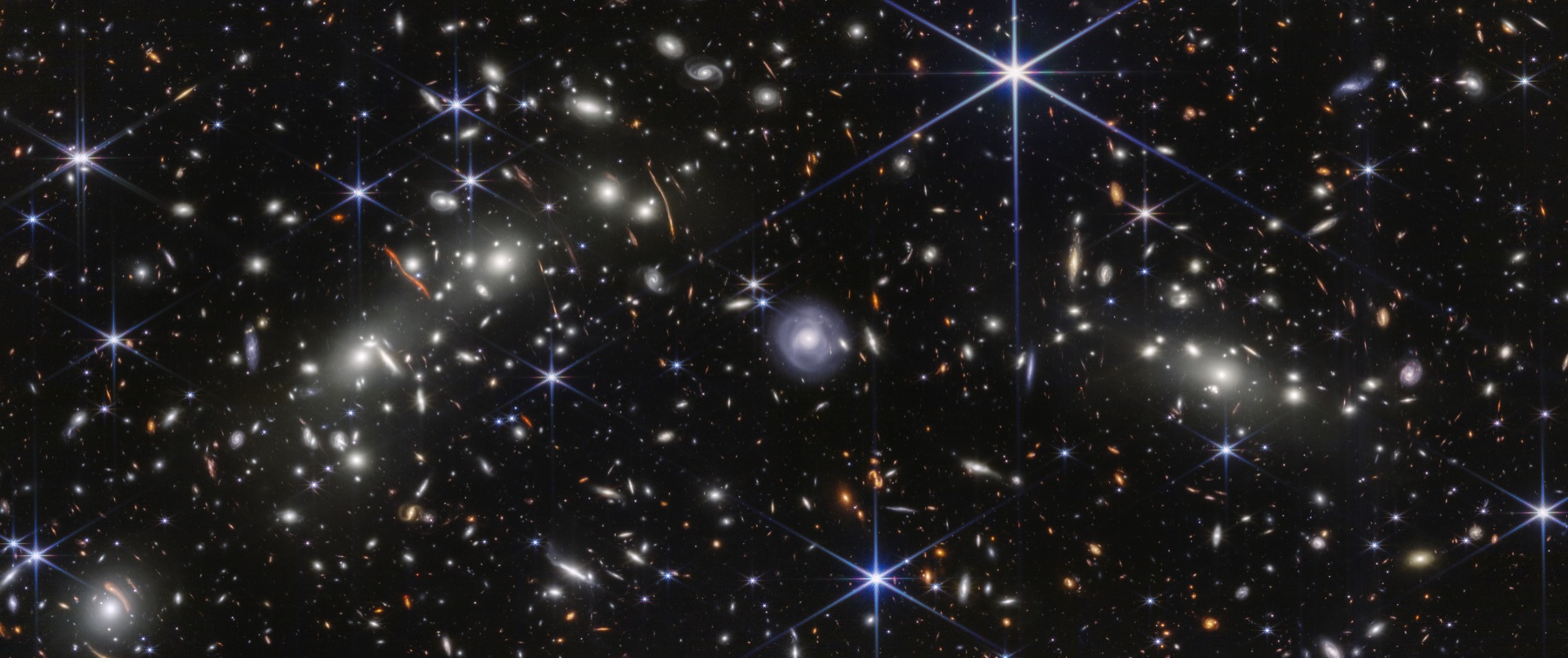
- Gravitational lensing reveals mass where there is no light, most clearly in the Bullet Cluster.
- The cosmic microwave background needs about five times more dark than ordinary matter.
- Cosmic structure could not have formed in time without it.
Galaxy clusters move too fast
In 1933 the Swiss astronomer Fritz Zwicky measured the speeds of galaxies in the Coma Cluster and found them moving at about 1,000 kilometers per second relative to each other (Zwicky’s 1933 Coma Cluster paper). At those speeds the cluster should fly apart, unless it holds far more mass than its stars. He estimated a density about 400 times the visible amount and called the missing component “dunkle Materie”. His factor was inflated by the distance scale of the time, but the conclusion held.
Galaxies spin too fast
In 1970 Vera Rubin and Kent Ford measured the velocities of 67 glowing gas clouds across the Andromeda galaxy, from 3 to 24 kiloparsecs from its center (Rubin and Ford’s Andromeda rotation curve). If most of the mass sat in the bright disk, the outer clouds should orbit more slowly, as the outer planets do around the Sun. They did not. The rotation curve stayed flat.
A flat curve means the enclosed mass keeps growing with distance, far beyond where the light ends. Rubin’s 1980 survey of 21 spiral galaxies showed the effect was universal (Rubin’s flat rotation curves). Together with radio measurements of hydrogen gas, it convinced most astronomers that galaxies sit inside massive dark halos.
Gravitational lensing and the Bullet Cluster
Mass bends light, so the distorted shapes of background galaxies map all the mass in front of them, dark or not. The Bullet Cluster, 1E 0657-558, is two galaxy clusters that passed through each other. During the collision, their hot gas, which holds most of the ordinary matter, slowed down and piled up in the middle, while the galaxies passed through.
In 2006 Douglas Clowe and colleagues showed that the lensing mass follows the galaxies, not the gas, with an offset significant at 8 sigma (the Bullet Cluster). Most of the mass is somewhere other than most of the ordinary matter. That is very hard to explain by changing the law of gravity alone.
The cosmic microwave background
The pattern of hot and cold spots in the cosmic microwave background depends on how much ordinary matter and how much dark matter the early universe held, because the two behave differently: ordinary matter interacts with light and bounces, dark matter does not. The height of the peaks in Planck’s measurements requires about five times more dark matter than ordinary matter (Planck 2018 cosmological parameters). This is a measurement of the whole universe, independent of any galaxy.
The ratio is precise. Planck’s 2018 analysis gives a dark matter density (written as Ωch2) of 0.120 ± 0.001 and an ordinary matter density of 0.0224 ± 0.0001, a ratio of about 5.4 to 1. The amount of ordinary matter agrees with an entirely separate measurement: the helium and deuterium forged in the first minutes after the Big Bang.
Cosmic structure
Galaxies grew from tiny ripples in the early universe, about one part in 100,000. With ordinary matter alone, those ripples could not have grown into galaxies by today, because ordinary matter was held smooth by radiation until 380,000 years after the Big Bang. Dark matter, unaffected by radiation, started clumping earlier. In 1984 George Blumenthal, Sandra Faber, Joel Primack and Martin Rees showed that slow-moving “cold” dark matter builds structure from small to large, matching what we see (the cold dark matter model).
Computer simulations built on that idea predict the shape of dark halos. In 1997 Julio Navarro, Carlos Frenk and Simon White found that simulated halos of every mass share one universal density profile, now called the NFW profile (the universal density profile). Its steep central “cusp” does not always match the gentler cores seen in small dwarf galaxies. That mismatch is one of the places where cold dark matter is being tested hardest today, and where alternatives such as self-interacting or ultralight dark matter try to do better.
Who discovered dark matter?
Dark matter was discovered gradually, and credit belongs to several people:
- Jan Oort (1932) estimated the density of matter near the Sun from the motions of nearby stars, an early attempt to weigh unseen local mass.
- Fritz Zwicky (1933) inferred huge amounts of invisible mass in the Coma Cluster and named it.
- Vera Rubin and Kent Ford (1970) measured the flat rotation of Andromeda; Rubin’s 1970s and 1980 work generalized it.
- Radio astronomers in the early 1970s found flat rotation curves in hydrogen gas extending beyond the visible disks.
- Jeremiah Ostriker, James Peebles and Amos Yahil, and independently Jaan Einasto and colleagues (1974) argued that galaxies are embedded in massive halos.
Rubin’s name now sits on the Vera C. Rubin Observatory, built in part to map dark matter.
What is dark matter made of?
Dark matter’s composition is unknown, but the candidates span more than 50 orders of magnitude in mass:
| Candidate | Mass scale | How scientists search | Status (October 2026) |
|---|
| WIMPs (weakly interacting massive particles) | Roughly a proton’s mass to thousands of times more | Underground xenon detectors, colliders, gamma rays | Not found; best limits from LZ (2025) |
| Axions | Far lighter than an electron | Converting axions to microwaves in strong magnetic fields | Not found; searches ongoing |
| Sterile neutrinos | Light, but heavier than known neutrinos | Faint X-ray emission lines | Not found |
| Primordial black holes | From asteroid to many solar masses | Microlensing, gravitational waves | Not found; can be at most part of dark matter in most mass ranges |
| Ultralight (“fuzzy”) dark matter | Extremely light, wave-like | Structure of dwarf galaxies and stellar streams | Being tested |
WIMPs were long the favorite because a particle with roughly the mass and interaction strength of the weak nuclear force would naturally leave behind about the right amount of dark matter after the Big Bang. Decades of null results have pushed them into ever narrower corners: LZ’s first run alone excluded interaction strengths above about 10-47 square centimeters for a WIMP of 36 times a proton’s mass. Axions were proposed for a different reason, to fix a puzzle in the theory of the strong nuclear force, and turned out to make good dark matter too; see axion dark matter for how experiments hunt them.
It cannot be ordinary atoms hiding as dim stars or gas: the cosmic microwave background and the amounts of helium and deuterium made in the first minutes measure the ordinary matter separately, and it falls far short.
How scientists search for dark matter
Scientists search for dark matter in four complementary ways.
Direct detection underground
If dark matter is a particle, a few should occasionally bump into an atomic nucleus. Detectors such as LZ in South Dakota, XENONnT in Italy and PandaX in China watch tonnes of ultrapure liquid xenon deep underground for those tiny recoils. The first LZ results in 2023 found no signal and set world-leading limits (LZ’s first results). Its December 2025 analysis of 417 live days tightened them further.
In September 2026 LZ reported one event, in a search for higher-energy interactions, that known backgrounds struggle to explain, at 2.6 sigma, far short of the 5 sigma needed for a discovery (LZ’s single-event hint). “We are not claiming to have seen dark matter,” the team said. More data through 2028 will tell.
Particle colliders
The Large Hadron Collider at CERN could make dark matter particles in collisions; they would escape unseen and show up as missing energy. No such signal has been confirmed.
Indirect detection
Dark matter particles might annihilate or decay in dense regions such as the center of the Milky Way, producing gamma rays, neutrinos or antimatter. An excess of gamma rays from the Galactic Center has been debated for years; it may come from dark matter or from unresolved pulsars.
Mapping it in the sky
Weak gravitational lensing maps dark matter across billions of light-years. ESA’s Euclid, launched on July 1, 2023, is surveying about 14,000 square degrees for this purpose; its first data release covered 26 million galaxies in deep fields in March 2025 (Euclid mission overview). Rubin began its ten-year survey in mid-2026, and NASA’s Roman Space Telescope launched on August 30, 2026. On smaller scales, a thin stream of stars found in 2026 around a galaxy 115 million light-years away gave a new way to weigh its dark halo (the first extragalactic globular cluster stream).
What if dark matter does not exist? MOND and modified gravity
The main alternative to dark matter is to change the law of gravity. In 1983 Mordehai Milgrom proposed MOND (Modified Newtonian Dynamics), in which gravity behaves differently at the extremely low accelerations found at the edges of galaxies. MOND fits individual galaxy rotation curves remarkably well, often with fewer adjustable inputs than dark matter models.
Why do most cosmologists still prefer dark matter? Because modified gravity struggles everywhere else. Galaxy clusters still need extra unseen mass under MOND. The Bullet Cluster shows mass separated from ordinary matter. And no modified-gravity theory reproduces the cosmic microwave background as naturally as dark matter does.
Strange galaxies help too. In June 2026 Keck astronomers reported DF9, a third faint galaxy that appears to contain almost no dark matter (DF9, a galaxy without dark matter). If gravity itself were modified, every galaxy should show the effect; a galaxy without it suggests dark matter is a substance that can be separated from stars.
Dark matter vs dark energy
Dark matter and dark energy are different things that together make up about 95% of the universe:
| Dark matter | Dark energy |
|---|
| Share of the universe | About 27% | About 68% |
| What it does | Pulls matter together, holds galaxies | Pushes the expansion to accelerate |
Read the full comparison in our dedicated explainer, and the other half of the story in our dark energy guide.
Latest results
The newest dark matter results (2025 and 2026) are mostly about tightening the net:
- Direct detection: LZ’s world-leading limits (December 2025) and its intriguing but insignificant single event (September 2026).
- Dark galaxies and missing dark matter: DF9 joins DF2 and DF4 as galaxies that appear to lack dark matter (June 2026).
- Mapping: the South Pole Telescope’s 2026 lensing map of matter agrees with the standard model, and Euclid’s first full data release is scheduled to begin in November 2026.
For a clear tour of the evidence, Dr. Becky’s “All the evidence we have for dark matter” and SciShow Space’s film on Vera Rubin are in our video library.
Key papers
Where the research is happening