Dark energy is the name for whatever is causing the expansion of the universe to accelerate; it makes up about 68% of the universe’s total energy. Two teams studying distant supernovae discovered it in 1998 (Nobel Prize 2011). The simplest explanation is Einstein’s cosmological constant, but DESI results in 2024 and 2025 hint it may vary over time.
In cosmology, dark energy is not a mystical force or a battery brand. It is a measured effect, the speeding-up of cosmic expansion, with an unknown cause. This guide covers what it is, how it was found, what it might be, and the new evidence that it may be changing.
What is dark energy?
Dark energy is the ingredient that makes the expansion of the universe speed up rather than slow down. Matter, both ordinary and dark, pulls galaxies toward each other and should brake the expansion. Since about 9 billion years after the Big Bang, roughly 5 billion years ago, the expansion has been accelerating instead.
What does “68%” mean? Einstein showed that energy and mass are equivalent, so cosmologists add everything up as an energy budget. In the Planck satellite’s 2018 results, about 68% of that budget is dark energy, 27% dark matter and 5% ordinary matter. Dark energy is spread almost perfectly evenly, so the amount in a room, or in the whole Solar System, is tiny. It matters only because there is so much empty space.
The leading idea is that dark energy is the energy of empty space itself. Quantum physics says a vacuum is not truly empty, and general relativity says energy in empty space would push space apart.
Why would energy push rather than pull? In general relativity, pressure also gravitates. Ordinary matter has positive or negligible pressure and attracts. Dark energy behaves as if it has a large negative pressure, a tension, and when the pressure is negative enough, its net gravitational effect is repulsive. Cosmologists track this with one number, the equation of state w, the ratio of pressure to energy density. Acceleration requires w below about -1/3; a cosmological constant has w = -1 exactly.
How was dark energy discovered?
Dark energy was discovered in 1998 by measuring how far away distant exploding stars are. Type Ia supernovae, white dwarfs that blow up near a fixed mass, reach nearly the same peak brightness, so their apparent brightness reveals their distance. Their redshift reveals how much the universe has expanded since the light left.
Both teams expected to measure how much gravity had slowed the expansion. Instead, the distant supernovae were too faint:
- The High-Z Supernova Search Team analyzed 16 high-redshift and 34 nearby supernovae and found the distant ones about 10% to 15% farther away than expected in a universe without a cosmological constant (Riess et al. 1998, the accelerating universe).
- The Supernova Cosmology Project analyzed 42 supernovae at redshifts 0.18 to 0.83 and concluded, with 99% confidence, that the cosmological constant is positive (Perlmutter et al. 1999).
Two rival teams with different samples reaching the same surprising answer is what made the result credible so quickly. Science magazine named it the Breakthrough of the Year for 1998. Since then, the cosmic microwave background, baryon acoustic oscillations and much larger supernova samples have confirmed it.
Who discovered dark energy?
Dark energy was discovered by two teams, and the Nobel Prize recognized both. Saul Perlmutter, who led the Supernova Cosmology Project, received half of the 2011 Nobel Prize in Physics. Brian Schmidt, who led the High-Z Supernova Search Team, and Adam Riess, lead author of its 1998 paper, shared the other half.
The name came from the theorist Michael Turner, who coined “dark energy” in 1998 in a paper with Dragan Huterer, by analogy with dark matter.
The cosmological constant: Einstein’s “biggest blunder”
The cosmological constant is a term Einstein added to his equations of general relativity in 1917, in the paper that founded relativistic cosmology (Einstein’s 1917 cosmological considerations). At the time, everyone assumed the universe was static, and Einstein’s equations without it could not describe a universe that stayed still. The constant, written with the Greek letter Lambda, acted as a gentle repulsion balancing gravity.
When Lemaître and Hubble showed the universe is expanding, Einstein dropped the term, publishing a model without it in 1931. According to George Gamow’s later recollection, Einstein called it the biggest blunder of his life; the line is secondhand, and no written record of Einstein using the phrase has been found. Either way, the constant came back in 1998 as the simplest description of dark energy, and it is the “Lambda” in the standard Lambda-CDM model.
What could dark energy be?
The main candidates differ in one measurable number: the equation of state w, the ratio of dark energy’s pressure to its density.
| Candidate | What it is | Predicted w | What it means for the future |
|---|
| Cosmological constant (vacuum energy) | Energy of empty space, fixed forever | Exactly -1, always | Eternal acceleration, then heat death |
| Quintessence | A field filling space that slowly changes | Above -1, can vary over time | Acceleration may slow or stop |
| Phantom energy | An exotic field whose density grows | Below -1 | Possible Big Rip |
| Modified gravity | General relativity changes on cosmic scales | Can mimic any w | Depends on the theory |
The phantom case is dramatic. In 2003 Robert Caldwell, Marc Kamionkowski and Nevin Weinberg showed that if w were -1.5, the universe would be torn apart in a Big Rip about 22 billion years from now (the Big Rip paper). Current data do not favor it.
The cosmological constant problem
The cosmological constant problem is the biggest mismatch between theory and measurement in physics. If dark energy is the energy of the vacuum, quantum field theory should be able to predict its value. Naive estimates come out larger than the measured value by up to about 120 powers of ten, depending on assumptions.
Steven Weinberg laid out the problem in a classic 1989 review (the cosmological constant problem). Before 1998, most physicists assumed some unknown symmetry made the constant exactly zero. Weinberg had argued in 1987 that it might instead be small but not zero, because galaxies, and observers, could only form where it is small. After 1998 the question became: why is it so small, but not zero? It is still unanswered.
Is dark energy weakening? The DESI results
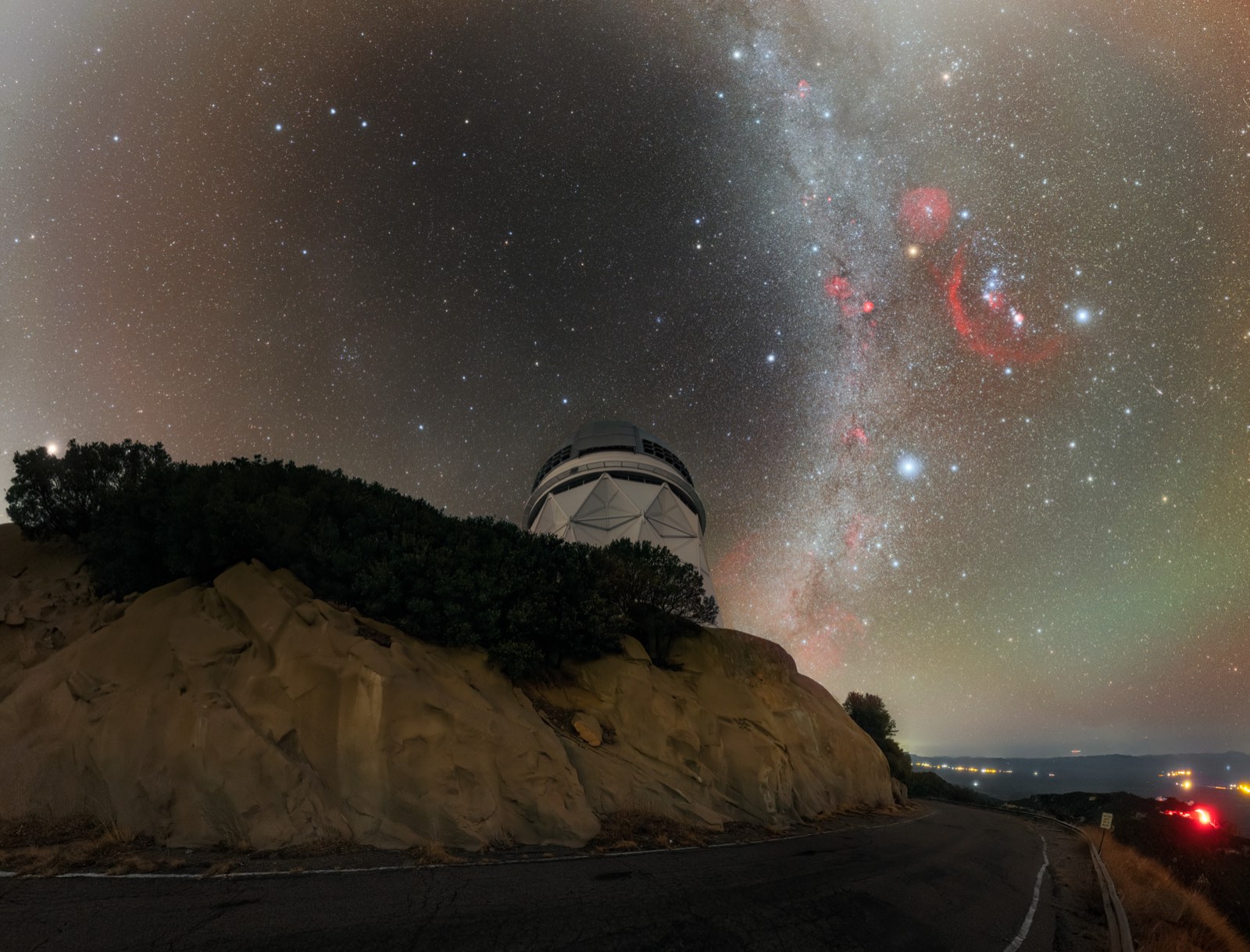
Dark energy may be weakening, according to the Dark Energy Spectroscopic Instrument, but the evidence is not yet decisive. DESI, on the Mayall 4-meter telescope at Kitt Peak, Arizona, uses 5,000 robotic fibers to map galaxies and quasars in 3D and measure the expansion history with baryon acoustic oscillations (the first detection of the baryon acoustic peak).
The results so far:
- April 2024 (first year): more than 6 million galaxies and quasars. Combined with the cosmic microwave background and supernovae, evolving dark energy was preferred at 2.5 to 3.9 sigma, depending on the supernova sample (DESI’s first-year results).
- March 2025 (three years): more than 14 million galaxies and quasars. Evolving dark energy was preferred at 3.1 sigma with the cosmic microwave background, and at 2.8 to 4.2 sigma when supernovae were added (DESI’s 2025 evolving dark energy result).
- Since then: a recalibration of Dark Energy Survey supernovae cut the strongest combination from 4.2 to 3.2 sigma, and DESI’s July 2026 Lyman-alpha analysis gave 2.7 sigma with the microwave background and 3.2 sigma with supernovae (DESI’s Lyman-alpha result).
None of these reaches the 5-sigma standard for a discovery. The full story, with the exact numbers and what would confirm or rule it out, is in our explainer is dark energy weakening?
How we measure dark energy
Cosmologists measure dark energy through its effect on how fast space expands and how fast structure grows. The four main methods:
- Type Ia supernovae. Standard candles that trace distance against redshift. The Dark Energy Survey’s five-year sample of 1,635 supernovae is the largest from a single survey (DES five-year supernova cosmology). Most were classified by a machine-learning algorithm from their light curves rather than by spectra, the approach the Rubin Observatory will need for the far larger sample it is about to collect.
- Baryon acoustic oscillations. A standard ruler from early-universe sound waves, measured by DESI and, from space, by Euclid.
- Weak gravitational lensing. Distorted galaxy shapes map how dark matter clumps over time, which dark energy slows down.
- Galaxy clusters. The number of massive clusters at each epoch depends on the balance between gravity and dark energy.
The next five years are crowded. DESI finished its planned five-year map in April 2026 with more than 47 million galaxies and quasars, and its full results are expected in 2027 (DESI completes its 3D map). Euclid, launched in 2023, releases its first cosmology results from mid-2027. The Vera C. Rubin Observatory began its ten-year Legacy Survey of Space and Time in mid-2026 (Rubin begins LSST), and NASA’s Roman Space Telescope launched on August 30, 2026.
What dark energy means for the end of the universe
Dark energy decides how the universe ends, so its exact nature matters for the far future:
- If it is constant, the universe expands forever, galaxies beyond our local group drift out of sight, and the cosmos fades toward a cold heat death (the Big Freeze).
- If it grows (phantom energy), expansion becomes violent enough to tear apart galaxies, stars and finally atoms in a Big Rip.
- If it weakens, as DESI hints, acceleration could slow or stop. If it fell far enough, or turned negative, expansion could even reverse into a Big Crunch, a possibility one 2025 preprint, not yet peer reviewed, explored.
Compare the three endings in Big Rip vs Big Crunch vs Big Freeze, read the future of the universe guide, and explore the timeline in Deep Time.
Dark energy vs dark matter
Dark energy and dark matter are different things. Dark matter is about 27% of the universe and pulls matter together through gravity, building galaxies; dark energy is about 68% and pushes the expansion to accelerate. See dark matter vs dark energy for the full comparison, and our dark matter guide.
For a short visual introduction, minutephysics’ “How Do We Know The Universe Is ACCELERATING?” and the World Science Festival panel “Is Dark Energy Decaying?” are in our video library.
Key papers
Where the research is happening