Dark matter vs dark energy
Dark matter pulls things together; dark energy pushes the universe apart. Together they are about 95% of the cosmos (27% and 68%, Planck 2018).
By The Orbital Record editorial teamPublished Last reviewed
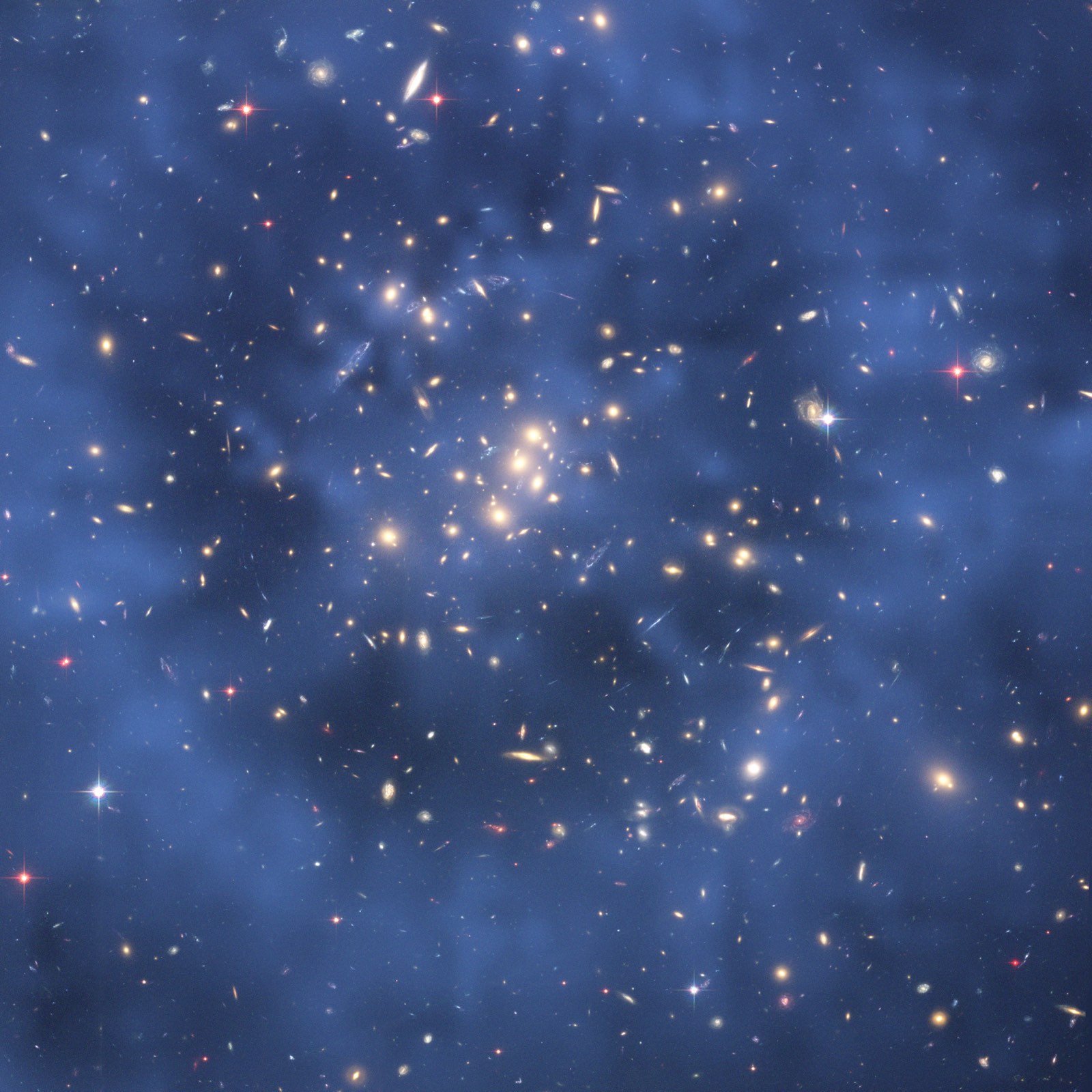
Dark matter and dark energy are opposites. Dark matter is invisible mass whose gravity pulls things together and holds galaxies in place; dark energy is whatever makes the expansion of the universe speed up. Together they make up about 95% of the universe: roughly 27% dark matter and 68% dark energy (Planck 2018).
Both are central to the standard model of cosmology, and both are named after what we cannot see. This explainer sits under our dark matter guide; for the other side, see the dark energy guide.
Dark matter vs dark energy at a glance
The quickest way to see the difference is side by side:
| Dark matter | Dark energy | |
|---|---|---|
| Share of the universe (Planck 2018) | About 27% (26.4%) | About 68% (68.5%) |
| What it does | Pulls: holds galaxies and clusters together | Pushes: makes cosmic expansion accelerate |
| Where it is | Clumped in halos around galaxies and clusters | Spread almost perfectly evenly through space |
| As the universe expands | Thins out as the volume grows | Stays nearly constant per cubic meter (if it is a cosmological constant) |
| First evidence | 1933, Fritz Zwicky, Coma Cluster | 1998, two supernova teams |
| How we detect it | Galaxy rotation, lensing, cluster motions, microwave background | Supernova distances, baryon acoustic oscillations, structure growth |
| Leading explanation | A new particle (WIMPs, axions and others) | Energy of empty space (the cosmological constant) |
| Latest twist (2025 to 2026) | LZ reports one unexplained event at 2.6 sigma | DESI hints it may be weakening |
What is dark matter?
Dark matter is matter that interacts through gravity but not with light. We see its effects at every scale: galaxies rotate too fast at their edges, clusters hold together despite fast-moving galaxies, and light from distant galaxies is bent by mass that does not shine.
Fritz Zwicky first inferred it in 1933 from galaxy speeds in the Coma Cluster (Zwicky’s 1933 Coma Cluster paper). Vera Rubin and Kent Ford’s 1970 measurements of Andromeda’s rotation made it hard to deny. The clearest single picture is the Bullet Cluster, where gravitational lensing shows most of the mass separated from most of the ordinary matter (the Bullet Cluster).
Dark matter behaves like ordinary matter in one key way: it clumps. That is why it is the scaffolding of the cosmic web, and why every large galaxy sits inside a dark halo many times its visible size.
What is dark energy?
Dark energy is the name for whatever is causing the expansion of the universe to accelerate. In 1998 two teams measuring distant exploding stars found the supernovae fainter, and so farther away, than expected in a universe whose expansion was slowing (the 1998 discovery of cosmic acceleration). Saul Perlmutter, Brian Schmidt and Adam Riess shared the 2011 Nobel Prize in Physics.
The simplest explanation is Einstein’s cosmological constant: a fixed energy carried by empty space itself. Because it belongs to space rather than to particles, it does not dilute as the universe expands. Each new cubic meter of space comes with the same amount.
That property is what makes it win in the end.
How do dark matter and dark energy change over time?
Dark matter dominated the universe’s past, and dark energy dominates its present and future. The reason is dilution:
- Early on, the universe was small and dense. Matter, mostly dark matter, was packed tightly and its gravity slowed the expansion.
- As space grew, matter thinned out: double the size of the universe and its density drops by a factor of eight.
- Dark energy did not thin out (or barely did). About 9 billion years after the Big Bang, roughly 5 billion years ago, it overtook matter, and the expansion began to accelerate.
- Today dark energy is about 68% of the total and growing in share, while matter’s share keeps falling.
Inside a galaxy or a cluster, nothing changes: dark matter’s gravity keeps those systems bound, and dark energy is far too weak to pull them apart, as long as it stays roughly constant.
Are they connected?
Probably not. In the standard Lambda-CDM model they are two independent ingredients, measured separately: dark matter mainly from galaxy dynamics and the peaks of the cosmic microwave background, dark energy from the expansion history. Speculative “unified dark sector” theories exist, but none fits the data better than treating them as separate.
There is one curiosity. Dark matter and dark energy have densities within a factor of about three of each other today, although they evolve very differently. Some physicists call this the “why now?” problem. It may be a coincidence of living at this particular time.
How do we study each one?
Several of the same surveys measure both, because both shape how structure grows and how space expands:
- Weak gravitational lensing maps dark matter directly and, by tracking how it grows over time, constrains dark energy. This is a core goal of ESA’s Euclid and the Vera C. Rubin Observatory.
- Baryon acoustic oscillations measure the expansion history, the main dark energy probe of the Dark Energy Spectroscopic Instrument (DESI).
- Underground detectors such as LZ hunt for dark matter particles. In September 2026 LZ reported a single event that known backgrounds struggle to explain, at 2.6 sigma, well short of a discovery (LZ’s single-event hint).
- Supernova surveys trace the expansion history. In 2025 DESI’s data, combined with supernovae and the cosmic microwave background, preferred a dark energy that changes over time at 2.8 to 4.2 sigma (DESI’s 2025 evolving dark energy result). See is dark energy weakening?
Why it matters
Dark matter decides how galaxies form, so without it there would be no Milky Way, no Sun and no us. Dark energy decides how the universe ends: a constant dark energy leads to a cold, ever-expanding future, while a changing one could lead to very different endings. Between them, they control both the history and the fate of the cosmos, and we cannot yet say what either one is.
If you prefer animation, Kurzgesagt’s “What is Dark Matter and Dark Energy?” in our video library covers both in a few minutes.
Questions people ask
What is the difference between dark matter and dark energy?
Dark matter is invisible mass that pulls through gravity and holds galaxies and clusters together. Dark energy is a property of space, or an unknown field, that makes the expansion of the universe speed up. Dark matter clumps around galaxies; dark energy is spread almost perfectly evenly. They are different phenomena with a shared word.
Are dark matter and dark energy the same thing?
No. They act in opposite ways: dark matter attracts and builds structure, dark energy drives the universe apart. They also behave differently as space expands. Dark matter thins out as the volume grows, while dark energy stays nearly constant per cubic meter. A few speculative theories try to unify them, but none is supported by data.
What percentage of the universe is dark matter and dark energy?
According to the Planck satellite's 2018 results, the universe's energy budget is about 68% dark energy, 27% dark matter and 5% ordinary matter. With decimals, Planck's numbers give roughly 68.5%, 26.4% and 4.9%. Everything we have ever seen with a telescope belongs to the last 5%.
Are dark matter and dark energy related?
As far as anyone can tell, no. In the standard model of cosmology they are independent ingredients with separate measured amounts. Their densities happen to be within a factor of a few of each other today, which some physicists find a suspicious coincidence, but there is no evidence of a physical link.
Which is stronger, dark matter or dark energy?
It depends on the scale and the era. Inside galaxies and clusters, dark matter's gravity wins and holds everything together. On the largest scales, dark energy has dominated the expansion for about the last five billion years. Earlier in cosmic history, matter, mostly dark matter, was in charge.
Why are they both called dark?
Both names signal ignorance rather than color. Dark matter is 'dark' because it does not emit, absorb or reflect any light. Dark energy borrowed the word in 1998, when cosmologist Michael Turner coined the term, to describe an equally invisible and unexplained ingredient. Neither is black; both are simply unidentified.