2025
Euclid Collaboration, Astronomy & Astrophysics, 697, A1, 2025
Euclid Mission Overview (2025): Mapping the Dark Universe
Described in 2025 ESA's Euclid, built to probe dark matter and dark energy over 14,000 square degrees. Mellier and the Euclid team set out the plan.
The Euclid mission overview, published in 2025 by the Euclid Collaboration, describes ESA’s space telescope for investigating dark matter and dark energy. Launched in 2023, Euclid is imaging about 14,000 square degrees of sky to trace how cosmic structure grew over roughly half the age of the universe.
What was Euclid built to answer?
The standard model of cosmology describes a wide range of measurements well, yet its two main ingredients remain unknown. Dark matter is invisible mass that holds galaxies together. Dark energy is whatever drives the accelerating expansion of the universe. Euclid was built to measure both, not directly, but through their effects on how matter clumps and how fast that clumping grows over cosmic time. It is a medium-class mission in ESA’s Cosmic Vision 2015-2025 program, part of the wider effort in telescopes and missions to pin down the dark universe.
What the paper describes
- Two kinds of data. High-resolution imaging in visible light, plus near-infrared imaging and spectroscopy, over about 14,000 square degrees of extragalactic sky, the parts of the sky away from the Milky Way’s glare.
- Two main probes. Weak gravitational lensing and galaxy clustering, which together trace the growth of structure over about half the age of the universe.
- The hardware. A 1.2-meter telescope feeding two instruments: VIS, a visible-light imager, and NISP, a near-infrared spectrometer and photometer.
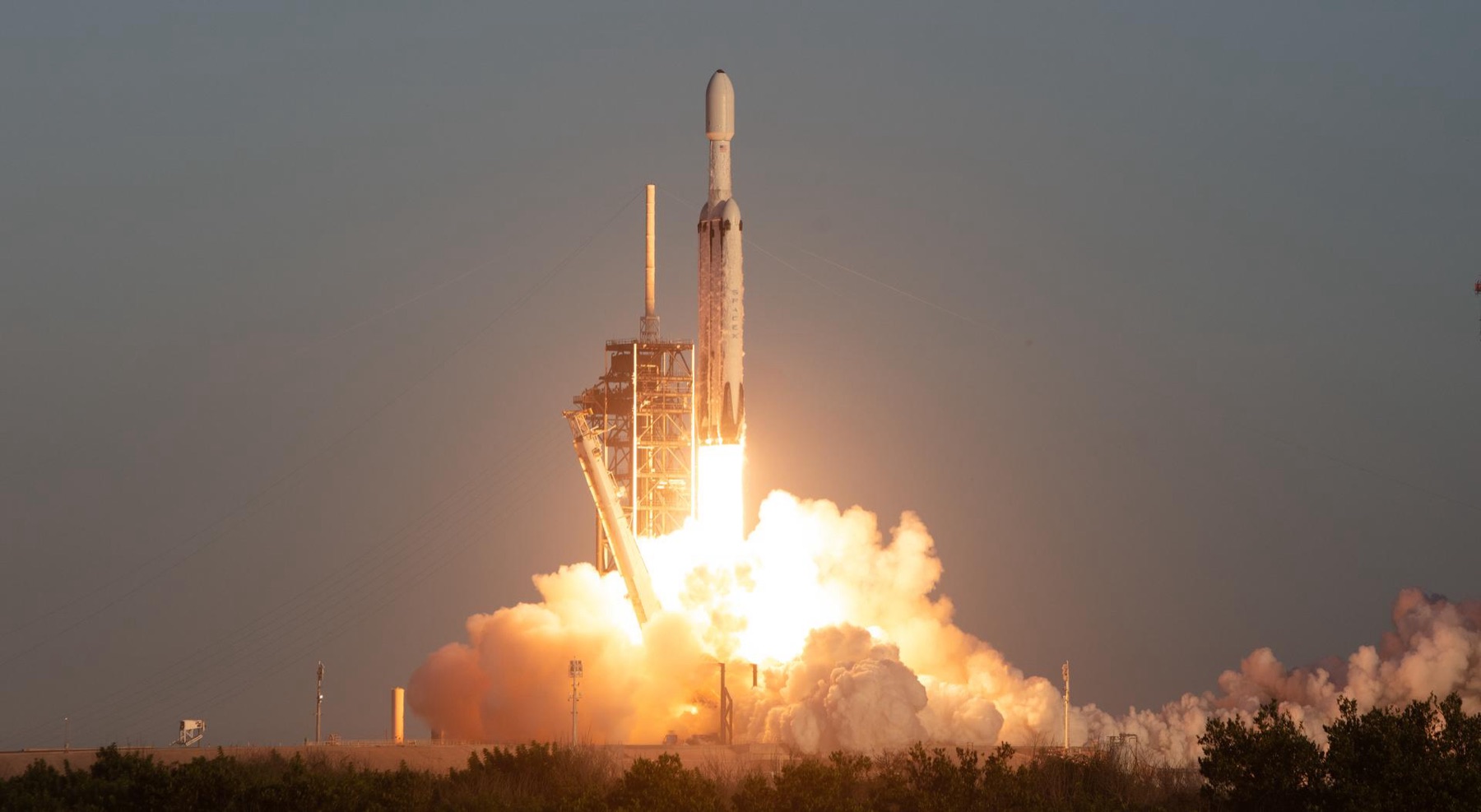
- Launch. Euclid launched on 1 July 2023 on a SpaceX Falcon 9 from Cape Canaveral.
- From pixels to science. The paper summarizes the survey design, the data-processing steps, the data products and the expected performance.
How it works
Weak lensing uses gravity as a lens. Mass between us and a distant galaxy bends its light and slightly distorts its shape. One galaxy’s distortion is too small to notice, but averaged over millions of galaxies the pattern maps where the mass, mostly dark matter, really is. Galaxy clustering uses spectra to place galaxies in three dimensions and measure how they bunch together. Both depend on how dark energy has stretched space, so comparing them across cosmic time tests what dark energy is.
Why it mattered
Euclid is designed to test whether dark energy changes over time, the possibility raised by DESI’s 2025 results, which preferred evolving dark energy at 3.1 sigma when combined with the cosmic microwave background. Lensing already revealed dark matter directly in the Bullet Cluster; Euclid scales the method from one cluster to more than a third of the sky. For the current state of that debate, see is dark energy weakening?
What we know now
Euclid’s first Quick Release (Q1), on 19 March 2025, covered 63.1 square degrees of deep fields with about 26 million galaxies and 500 strong-lens candidates. In July 2026 ESA reported 31 distant quasars from the Wide Survey, the most distant at redshift 7.77, about 670 million years after the Big Bang. As of October 2026, Euclid plans its first large data release, covering about 1,900 square degrees, in November 2026, with cosmology data products in mid-2027 and the survey ending in 2030.
Who wrote it
The paper is the first in a series from the Euclid Collaboration, led by Y. Mellier with Abdurro’uf and many others. It was posted to arXiv in May 2024 and published in 2025. Semantic Scholar lists about 400 citations (October 2026).
Read the original
Euclid Collaboration: Mellier, Y., Abdurro’uf, et al. (2025). “Euclid. I. Overview of the Euclid mission.” Astronomy & Astrophysics 697, A1. doi:10.1051/0004-6361/202450810
Free to read: arXiv preprint.
This week in papers
Five new results in one line each, plus one landmark like this one. Weekly.
Keep reading
Vera C. Rubin Observatory Team, The Astronomical Journal, 171, 360, 2026
Rubin Data Preview 1: The First Rubin Observatory Data
Described in 2026 Rubin Observatory's first data: 1,792 exposures over 15 square degrees, with 2.3 million objects and 93 new Solar System bodies.
Rigby et al., Publications of the Astronomical Society of the Pacific, 135, 048001, 2023
JWST's Science Performance: Better Than Expected
Measured in 2023 how the James Webb Space Telescope performed in commissioning. Jane Rigby's team found it better than expected almost across the board.
Ivezić et al., The Astrophysical Journal, 873, 111, 2019
Rubin's LSST: The Plan for a 10-Year Movie of the Sky
Described in 2019 the design of the Legacy Survey of Space and Time. Ivezić and colleagues planned Rubin's 10-year movie of the sky, begun in 2026.
Topic guide
Telescopes and missions
Recent news in telescopes and missions