Is dark energy weakening?
Maybe. DESI's 2025 data prefer a weakening dark energy at 2.8 to 4.2 sigma, depending on the supernovae used. Not a discovery yet: what would settle it.
By The Orbital Record editorial teamPublished Last reviewed
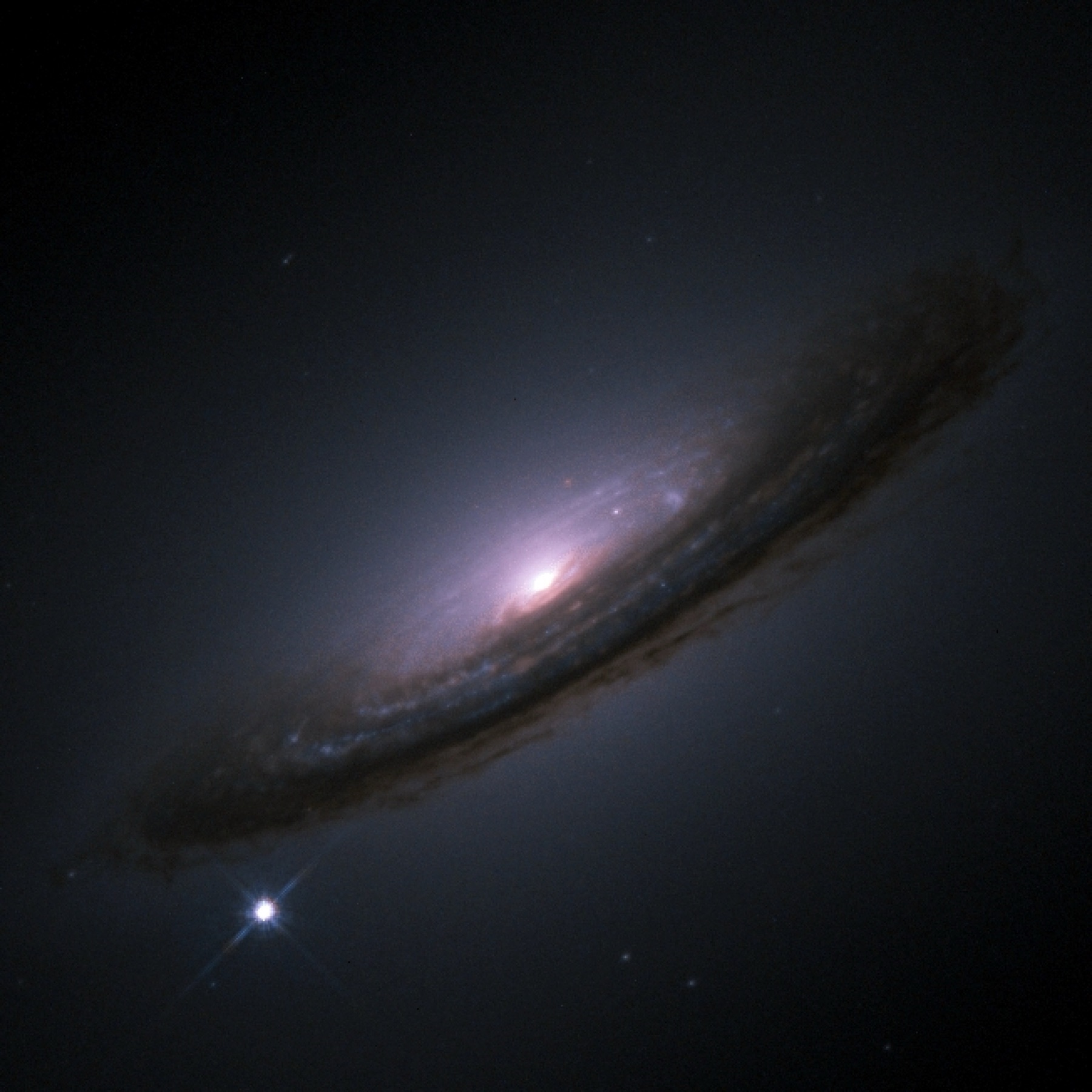
Dark energy may be weakening, but it is not confirmed. In March 2025 the Dark Energy Spectroscopic Instrument (DESI) reported that its data, combined with the cosmic microwave background and supernovae, prefer an evolving dark energy over a constant one at 2.8 to 4.2 sigma, depending on the supernova sample. A discovery requires 5 sigma.
It is the most important open result in dark energy research since the 1998 discovery of cosmic acceleration. This explainer gives the exact numbers, explains what “weakening” means, and lists what would confirm or kill the idea. As of October 2026, the question is open.
What does “weakening” mean?
Weakening means that the energy density of dark energy, the amount per cubic meter of space, is smaller today than it was a few billion years ago. In the standard model, dark energy is Einstein’s cosmological constant, which never changes. A weakening dark energy would be something else: probably a field that evolves with time.
Cosmologists describe this with the equation of state, w, the ratio of dark energy’s pressure to its density:
- w = -1 exactly: a cosmological constant. Density never changes.
- w above -1: density slowly falls as the universe expands (dark energy weakens).
- w below -1: density grows (“phantom” dark energy, which could end in a Big Rip).
Because w might change over time, DESI used a common two-number description. w0 is the value of w today. wa says how w has changed: a negative wa means w was lower in the past. DESI’s data prefer w0 above -1 and wa below 0, so the “evolving dark energy” model is often called w0waCDM.
Taken literally, the best fits say something stranger than simple fading. With DESI, the microwave background and Dark Energy Survey supernovae, the best fit is w0 = -0.752 and wa = -0.86. That curve sits below -1 in the past and crosses above it at a redshift of about 0.4, roughly 4 to 5 billion years ago (our calculation from the published values). So dark energy would have strengthened slightly, peaked, and then begun to weaken.
What did DESI find? The exact results
DESI, mounted on the 4-meter Mayall Telescope at Kitt Peak, Arizona, measures baryon acoustic oscillations: a frozen sound-wave pattern in the distribution of galaxies that works as a standard ruler for cosmic distances. On its own, the ruler maps the expansion history. Combined with other data, it can test whether dark energy changes.
First-year results (DR1, April 2024)
DESI’s first-year analysis used more than 6 million galaxies and quasars from redshift 0.1 to 4.2, with a blind analysis to avoid bias (DESI 2024 baryon acoustic oscillation cosmology). The preference for evolving dark energy was:
- 2.6 sigma for DESI plus the cosmic microwave background (CMB).
- 2.5, 3.5 and 3.9 sigma when supernovae were added, for the Pantheon+, Union3 and Dark Energy Survey five-year (DES-SN5YR) samples respectively.
Three-year results (DR2, March 2025)
DESI’s second data release, more than 14 million galaxies and quasars from three years of observing, was posted to arXiv on March 18, 2025, presented the next day, and published in Physical Review D on October 6, 2025 (DESI’s 2025 evolving dark energy result). Every number below comes from that paper:
| Data combination | Preference for evolving dark energy | w0 | wa |
|---|---|---|---|
| DESI BAO alone | 1.7 sigma | about -0.48 | below -1.34 |
| DESI + CMB | 3.1 sigma | -0.42 ± 0.21 | -1.75 ± 0.58 |
| DESI + CMB + Pantheon+ | 2.8 sigma | -0.838 ± 0.055 | about -0.62 |
| DESI + CMB + Union3 | 3.8 sigma | -0.667 ± 0.088 | about -1.09 |
| DESI + CMB + DES-SN5YR | 4.2 sigma | -0.752 ± 0.057 | about -0.86 |
Two details matter. First, DESI’s own data, taken alone, fit a constant dark energy fine; the preference appears when DESI is combined with other probes. Second, DESI and the CMB disagree mildly (2.3 sigma) on some parameters when a constant dark energy is assumed, and evolving dark energy is one way to resolve that.
“It’s looking more and more like we may need to modify our standard model of cosmology,” DESI co-spokesperson Will Percival said when the results were released.
What has happened since?
The signal has been tested, and so far it has bent but not broken:
- November 2025: Dark Energy Survey recalibration. A reanalysis of DES supernovae with improved calibration (the “DES-Dovekie” sample, a preprint led by B. Popovic) lowered the combined DESI + CMB + DES significance from 4.2 to 3.2 sigma, about 5-to-1 Bayesian odds, which the authors call a weak preference.
- May 2026: the full Dark Energy Survey. Combining all DES probes (a preprint) gave 2.2 sigma on its own, 2.3 sigma with DESI, and 3.0 sigma with the CMB. The authors read this as support for a weak preference for evolving dark energy, not a detection.
- July 2026: DESI’s Lyman-alpha full-shape analysis. A new DR2 analysis of hydrogen absorption in quasar light (a preprint) moved slightly back toward a constant: 2.7 sigma for DESI + CMB and 3.2 sigma with supernovae (DESI’s Lyman-alpha full-shape result).
The pattern: the hint persists at roughly 3 sigma across independent analyses, while the most dramatic number, 4.2 sigma, depended on one supernova calibration that has since been revised.
Why it is not a discovery yet
Physicists hold out for 5 sigma, and for good reasons here:
- It depends on the supernovae. The answer swings from 2.8 to 4.2 sigma just by changing the supernova sample, and one sample’s recalibration cut its result by a full sigma. That points to systematics, not statistics, as the limiting factor.
- Sigma ignores unknown errors. A 4 sigma result is unlikely by chance, but not unlikely if something in the data is slightly miscalibrated. The DESI collaboration itself has pointed out that many 3-sigma results in physics have faded away with more data.
- The two-number model is a convenience. w0 and wa are a simple way to let dark energy vary, not a physical theory. Some of the preference may reflect how the model and its priors are set up.
- It needs a crossing that simple theories avoid. The best fits cross w = -1, which the simplest evolving-field models (quintessence) cannot do.
What would confirm it, and what would kill it?
The test is coming quickly, because the surveys built to answer it are running now:
| Test | When | Confirms weakening if | Kills it if |
|---|---|---|---|
| DESI full five-year analysis (47+ million objects) | Expected 2027 | Preference grows toward 5 sigma | Results converge on w = -1 |
| Euclid DR1 cosmology (weak lensing, clustering) | Mid-2027 | Independent probe finds the same w0, wa | Euclid alone fits a constant |
| New supernova samples (Rubin LSST, Roman) | Late 2020s | All samples agree on the shift | The signal shrinks as calibration improves |
| CMB updates (ACT, SPT, future experiments) | Ongoing | The DESI-CMB mismatch persists | The mismatch disappears |
DESI finished its planned five-year map ahead of schedule on April 14, 2026, with more than 47 million galaxies and quasars (DESI completes its 3D map). Euclid began its survey in 2023, the Vera C. Rubin Observatory started its ten-year survey in mid-2026, and NASA’s Roman Space Telescope launched on August 30, 2026 (Roman’s launch).
What would it mean for the universe?
If dark energy is a cosmological constant, the universe expands forever toward a cold, dark heat death. A weakening dark energy changes the forecast:
- No Big Rip. That scenario needs w below -1 in the future (the Big Rip paper); DESI’s fits point the other way.
- A less certain future. If dark energy keeps falling, the acceleration could stop. In some models it could even reverse, ending in a Big Crunch. A 2025 preprint by Hoang Nhan Luu, Yu-Cheng Qiu and Henry Tye, not yet peer reviewed, fitted such a model and found a total lifespan of about 33 billion years, with collapse about 20 billion years from now. That result depends heavily on its assumptions.
Compare the scenarios in Big Rip vs Big Crunch vs Big Freeze, and see where they fall on the cosmic timeline in Deep Time. For a discussion with the scientists involved, the World Science Festival’s “Is Dark Energy Decaying?” is in our video library.
Questions people ask
Is dark energy weakening?
Possibly, but it is not established. In March 2025 the Dark Energy Spectroscopic Instrument (DESI) reported that its data, combined with the cosmic microwave background and supernovae, prefer a dark energy that weakens over time at 2.8 to 4.2 sigma. Physicists require 5 sigma for a discovery, and later reanalyses have trimmed the signal.
Has DESI proven that dark energy is changing?
No. DESI's results are a preference, not proof. The strength of the evidence depends on which supernova sample is combined with DESI, ranging from 2.8 to 4.2 sigma, and none reaches 5 sigma. DESI's baryon acoustic oscillation data on their own are consistent with a constant dark energy.
What do w0 and wa mean?
They describe dark energy's equation of state, w, the ratio of its pressure to its energy density. A cosmological constant has w equal to minus 1 at all times. In the common two-number description, w0 is the value today and wa measures how much w has changed over cosmic history. DESI prefers w0 above minus 1 and wa below zero.
What does 4.2 sigma mean?
Sigma measures how unlikely a result would be if the simplest explanation, here a constant dark energy, were true. A 4.2 sigma result would arise by chance about 1 time in 37,000 in the ideal case. But sigma only covers known statistical errors, not hidden systematic problems in the data, which is why physicists wait for 5 sigma.
What would confirm that dark energy is weakening?
Confirmation would need the signal to reach 5 sigma and to appear in independent data. The key tests are DESI's full five-year results expected in 2027, Euclid's cosmology results expected from mid-2027, and new supernova samples from the Rubin Observatory and the Roman Space Telescope, all pointing the same way.
If dark energy is weakening, will the universe end in a Big Crunch?
Not necessarily. A weakening dark energy rules out the Big Rip and makes the future less certain. Whether expansion ever reverses depends on how far dark energy falls. One 2025 preprint, not yet peer reviewed, fitted a model in which the universe collapses about 20 billion years from now, but this is highly model-dependent.
Why do different supernova samples give different answers?
Supernova samples differ in which telescopes found them, how their brightness was calibrated and how nearby and distant events were tied together. Small calibration differences shift the inferred distances slightly, and that is enough to move the dark energy result. A 2025 recalibration of the Dark Energy Survey sample lowered its signal from 4.2 to 3.2 sigma.