Heat death of the universe
The heat death of the universe is a slow fade into cold, even darkness. What it means, the timeline to 10100 years, and whether it is inevitable.
By The Orbital Record editorial teamPublished Last reviewed
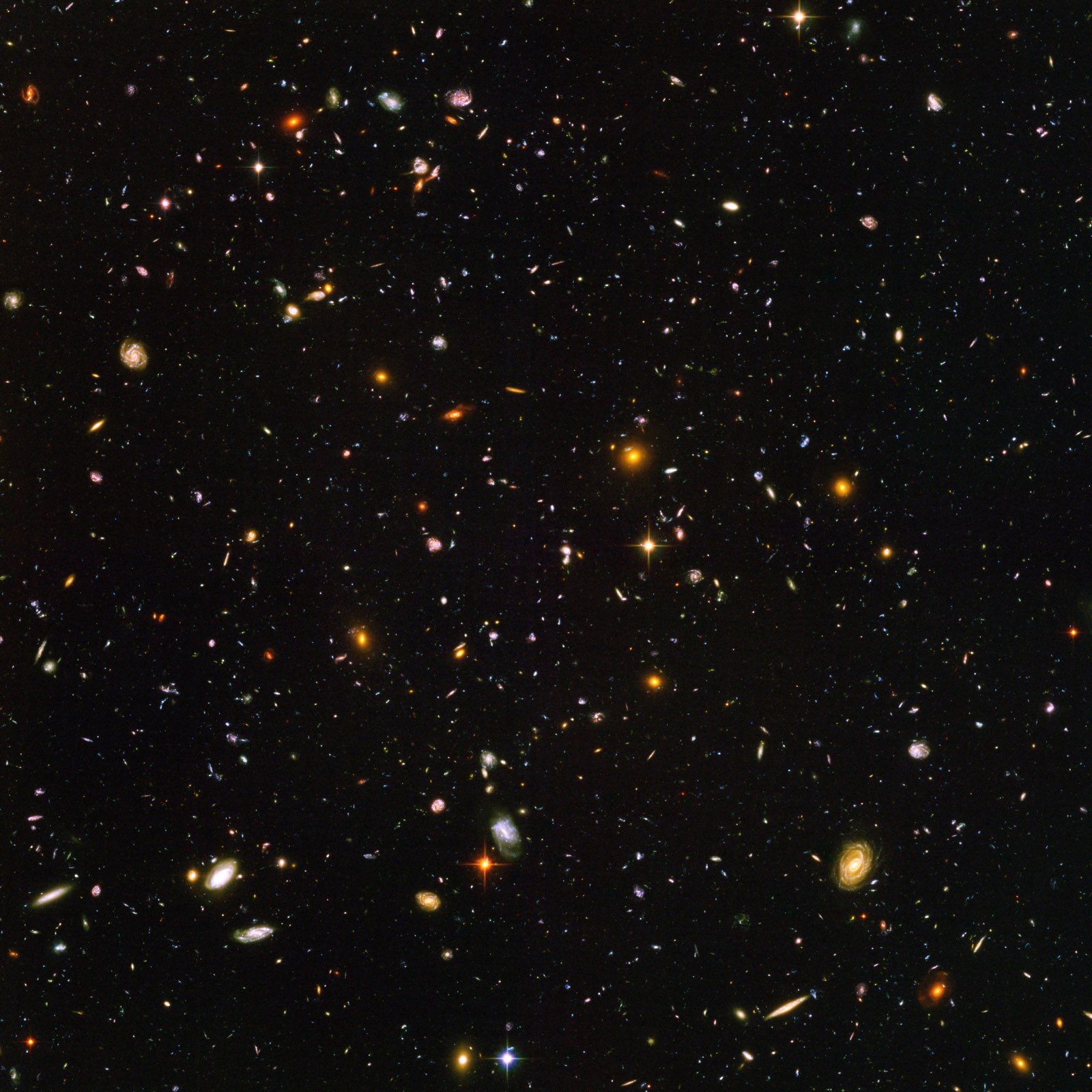
The heat death of the universe is the end state of a universe that expands forever: the stars burn out, black holes evaporate, and everything settles at nearly the same, almost absolute-zero temperature, so no energy can flow and nothing more can happen. In the standard model it unfolds over about 10100 years.
It is the leading scenario in our guide to the future of the universe, and it is not a sudden event. It is a slow running down, spread over more powers of ten in time than the universe has lived so far.
What is the heat death of the universe?
The idea is older than modern cosmology. In the 1850s and 1860s, as the second law of thermodynamics took shape, Hermann von Helmholtz and Rudolf Clausius realized that if entropy (roughly, the amount of disorder or spread-out energy) always increases, the universe should eventually reach equilibrium: one uniform temperature everywhere. Engines need heat to flow from hot to cold. With no temperature differences left, no work can be done.
Modern cosmology changed the picture in a way Fred Adams and Gregory Laughlin spelled out in their 1997 review, “A dying universe”. An expanding universe never reaches a single equilibrium temperature, because expansion keeps cooling it. So the classical heat death is avoided on a technicality. What remains is what they call cosmological heat death: a universe that still exists, but in which every process that produced energy and entropy has run its course.
Why the universe is heading there
Two measured facts point to heat death:
- The expansion is accelerating. The 1998 discovery of cosmic acceleration showed that dark energy is pushing galaxies apart faster over time. As long as it does, gravity cannot pull the universe back together.
- Usable energy is finite and being spent. Stars convert hydrogen into heavier elements and radiation. Once galaxies run out of gas and the last red dwarfs fade, the main power source of the universe is gone.
The current best fit to all cosmological data, the ΛCDM model with a cosmological constant, leads straight to heat death. Combining Planck data with supernovae gives a dark energy equation of state of w = −1.03 ± 0.03, consistent with a constant (Planck 2018).
Heat death timeline
The heat death timeline below follows the eras of Adams and Laughlin, with later corrections. Times are after the Big Bang.
| Time | Milestone | Era |
|---|---|---|
| 13.8 billion years | Today: stars still forming, past their peak | Stelliferous |
| 1 to 10 trillion years | Galaxies run out of gas for new stars | Stelliferous |
| About 12 trillion years | The smallest red dwarfs burn out (Adams, Laughlin and Graves 2004) | Stelliferous |
| 1014 years | Normal star formation ends | End of Stelliferous |
| About 1019 to 1020 years | Galaxies evaporate, flinging out dead stars | Degenerate |
| More than 1034 years | Protons may decay, if they decay at all | Degenerate |
| About 1067 years | Black holes of one solar mass evaporate | Black Hole |
| About 10100 years | The largest black holes evaporate | End of Black Hole |
| Beyond 10100 years | Only photons, neutrinos, electrons and positrons remain | Dark |
The Deep Time explorer walks through the same milestones on a logarithmic scale.
How cold does it get?
The universe today has a background temperature of 2.725 kelvin, the glow of the cosmic microwave background (Fixsen 2009). Expansion stretches that light and cools it in proportion to how much space grows. Once a cosmological constant fully dominates, space grows by a factor of e (about 2.7) roughly every 17.5 billion years, so the background temperature falls exponentially.
It does not fall to absolute zero. A universe with a cosmological constant has a horizon, the distance beyond which light can never reach us, and in 1977 Gary Gibbons and Stephen Hawking showed that such a horizon has a temperature, much as a black hole does. Here is the estimate, using Planck’s numbers:
- Late-time expansion rate: H = H0 × √ΩΛ = 67.4 × √0.685 ≈ 55.8 km/s per megaparsec, or 1.81 × 10⁻¹⁸ per second.
- Horizon temperature: T = ħH / (2πkB) = (1.055 × 10-34 × 1.81 × 10-18) / (2π × 1.381 × 10-23) ≈ 2 × 10-30 kelvin.
That is the floor: about 2 × 10-30 kelvin, roughly 1030 times colder than today’s background.
When does heat death “happen”?
There is no single moment. A useful way to think about it is in three stages:
- The lights go out (around 1014 years). No new stars form, and starlight no longer powers anything.
- The remnants decay (1014 to 10100 years). White dwarfs cool to black dwarfs, galaxies dissolve, and black holes become the last energy sources. They cannot even start shrinking until the background radiation is colder than they are; for a solar-mass black hole, whose Hawking temperature is about 6 × 10⁻⁸ kelvin, our estimate from the cooling rate above is a few hundred billion years. Then they evaporate, the smallest first (Hawking 1974).
- The Dark Era (after about 10100 years). Adams and Laughlin found that energy and entropy keep being produced until about 10100 years, so cosmological heat death is postponed until then. After that, the universe can become, in effect, inert.
Is heat death inevitable?
It is the most likely outcome, not a proven one. Three things could change it:
- Dark energy might not be constant. DESI’s 2025 results prefer dark energy that changes with time, at 2.8 to 4.2 sigma, short of the 5-sigma discovery threshold. Weakening dark energy still usually leads to heat death; only dark energy that turns negative would cause a recollapse. See Big Rip vs Big Crunch vs Big Freeze.
- The vacuum might be unstable. Vacuum decay would end things differently, at any time, though almost certainly not soon.
- Unknown physics at extremely low energies. Adams and Laughlin flagged this themselves: our predictions assume today’s laws hold over 100 powers of ten in time.
There is also a meme that the heat death will happen in 2036. It has no basis in any published physics.
Why it is still far away
Even if heat death is certain, the universe is at the very start of the process. At 13.8 billion years, it is about 0.014% of the way through the age of stars alone. If you want the arithmetic, read is the universe young? Dr. Becky’s video on whether heat death is inevitable, and PBS Space Time’s “How Will the Universe End?”, are in our video library.
Questions people ask
What is the heat death of the universe?
It is the state an ever-expanding universe approaches when no usable energy is left: stars have burned out, black holes have evaporated, and everything sits at nearly the same extremely low temperature. Without temperature differences, no engine, chemistry or life can run. It is also called the Big Freeze.
When will the heat death of the universe happen?
Gradually, not on a date. Star formation should end around 1014 years after the Big Bang, and the largest black holes should finish evaporating around 10100 years. The universe then enters the Dark Era, the closest thing to a completed heat death, and stays there.
Is the heat death of the universe inevitable?
It is the leading forecast, not a certainty. It assumes dark energy stays constant or fades gently. If dark energy grows, the universe ends sooner in a Big Rip; if it turns negative, it recollapses. Vacuum decay or new physics could also change the ending.
Does heat death mean the universe gets hot?
No. The name comes from 19th-century thermodynamics, where heat death meant all heat evenly spread so none could flow. In an expanding universe that even state is extremely cold, approaching a floor of about 10−30 kelvin set by the cosmic horizon.
Is the heat death the same as the Big Freeze?
Mostly, yes. Big Freeze describes the cooling of an ever-expanding universe, and heat death describes the end state where no useful energy remains. In the standard model of cosmology the first leads to the second, so most sources use the terms interchangeably.