Vacuum decay
Vacuum decay could end the universe as we know it: a bubble of lower-energy vacuum spreading at light speed. How it works, and how unlikely it is.
By The Orbital Record editorial teamPublished Last reviewed
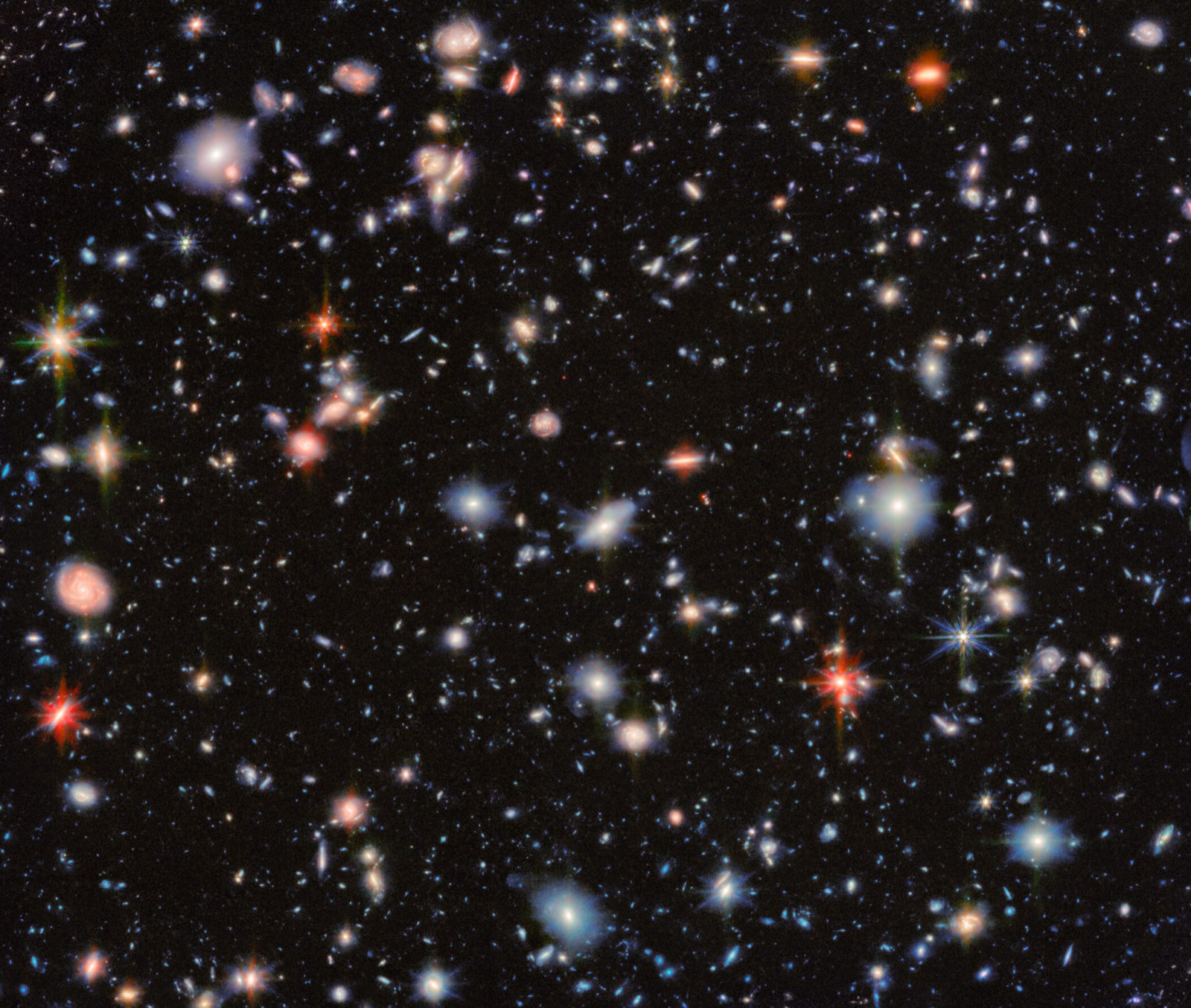
Vacuum decay is a hypothetical event in which empty space drops from its current energy state into a lower one. It would start as a microscopic bubble of “true vacuum” and expand at nearly the speed of light, rewriting particle physics inside it. It could in principle happen at any moment, but calculations put the expected wait far beyond 10100 years.
Unlike the other endings in our guide to the future of the universe, vacuum decay does not depend on dark energy or on stars burning out. It depends on the shape of the Higgs field’s energy landscape.
What is a false vacuum?
In physics, the vacuum is not “nothing”. It is the lowest-energy state of all the fields that fill space, including the Higgs field, which gives particles such as electrons and quarks their masses.
Picture a ball rolling in a landscape of hills and valleys. The ball settles in a valley. If that valley is the deepest one, the ball is in the true vacuum and stays there forever. If there is a deeper valley somewhere else, the ball is in a false vacuum: stable for now, but not for good. Classically it would stay put. Quantum mechanics lets it tunnel through the hill.
Michael Turner and Frank Wilczek asked in 1982, in Nature, whether our own vacuum might be metastable, long-lived but not permanent. Fred Adams and Gregory Laughlin included the possibility in their 1997 survey of the far future, “A dying universe”, as one of the most dramatic processes that could change the universe.
How vacuum decay would work
- A bubble nucleates. Somewhere, by pure chance, a tiny region of space tunnels into the true vacuum.
- The bubble grows. If it is larger than a critical size, the energy released drives its wall outward, quickly approaching the speed of light.
- Physics changes inside. In the new vacuum, the Higgs field has a different value, so particles have different masses and forces behave differently. Atoms, chemistry and life as we know them could not exist.
- Gravity may finish the job. In 1980 Sidney Coleman and Frank De Luccia worked out the gravitational effects of vacuum decay. If the true vacuum has negative energy, the interior of the bubble collapses on itself in a short time.
Because the wall moves at almost the speed of light, no warning could reach us before it did.
Is our vacuum metastable?
Possibly, and the reason is two measured numbers. Since the discovery of the Higgs boson in 2012, its mass is known to be about 125 GeV, and the top quark, the heaviest known particle, weighs about 173 GeV. Feeding these into the Standard Model and running the equations up to very high energies, the Higgs potential bends down: there is a deeper valley than ours.
With current values, our vacuum sits in the metastable zone. It is not unstable enough to have decayed already, and not stable enough to last forever. The top quark mass matters most: small changes in it move the result significantly.
The big assumption is that no new particles or forces appear between the energies we have tested and the Planck scale, where quantum gravity takes over. Dark matter, for instance, is not part of the Standard Model, and new physics could make the vacuum fully stable or less stable.
How long would it take?
Tunneling is random, so physicists compute a decay rate and turn it into an expected waiting time. Published Standard Model estimates:
| Study | Result | Notes |
|---|---|---|
| Andreassen, Frost and Schwartz (2018), Phys. Rev. D | Lifetime of about 10139 years; with 95% confidence, more than 1058 years | Billed as the first complete calculation |
| Baratella, Nemevšek, Shoji, Trailović and Ubaldi (2025), Phys. Rev. Lett. | Decay rate about 10-781 per billion years per cubic gigaparsec, about 10790 years in the Jožef Stefan Institute’s summary | Corrects a counting error; makes decay slightly more likely than before |
| Adams and Laughlin (1997) | Toy model: anywhere from very soon to 1010,000 years | Illustrates how uncertain the answer is without the measured potential |
The spread between estimates, hundreds of powers of ten, shows how sensitive the answer is to inputs and methods. What all of them agree on is that the expected wait is enormously longer than the 13.8 billion years the universe has existed.
Can the universe end at any moment?
Technically yes, practically no. A quantum process with a lifetime of 10139 years has no schedule: it is as likely to happen tomorrow as in any other single day of the same length. But the probability for any given day is so small that, over a human lifetime, it is effectively zero.
Accelerating expansion also helps. Because dark energy is pushing distant galaxies away faster over time, the universe has an event horizon: regions beyond it can never send us a signal. A bubble that forms beyond that horizon can never reach us, no matter how long we wait.
Could we trigger it?
No. In 1983 Piet Hut and Martin Rees showed that cosmic rays have been smashing into matter at energies far above those of any accelerator for billions of years, all over the universe. If collisions like these could set off vacuum decay, the universe would not be here.
How vacuum decay compares with the other endings
| Ending | Trigger | Warning | Typical timescale |
|---|---|---|---|
| Heat death | Expansion continues, energy runs out | Trillions of years of slow fading | 1014 to 10100 years |
| Big Rip | Dark energy grows | Galaxies rip first | Tens of billions of years, if at all |
| Big Crunch | Dark energy turns negative | Expansion slows and reverses | Tens of billions of years, if at all |
| Vacuum decay | Quantum tunneling of the Higgs field | None | Random; expected far beyond 10100 years |
For the dark energy endings side by side, see Big Rip vs Big Crunch vs Big Freeze. Katie Mack’s Perimeter Institute public lecture on how the universe ends, which walks through what each ending would look like, is in our video library.
Why it matters now
Vacuum decay is a reminder that the long timeline in our Deep Time explorer carries a silent footnote: it assumes the laws of physics stay the same. Measuring the top quark and Higgs masses more precisely, at the LHC and future colliders, is the most direct way to sharpen the answer.
Questions people ask
What is vacuum decay?
Vacuum decay is a hypothetical transition of empty space from a higher-energy state, a false vacuum, to a lower-energy true vacuum. It would start as a tiny bubble formed by quantum tunneling and grow at nearly the speed of light, changing the properties of particles inside it and ending physics as we know it.
Can vacuum decay happen at any moment?
In principle, yes: tunneling is random, so a bubble could form at any time. In practice, Standard Model calculations put the expected wait far beyond the age of the universe, with central estimates from about 10139 to 10790 years. The chance of it happening in your lifetime is effectively zero.
Would we see vacuum decay coming?
No. The bubble wall would move at nearly the speed of light, so no light signal could outrun it to warn us. Anything inside its path would be overtaken almost instantly. Because the universe's expansion is accelerating, bubbles that form far enough away could never reach us at all.
Is our universe in a false vacuum?
Possibly. If the Standard Model of particle physics holds up to very high energies, the measured masses of the Higgs boson and top quark place our vacuum in a metastable state, long-lived but not the lowest possible. Undiscovered particles or forces could make it fully stable, or less stable.
Could a particle collider trigger vacuum decay?
No. In 1983 Piet Hut and Martin Rees pointed out that cosmic rays have been colliding with matter at energies far above any accelerator's for billions of years. If such collisions could trigger vacuum decay, it would have happened long ago.