Webb Shows How Giant Planet WD 1856 b Survived the Death of Its Star
A Jupiter-sized planet seven times wider than its white dwarf likely survived the red giant phase far out, then moved inward billions of years later.
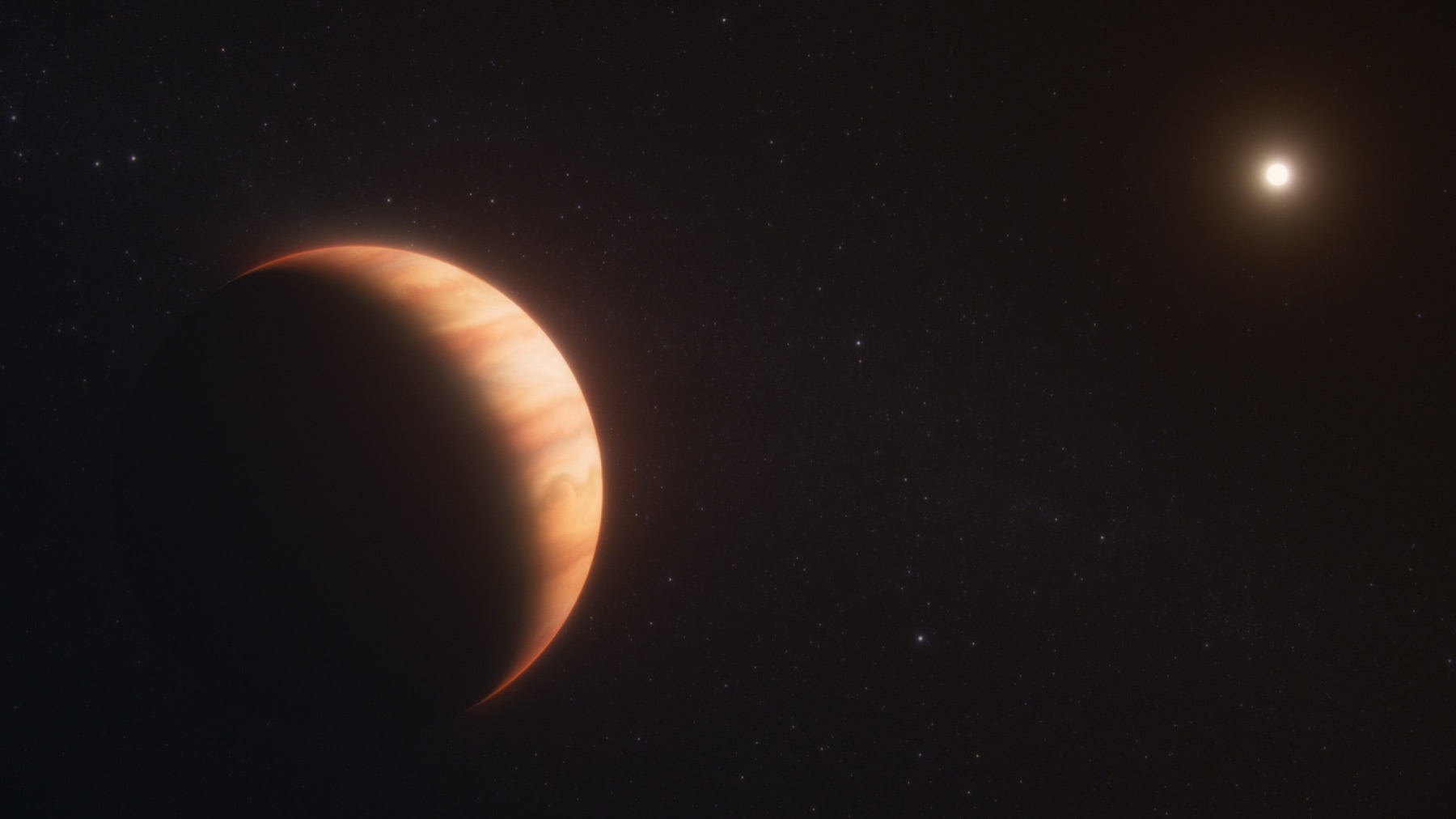
The James Webb Space Telescope has helped explain how WD 1856 b, a giant planet orbiting a dead star, survived that star’s death. The study, led by Ryan MacDonald of the University of St Andrews, was published in Nature on July 1, 2026, and ESA/Webb announced it the same day.
WD 1856 b orbits the white dwarf WD 1856+534, about 80 light-years away, every 34 hours, at less than 3 million km. That is about 50 times closer than Earth is to the Sun. The planet is Jupiter-sized while its white dwarf is about the size of Earth, so the planet is roughly seven times wider than its star.
Webb watched the planet pass in front of the star and measured a mass between four and eleven times Jupiter’s and a temperature of about 126 °C, hotter than the white dwarf’s light alone can explain. The extra warmth is leftover heat. Modeling it shows the planet was most likely heated 3 to 5.5 billion years after the star became a white dwarf. That favors a scenario in which the planet survived the star’s red giant phase on a wide orbit and migrated inward much later, probably nudged by companion stars in this triple system.
This is a preview of what may happen to giant planets like Jupiter after the Sun becomes a white dwarf. Models suggest the red giant Sun will engulf Earth, but planets farther out may survive. For another planet around a white dwarf, see the candidate second-generation planet at HS 0209+0832. More in our future of the universe guide and exoplanets guide.
What to watch next: more Webb observations of planets around white dwarfs will show whether late migration like this is common.
Primary source
This summary is based on ESA/Webb and the peer-reviewed paper. Read the original for full details, data and caveats.
This week in papers
The week's most important results, one line each, every week.