Webb Finds Water and Fresh Dust Around a Dying Star Near Sgr A*
Webb's MIRI detected water and oxygen-rich dust around IRS 3, an aging star just 0.55 light-years from the Milky Way's central black hole.
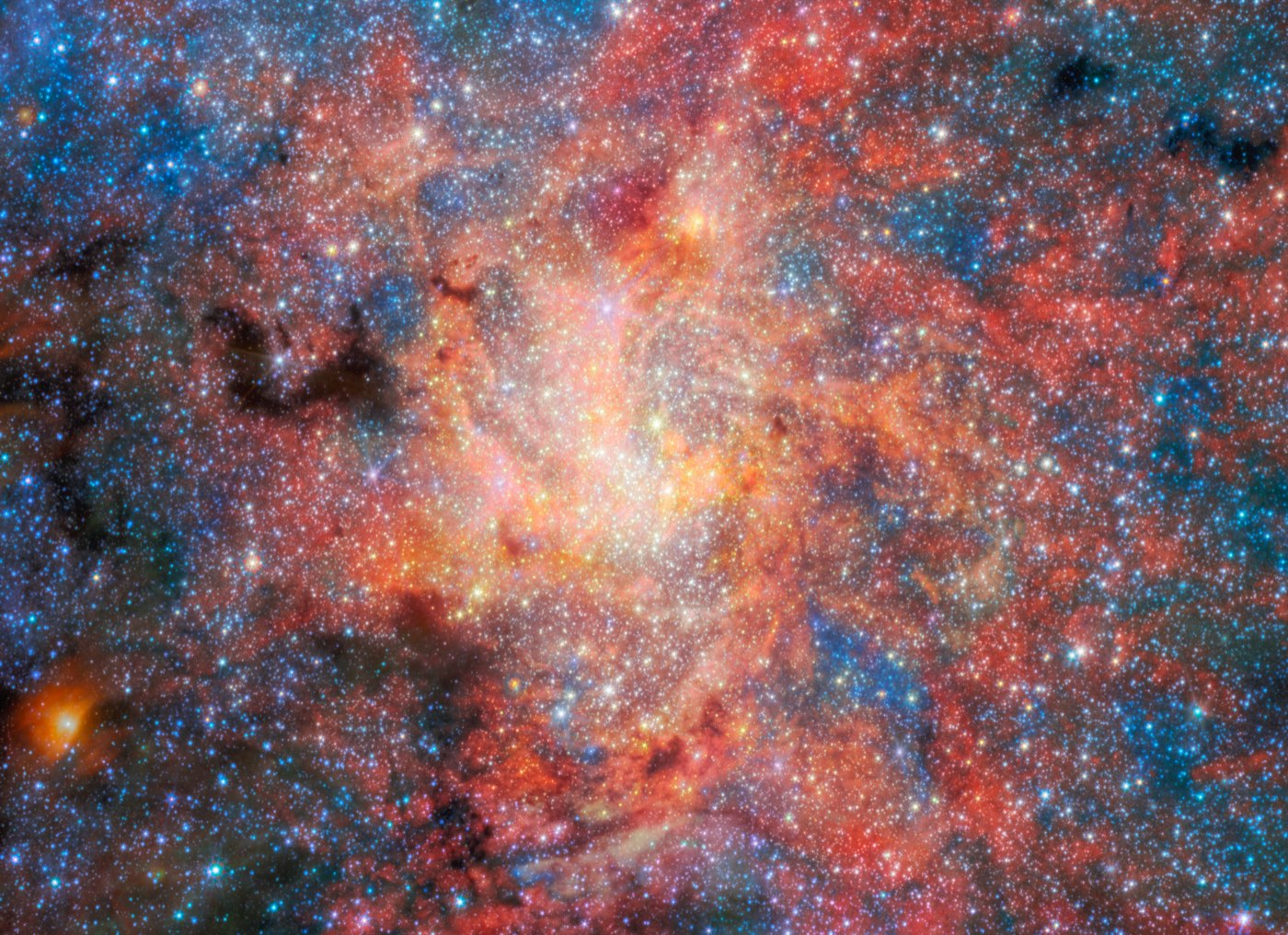
The James Webb Space Telescope has found water and freshly made dust around IRS 3, an aging star just 0.55 light-years from Sagittarius A*, the supermassive black hole at the center of the Milky Way. The study, led by Florian Peißker of the University of Cologne, was published in Astronomy & Astrophysics, and ESA/Webb announced it on August 11, 2026.
IRS 3 is on the asymptotic giant branch, a late stage of life when stars shed large amounts of gas and dust into space. Webb’s MIRI instrument took the first continuous mid-infrared spectrum of the star. It shows oxygen-rich silicate dust and, for the first time, water in the star’s outer envelope. That settles a question about its chemistry: earlier work had suggested IRS 3 was carbon-rich, and the new data show it is oxygen-rich instead.
The setting is extreme. The region around Sagittarius A* is crowded with stars and swept by intense radiation and strong tides; the black hole’s mass of about four million Suns was measured from stars racing around it, including the recently found fastest known star, S301. Finding dust production surviving so close means galactic centers can still supply raw material for new stars and planets. This is one star, so it shows the process can happen there, not how much dust the center makes overall. More in our guide to galaxies and black holes guide.
What to watch next: similar spectra of other evolved stars near the center would show whether IRS 3 is typical.
Primary source
This summary is based on ESA/Webb and the peer-reviewed paper. Read the original for full details, data and caveats.
This week in papers
The week's most important results, one line each, every week.