Cosmology is the study of the origin, structure and evolution of the universe as a whole. The Big Bang theory says the universe expanded from a hot, dense state about 13.8 billion years ago, everywhere at once rather than from one point. Three pillars of evidence support it: cosmic expansion, the cosmic microwave background and the light elements.
This guide is the map. Each section answers one big question in plain words and points to the deeper explainers, the original papers and the latest results.
What is the Big Bang theory?
The Big Bang theory is the scientific account of how the universe evolved from an extremely hot, dense early state into the cool, structured cosmos we see today. It is the best-tested idea in cosmology, but it is often described wrongly.
It was not an explosion in space. There was no center and no outside. Every region of space was hot and dense, and every region has been stretching apart since. The galaxies are not flying through space away from a blast point; the space between them is growing.
It is also not a theory of “time zero”. The theory describes what happened after the first tiny fraction of a second, and it works extremely well from there. What happened at the very beginning, or whether “beginning” is even the right word, is outside what it can tell us today.
The idea came in steps. In 1922 Alexander Friedmann showed that Einstein’s equations allow a universe whose size changes with time (Friedmann’s 1922 paper). Einstein had completed general relativity in 1915 (Einstein’s 1915 field equations), and in 1917 he added a “cosmological constant” precisely to keep the universe static (Einstein’s 1917 cosmology paper). In 1927 Georges Lemaître went further and connected an expanding universe to the measured redshifts of galaxies.
How old is the universe?
The universe is about 13.8 billion years old. The most precise value, 13.787 billion years with an uncertainty of 20 million years, comes from the Planck satellite’s 2018 analysis of the cosmic microwave background.
There are two independent ways to reach that number. The first runs the expansion backwards: measure what the universe contains and how fast it expands, and compute how long it took to get here. The second dates the oldest stars, which cannot be older than the universe that made them. The oldest globular star clusters come out at about 13.4 billion years, which fits comfortably. The full story, including why you still see “13.7” and why a 2023 claim of 26.7 billion years is not accepted, is in our explainer on the age of the universe.
The evidence for the Big Bang
Four independent lines of evidence point to the same hot, expanding history:
- The expanding universe. Galaxies recede faster the farther away they are.
- The cosmic microwave background. The whole sky glows with leftover heat from the early universe.
- Big Bang nucleosynthesis. The oldest gas is about three quarters hydrogen and one quarter helium by mass, exactly as predicted.
- Large-scale structure. The pattern of galaxies across billions of light-years still carries the imprint of sound waves from the young universe.
The expanding universe
Lemaître derived an expansion rate of about 625 kilometers per second per megaparsec in his 1927 paper (Lemaître’s 1927 expanding universe), published in French in a little-read Belgian journal. Two years later Edwin Hubble combined distances to 24 galaxies with their velocities and found a roughly linear relation (Hubble’s law of 1929). His value was about seven times too large because his distance scale was off, but the relation was right. In 2018 the International Astronomical Union recommended calling it the Hubble-Lemaître law. Both men stood on the work of Henrietta Leavitt, whose 1912 law for Cepheid variable stars (Leavitt’s period-luminosity relation) made distances to other galaxies measurable.
The cosmic microwave background
In 1965 Arno Penzias and Robert Wilson found an unexplained 3.5-kelvin hiss in a Bell Labs antenna that came equally from every direction (the discovery of the cosmic microwave background). A group at Princeton, writing in the same journal issue, identified it as cooled radiation from the hot early universe. Penzias and Wilson shared the 1978 Nobel Prize in Physics.
Three satellites turned that hiss into precision science. NASA’s COBE showed in 1990 that its spectrum is an almost perfect blackbody (COBE’s blackbody measurement) and in 1992 found ripples of about one part in 100,000 (COBE’s first anisotropy maps); John Mather and George Smoot shared the 2006 Nobel Prize. WMAP fixed the age at 13.7 billion years in 2003, and ESA’s Planck sharpened every number. The modern temperature is 2.725 kelvin (2.72548 ± 0.00057 K, Fixsen 2009).
Big Bang nucleosynthesis
In 1948 Ralph Alpher and George Gamow argued that light elements were forged in the first minutes after the Big Bang (the alpha-beta-gamma paper). The test is the helium fraction in nearly pristine gas. In September 2026 the LBT Yp Project reported a primordial helium mass fraction of 0.2458 ± 0.0013, matching the prediction from Planck’s data (0.2467) to within its 0.5% precision (the most precise primordial helium measurement). Physics from about one second after the Big Bang agrees with physics from 380,000 years later.
Large-scale structure and baryon acoustic oscillations
Sound waves rippled through the hot plasma of the young universe and froze when it became transparent. That frozen ring, about 100 h-1 megaparsecs across (roughly 480 million light-years), shows up as a slight preference for galaxies to sit that distance apart. Daniel Eisenstein and colleagues first detected it in 2005 in Sloan Digital Sky Survey galaxies (detection of the baryon acoustic peak). It is now the main ruler of the Dark Energy Spectroscopic Instrument (DESI), which finished its planned five-year map of more than 47 million galaxies and quasars in April 2026.
A short history of the universe
The universe’s history runs from a fraction of a second to 13.8 billion years. Times below are approximate, and the early ones are model-dependent.
| Epoch | Time after the Big Bang | What happened |
|---|
| Inflation (proposed) | A tiny fraction of a second | Space expands exponentially, seeding all later structure |
| Nucleosynthesis | First few minutes | Hydrogen, helium and traces of lithium form |
| Recombination | About 380,000 years | Atoms form, light travels freely: the cosmic microwave background |
| Cosmic dark ages | Until the first stars | No starlight, only cooling gas and dark matter |
| First stars and galaxies | A few hundred million years | Earliest confirmed galaxy, MoM-z14, seen 280 million years after the Big Bang |
| Reionization | Complete by about 1 billion years | Ultraviolet light from early galaxies re-ionizes intergalactic gas |
| Cosmic noon | About 3.5 billion years | Star formation in the universe peaks |
| Acceleration begins | About 9 billion years | Dark energy starts to dominate the expansion |
| Today | 13.8 billion years | The Stelliferous Era, the age of stars |
The story does not stop here. The universe’s far future, from the last stars to evaporating black holes, is mapped in our Deep Time explorer.
Why is the universe expanding?
The universe is expanding because it began expanding, and nothing has stopped it. General relativity says a universe filled evenly with matter cannot stay still: it must grow or shrink. Ours has been growing since the Big Bang.
You see this as redshift. Light from a distant galaxy is stretched on its way to us because the space it crosses grows, so its wavelength shifts toward the red. The farther the galaxy, the longer the light has traveled through stretching space, and the larger the redshift.
For most of cosmic history gravity slowed the expansion. Then, about 9 billion years after the Big Bang (roughly 5 billion years ago), it began to speed up. Two supernova teams discovered that acceleration in 1998. The cause is called dark energy, and it is now the largest open question in the field. Our dark energy guide covers it, including the 2024 to 2026 results that hint it may be changing.
The standard model of cosmology (Lambda-CDM)
The standard model of cosmology, called Lambda-CDM, describes the whole history of the universe with just six numbers. Lambda is the cosmological constant (the simplest form of dark energy) and CDM stands for cold dark matter.
In words, the six parameters are: how much ordinary matter there is, how much dark matter, the angular size of the sound-wave ruler in the cosmic microwave background, how much the early gas was re-ionized, and the strength and slope of the primordial ripples. Everything else, including the age and today’s expansion rate, follows from them.
Planck’s 2018 values give a universe made of roughly:
- 5% ordinary matter: atoms, stars, planets, gas, you.
- 27% dark matter: unseen mass that holds galaxies together. See our dark matter guide.
- 68% dark energy: whatever drives the accelerating expansion.
The model has passed thousands of tests. Its two big ingredients, though, are names for things nobody has identified.
Cosmic inflation
Cosmic inflation is the proposal that the universe expanded exponentially for a tiny fraction of a second before the hot Big Bang. Alan Guth introduced it in 1981 (Guth’s inflationary universe) to explain two puzzles: why distant regions of the sky have the same temperature without ever having been in contact (the horizon problem), and why space is so close to flat (the flatness problem).
Guth’s original version had a flaw, and Andrei Linde, and independently Andreas Albrecht and Paul Steinhardt, proposed “new inflation” in 1982. Inflation predicts nearly, but not exactly, scale-invariant ripples; Planck measured a spectral index of 0.965 ± 0.004, just below 1, as expected.
Inflation is not confirmed. Its cleanest signature would be primordial gravitational waves imprinted in the polarization of the cosmic microwave background. The tightest limit so far, from BICEP/Keck in 2021, says their strength (the tensor-to-scalar ratio) is below 0.036. Experiments at the South Pole and in Chile keep pushing that number down.
How big is the universe? The observable universe vs the whole universe
The observable universe is about 93 billion light-years across, but the whole universe is larger and may be infinite. The two are different things.
The observable universe is the sphere from which light has had time to reach us since the Big Bang. Because space kept stretching while that light traveled, the most distant regions we see are now about 46 billion light-years away, not 13.8 billion. Beyond that edge there is almost certainly more universe; we simply cannot see it yet.
Is the whole thing infinite? Planck plus baryon acoustic oscillation data find space to be flat to within 0.2% (curvature 0.0007 ± 0.0019). A perfectly flat universe can be infinite, but measurements can never prove exact flatness. Our explainer is the universe infinite? walks through what we can and cannot know.
What came before the Big Bang?
Nobody knows what came before the Big Bang, or whether “before” has a meaning. Classical general relativity runs backward into a singularity where its own equations fail, so the question needs a theory of quantum gravity that does not yet exist.
The serious ideas, in one line each:
- Time began with the universe. Asking what came before is like asking what is south of the South Pole (the Hartle-Hawking “no-boundary” proposal, 1983).
- Eternal inflation. Our Big Bang is one bubble in an inflating space that keeps making others.
- A bounce. A previous contracting universe rebounded, as in loop quantum cosmology or cyclic models.
- Cycles of aeons. Roger Penrose’s conformal cyclic cosmology links the far future of one universe to the Big Bang of the next.
None has observational support yet. Our explainer what came before the Big Bang explains each idea and how it might be tested.
Open problems in cosmology
Cosmology’s open problems are serious, and three of them are moving fast in 2026.
The Hubble tension
Two families of measurements disagree on how fast the universe expands today. The early-universe route, using the cosmic microwave background and the standard model, gives about 67.4 km/s/Mpc. The distance ladder, built from Cepheids, supernovae and other nearby yardsticks, gives about 73. In 2022 the SH0ES team measured 73.04 ± 1.04 and put the disagreement at 5 sigma (the SH0ES Hubble constant); a 2026 community analysis combining eight methods found 73.50 ± 0.81. Either there is an unrecognized error, or the standard model is missing something. Our explainer on the Hubble tension lays out both sides.
The nature of dark matter and dark energy
95% of the universe is made of two things identified only by their effects. Dark matter has evaded every direct detection experiment so far; in September 2026 the LZ experiment reported a single event that known backgrounds struggle to explain, at only 2.6 sigma (LZ’s single-event hint). Dark energy may not be constant: DESI’s 2025 analysis preferred an evolving dark energy at 2.8 to 4.2 sigma depending on the data combination (DESI’s 2025 evolving dark energy result). Neither result reaches the 5-sigma threshold for a discovery.
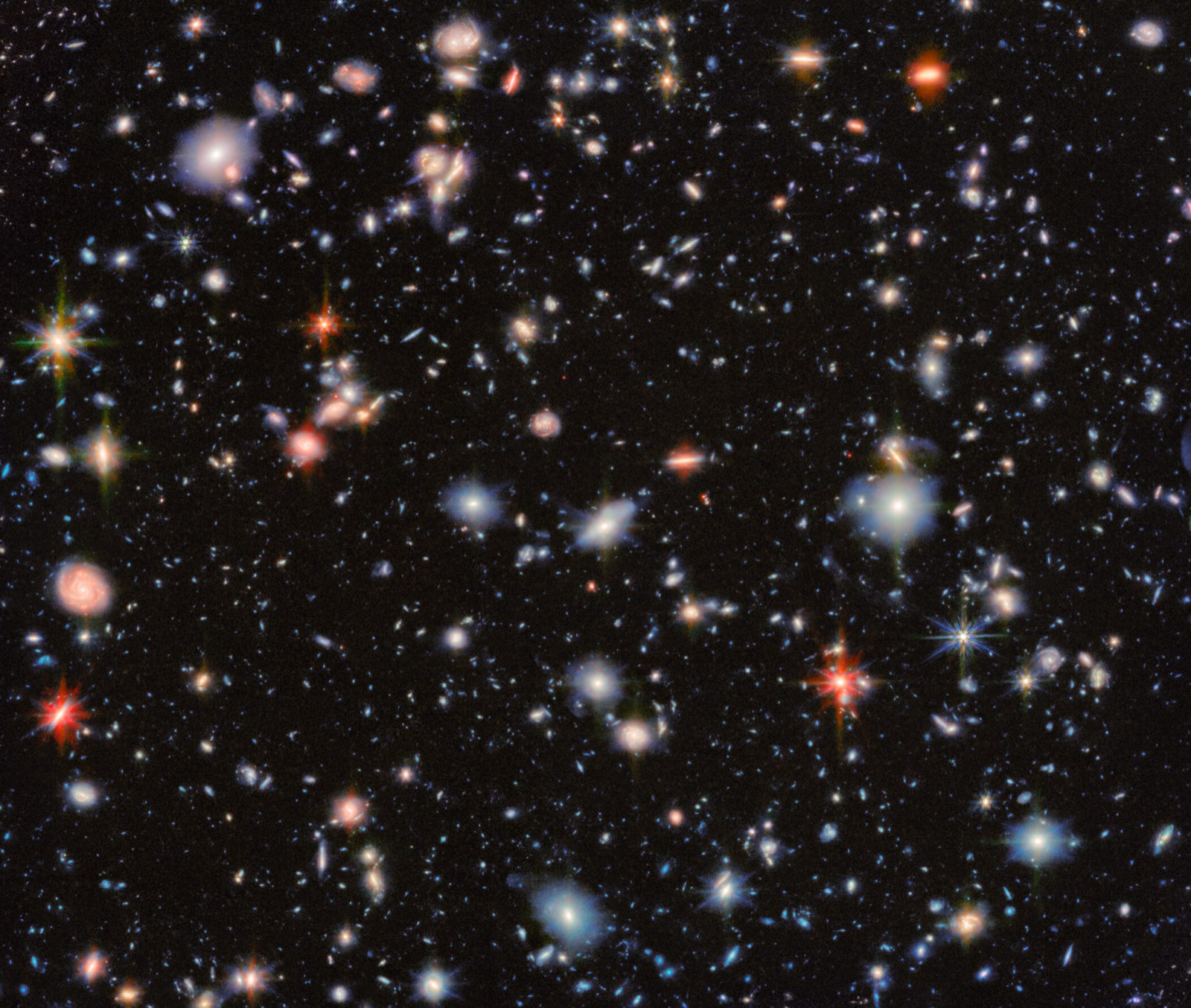
The first galaxies seen by JWST
The James Webb Space Telescope found galaxies brighter and earlier than many models expected, starting with the red candidates reported by Ivo Labbé and colleagues in 2023 (massive early galaxies). Most of the apparent conflict has eased: some candidates turned out to be growing black holes rather than giant galaxies, now known as little red dots. The current distance record, MoM-z14 at redshift 14.44, sits 280 million years after the Big Bang. Galaxies formed fast, but so far the standard model survives.
Measuring the clumpiness of the universe
In September 2026 the South Pole Telescope released its most sensitive map of matter traced by gravitationally bent microwave light (South Pole Telescope’s mass map). It agrees closely with Planck, a sign that structure has grown as the standard model predicts. A month earlier the DESI Legacy Imaging Surveys published a sky atlas of nearly four billion objects (the largest 2D map of the universe), the base for DESI’s 3D map.
If you prefer to watch first, our video library includes Kurzgesagt’s “The Beginning of Everything: The Big Bang” and PBS Space Time’s “Cosmic Microwave Background Explained”.
Key papers
Where the research is happening