GWTC-5.0 Catalog Brings the Gravitational-Wave Tally to 390 Events
The new catalog adds 161 events from 2024 and early 2025, including the clearest signal ever recorded and a record-precise sky position.
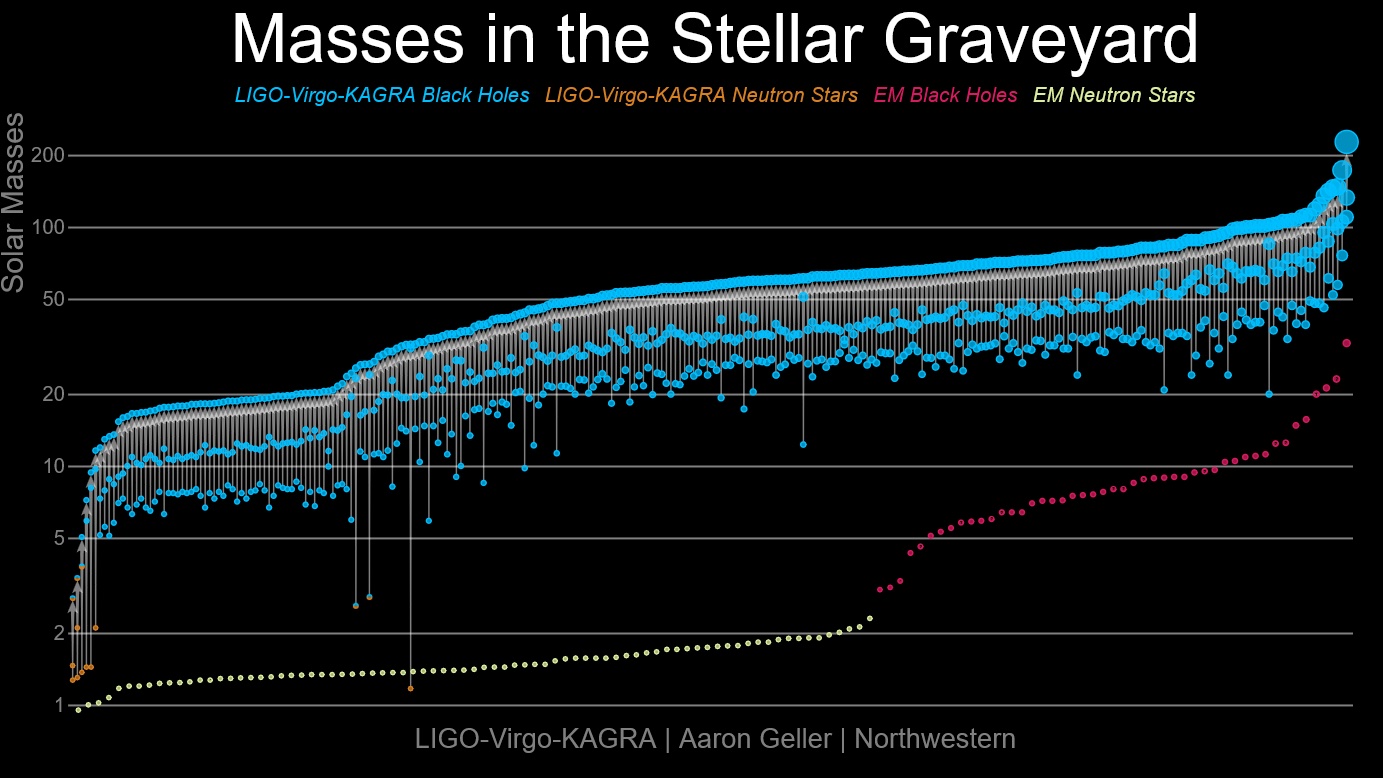
The LIGO, Virgo and KAGRA collaborations have released GWTC-5.0, a catalog that adds 161 gravitational-wave events and brings the total to 390 confirmed events since 2015. The LIGO Laboratory announced the catalog on May 26, 2026, and the paper is posted to arXiv. The new events were detected between April 10, 2024 and January 28, 2025, in the O4b part of the fourth observing run.
The fourth run alone accounts for roughly 75% of all gravitational-wave events ever detected, a sign of how much more sensitive the detector network has become since the first detection in 2015. It follows GWTC-4.0, which covered the first part of the run.
Highlights from the new catalog:
- GW250114, the clearest signal ever recorded, with a signal-to-noise ratio of 76.9, from two black holes of about 32 and 34 solar masses. It was already used to test Hawking’s area theorem.
- GW240615, a merger of black holes of about 26 and 30 solar masses more than 3 billion light-years away, localized to just 6 square degrees of sky, a record made possible by triangulation with Virgo.
- GW241011 and GW241110, whose spins point to “second-generation” black holes, themselves products of earlier mergers.
The data also give an independent measurement of the Hubble constant, about 25% more precise than earlier gravitational-wave results. With nearly 400 events, gravitational-wave astronomy has become a statistical science that can map black hole populations and weigh in on the Hubble tension. More in our gravitational waves guide.
What to watch next: the catalog covering the rest of the fourth observing run.
Primary source
This summary is based on LIGO Laboratory (Caltech) and the peer-reviewed paper. Read the original for full details, data and caveats.
This week in papers
The week's most important results, one line each, every week.