2026
LIGO Scientific Collaboration, Virgo Collaboration and KAGRA Collaboration, The Astrophysical Journal Letters, 2026
GWTC-4.0 (2026): 128 New Gravitational-Wave Events in One Catalog
Added 128 new gravitational-wave candidates from 2023-2024, bringing the catalog to 218. The LIGO-Virgo-KAGRA GWTC-4.0 catalog of black hole mergers.
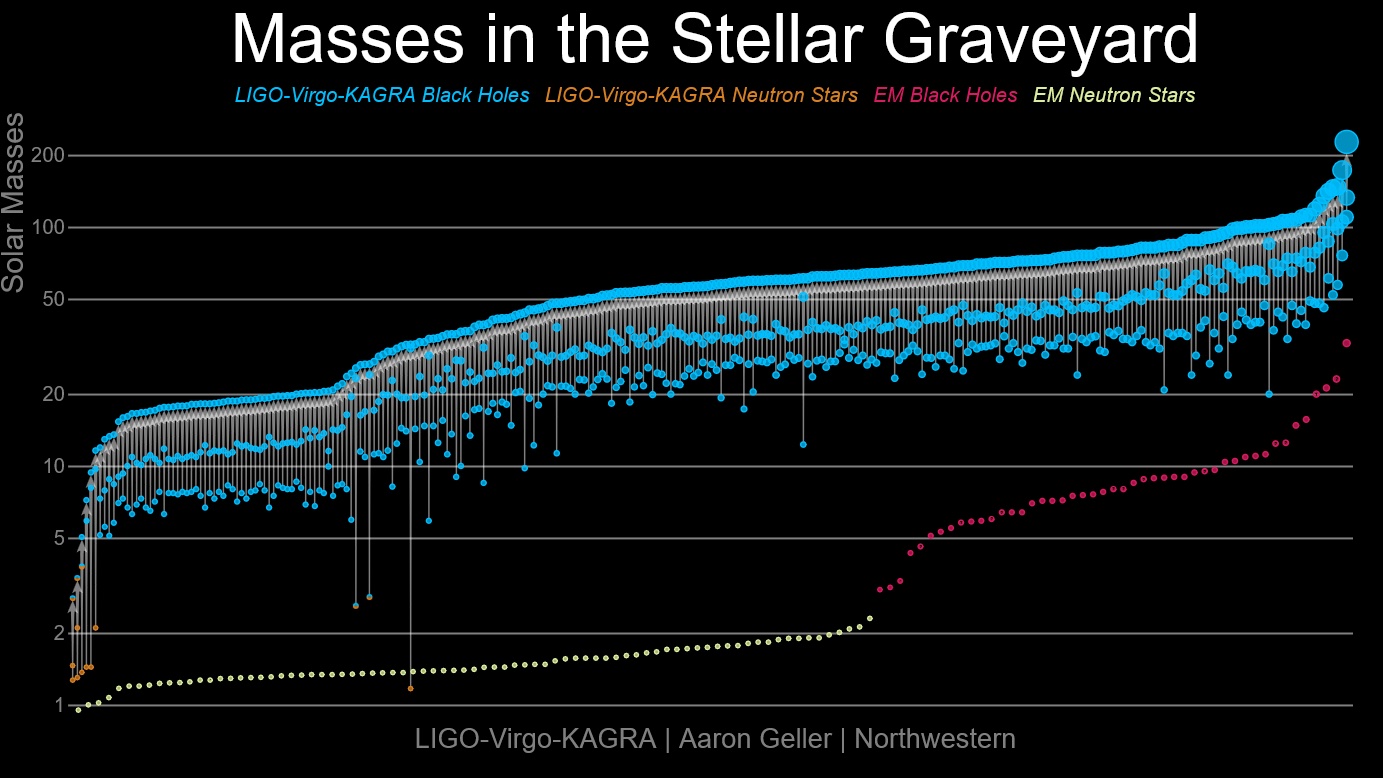
GWTC-4.0 is the LIGO-Virgo-KAGRA catalog of gravitational-wave events from the first part of the fourth observing run, May 2023 to January 2024. It adds 128 new candidate mergers of black holes and neutron stars, bringing the total to 218 and more than doubling the catalog. Published in 2026, it is a reference data set for black hole populations.
The question before the paper
After the first detection in 2015, each new gravitational-wave event was news. By the end of the third observing run the earlier catalog, GWTC-3, held 90 candidates. With upgraded detectors in the fourth run, events arrived every few days. The questions changed: not “is this real?” but how often black holes merge, how massive they get, how fast they spin, and how they formed. Answering those needs a large, uniformly analyzed sample.
What the paper found
- 128 new candidates. Compact binary mergers with at least a 50% probability of astrophysical origin, from the O4a period, May 24, 2023 to January 16, 2024, plus a preceding engineering run.
- Detailed properties for 86 of them, those with false-alarm rates below one per year.
- Mostly black hole pairs. Candidates are consistent with binary black holes and neutron star-black hole binaries, including GW230529_181500.
- 218 in total. Together with the 90 candidates of GWTC-3, the catalog more than doubles.
How they did it
The LIGO-Virgo-KAGRA collaboration searched all data from the observing period for the chirp-shaped signals of merging compact objects buried in detector noise. Each candidate was assigned a probability of being astrophysical. For the most confident ones, the team estimated masses, spins and distances by matching the signals to waveforms predicted by general relativity.
Why it mattered
Gravitational-wave astronomy has moved from single events to population studies. A catalog of hundreds of mergers lets astronomers measure merger rates, map the distribution of black hole masses and spins, and work out how the black holes formed. This catalog is the reference data set for that work on the first part of the fourth run.
What we know now
The count keeps rising. The GWTC-5.0 catalog (May 2026) added 161 events from the second part of the run, for 390 confirmed events since 2015. It includes GW250114, the clearest signal yet, and black holes whose spins suggest they are products of earlier mergers. The fourth observing run ended on November 18, 2025. See our gravitational waves guide.
Who wrote it
The paper is signed by the LIGO Scientific Collaboration, the Virgo Collaboration and the KAGRA Collaboration, with individual authors starting with A. G. Abac and I. Abouelfettouh.
Read the original
LIGO Scientific Collaboration, Virgo Collaboration and KAGRA Collaboration, Abac, A. G., Abouelfettouh, I., et al. (2026). “GWTC-4.0: Updating the Gravitational-wave Transient Catalog with Observations from the First Part of the Fourth LIGO-Virgo-KAGRA Observing Run.” The Astrophysical Journal Letters. doi:10.3847/2041-8213/ae2c74. First posted to arXiv in August 2025 and free there: 2508.18082. LIGO’s plain-language summary is also free.
This week in papers
Five new results in one line each, plus one landmark like this one. Weekly.
Keep reading
LIGO Scientific Collaboration, Virgo Collaboration and KAGRA Collaboration, Physical Review Letters, 135, 111403, 2025
GW250114: The Clearest Signal Yet Confirms Hawking's Law
Confirmed Hawking's 1971 area theorem and the Kerr nature of black holes with GW250114, the clearest gravitational-wave signal yet. LIGO-Virgo-KAGRA, 2025.
NANOGrav Collaboration, The Astrophysical Journal Letters, 951, L8, 2023
NANOGrav: Evidence for the Gravitational Wave Background
Found evidence in 2023 for a background hum of gravitational waves by timing 67 pulsars for 15 years. The NANOGrav Collaboration's 15-year data set paper.
Pardo et al., Journal of Cosmology and Astroparticle Physics, 2018, 048, 2018
GW170817 Counts Spacetime Dimensions: The Answer Is Four
Showed in 2018 that GW170817's gravitational waves travel in 3+1 spacetime dimensions, with no leak into large extra ones. Pardo, Fishbach, Holz, Spergel.
Topic guide
Gravitational waves
Recent news in gravitational waves
GWTC-5.0 Catalog Brings the Gravitational-Wave Tally to 390 Events