Gravitational waves are ripples in the fabric of spacetime, produced when massive objects such as black holes or neutron stars accelerate, and they travel at the speed of light. Albert Einstein predicted them in 1916. LIGO first detected them on September 14, 2015 (GW150914), and the discovery was announced in February 2016.
Ten years later, gravitational waves are a working branch of astronomy with hundreds of detections. This guide explains what they are, how detectors catch them, what they have revealed and what comes next.
What are gravitational waves?
Gravitational waves are disturbances in the shape of space and time that spread outward from accelerating masses. In Einstein’s general relativity, completed in November 1915 (Einstein’s field equations), mass curves spacetime; when masses move violently, the curvature changes, and those changes travel outward as waves.
A passing wave alternately stretches space in one direction and squeezes it in the perpendicular direction. Imagine a ring of floating beads in space: as the wave goes by, the ring becomes an oval, then an oval the other way, over and over.
The effect is astonishingly small. The first wave detected, from two black holes 1.3 billion light-years away, changed distances on Earth by about 1 part in 1021 at its peak (the first gravitational wave detection).
What causes gravitational waves?
Any accelerating mass makes gravitational waves, but only extreme events make waves strong enough to detect:
- Merging black holes, the most common source LIGO hears.
- Merging neutron stars, which also shine in light and forge heavy elements.
- A neutron star and a black hole merging, a mixed pair now seen in several events.
- Spinning neutron stars with tiny mountains on their surface, expected to hum continuously (not yet detected).
- Supernovae, if the collapse is lopsided (not yet detected).
- Pairs of supermassive black holes orbiting for millions of years, the likely source of the nanohertz background.
- The early universe, possibly including cosmic inflation (not yet detected).
How are gravitational waves detected?
Gravitational waves are detected by measuring tiny changes in distance, either between mirrors with lasers or between Earth and distant pulsars with radio telescopes.
Laser interferometers: LIGO, Virgo and KAGRA
LIGO has two L-shaped detectors, in Hanford, Washington and Livingston, Louisiana, 3,002 kilometers apart. Each has two 4-kilometer arms. A laser beam is split, sent down both arms, bounced off mirrors and recombined. Normally the two beams cancel out. When a gravitational wave stretches one arm and squeezes the other, the beams fall out of step and a flicker of light reaches the detector.
At its most sensitive, LIGO can detect a change in arm length of 1/10,000 the width of a proton, like noticing the distance to the nearest star change by the width of a human hair. It works as a pair: a real signal must appear at both sites, no more than about 10 milliseconds apart. Our explainer how does LIGO work walks through the lasers, mirrors and noise fighting step by step.
LIGO operates with Virgo, a 3-kilometer detector near Pisa, Italy, and KAGRA in Japan, the first detector built underground with cryogenically cooled mirrors. Together they form the LIGO-Virgo-KAGRA network. A fifth detector, LIGO-India, broke ground on April 23, 2026, in Maharashtra, with the same design as the US detectors (LIGO-India breaks ground). A detector far from the others will sharpen sky positions for telescopes.
Veritasium’s “The Absurdity of Detecting Gravitational Waves”, in our video library, shows why this is so hard.
Pulsar timing arrays
Pulsar timing arrays use the galaxy as a detector. Millisecond pulsars are dead stars that spin hundreds of times a second and sweep beams past Earth with clock-like regularity. A gravitational wave passing between Earth and the pulsars makes pulses arrive slightly early or late, in a pattern that depends on the angle between pulsars. These arrays are sensitive to waves with periods of years, far below LIGO’s range.
NANOGrav and partner arrays in Europe and India, Australia and China lead this effort.
In space: LISA
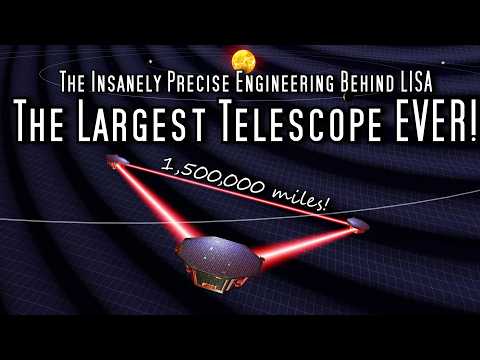
The Laser Interferometer Space Antenna will fly three spacecraft in a triangle with arms 2.5 million kilometers long, exchanging laser beams. ESA adopted the mission on January 25, 2024, with launch planned for the mid-2030s; NASA contributes the telescopes and ordered an engineering test unit in October 2026 (LISA’s test telescope). LISA will hear merging supermassive black holes and thousands of compact binary stars in the Milky Way.
The first detection: GW150914
The first direct detection of gravitational waves was GW150914, recorded on September 14, 2015, at 09:50:45 UTC by both LIGO detectors. The signal swept upward in frequency from 35 to 250 hertz in a fraction of a second, the “chirp” predicted for two black holes spiraling together.
The black holes had about 36 and 29 times the Sun’s mass and merged into one of 62 solar masses about 410 megaparsecs (1.3 billion light-years) away. The missing three solar masses were converted into gravitational-wave energy. The false alarm rate was below once per 203,000 years, more than 5.1 sigma. It was also the first observation of two black holes merging.
Rainer Weiss, Barry Barish and Kip Thorne received the 2017 Nobel Prize in Physics “for decisive contributions to the LIGO detector and the observation of gravitational waves”.
Who discovered gravitational waves?
Gravitational waves were predicted, then inferred, then detected, by different people:
- Albert Einstein (1916 and 1918) predicted them from general relativity. His 1916 paper contained an error; in 1918 he derived the quadrupole formula for how much energy a system radiates. At times he doubted the waves were physically real.
- Russell Hulse and Joseph Taylor (1974) found the pulsar PSR 1913+16 with the Arecibo radio telescope. It orbits another neutron star every 7.75 hours, and follow-up timing showed the orbit shrinking exactly as expected if it loses energy to gravitational waves, agreeing with general relativity to better than 0.5% (the Hulse-Taylor binary pulsar). They received the 1993 Nobel Prize.
- The LIGO and Virgo collaborations (2015) made the first direct detection, the result of decades of detector development.
GW170817: when gravitational waves met light
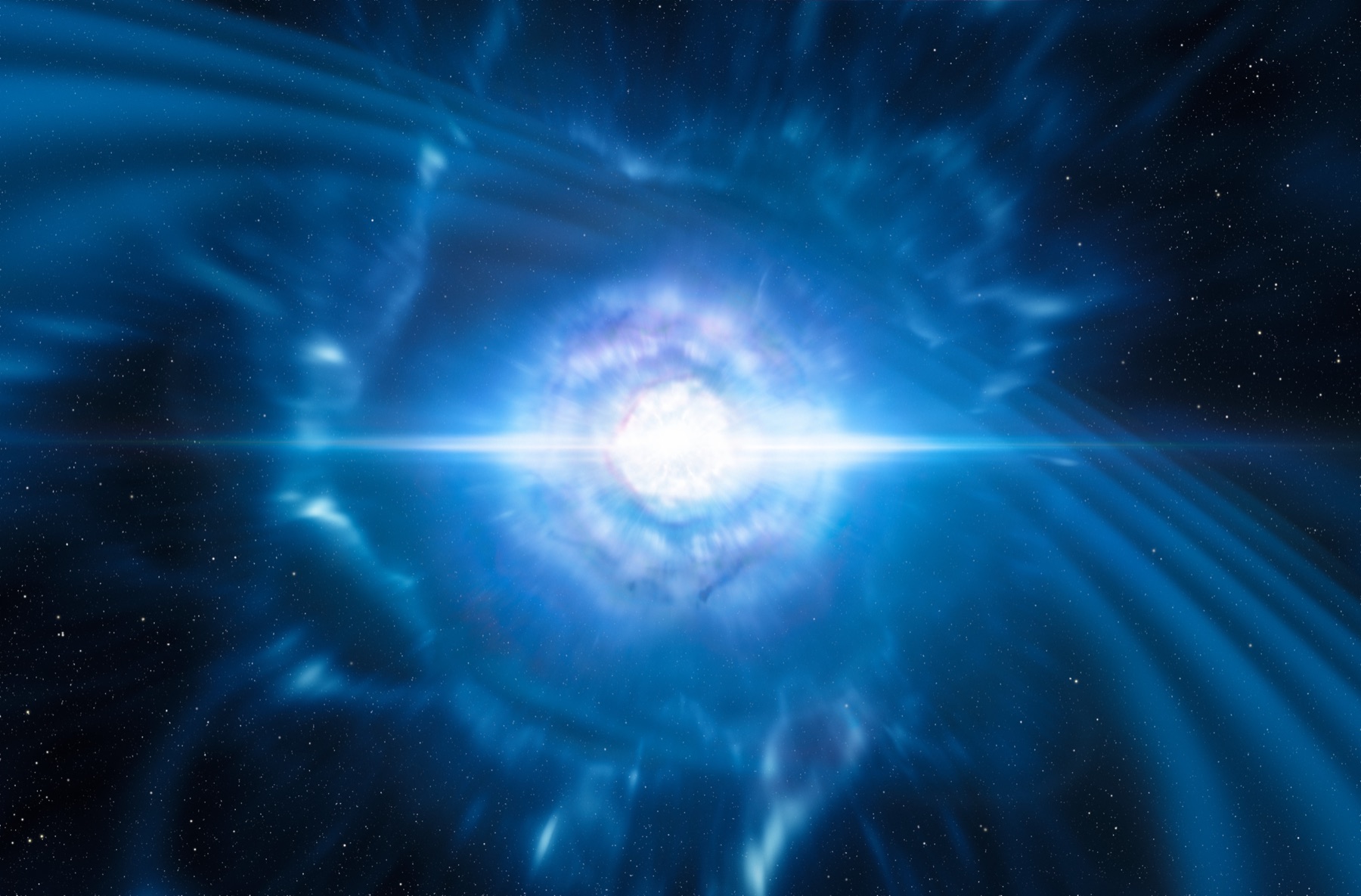
GW170817 was the first neutron star merger ever detected and the first event seen in both gravitational waves and light. On August 17, 2017, LIGO and Virgo recorded two neutron stars, with a total of about 2.7 solar masses, spiraling together about 40 megaparsecs (about 130 million light-years) away (GW170817).
Just 1.7 seconds after the merger, NASA’s Fermi satellite detected a short gamma-ray burst from the same patch of sky. Within 11 hours, telescopes found a new glowing source, a kilonova, in the galaxy NGC 4993. Its spectra showed freshly made heavy elements from rapid neutron capture: neutron star collisions forge a large share of the universe’s gold and platinum. More on kilonovae and the other events in neutron star mergers.
The timing also settled a basic question. After traveling for about 130 million years, the gravitational waves and gamma rays arrived 1.7 seconds apart. That limits any difference between the speed of gravity and the speed of light to between -3 × 10-15 and +7 × 10-16 of the speed of light. How that limit was set, and the dark energy theories it ruled out, is explained in do gravitational waves travel at the speed of light?
How many gravitational waves has LIGO detected?
As of the GWTC-5.0 catalog (May 2026), the LIGO-Virgo-KAGRA network has confirmed 390 gravitational-wave events since 2015. The count has grown quickly as detectors improved:
| Catalog | Observing period | New catalog entries | Cumulative total |
|---|
| GWTC-3 | O1 to O3 (from 2015) | 90 | 90 |
| GWTC-4.0 | O4a (May 24, 2023 to January 16, 2024) | 128 | 218 |
| GWTC-5.0 | O4b (April 10, 2024 to January 28, 2025) | 161 | 390 |
The catalogs use slightly different counting criteria, so the totals are those reported by the collaboration (the GWTC-4.0 catalog; GWTC-5.0 and its 390 events). The fourth observing run, O4, ran from May 24, 2023 to November 18, 2025, and issued about 250 public alerts; the events from its final stretch are not yet in a catalog.
Highlights from O4 include:
- GW250114, the clearest signal yet, with a signal-to-noise ratio near 80. It confirmed Stephen Hawking’s 1971 area theorem: the merged black hole’s horizon area was larger than the two original ones combined (GW250114 and Hawking’s area law).
- GW240615, localized to just 6 square degrees of sky, a record, thanks to Virgo.
- GW241011 and GW241110, whose spins suggest “second-generation” black holes, themselves the products of earlier mergers.
The gravitational wave background
The gravitational wave background is a faint, constant hum of long-wavelength gravitational waves filling the universe. In June 2023 NANOGrav reported evidence for it from 15 years of timing 67 millisecond pulsars (NANOGrav’s 15-year evidence). The telltale Hellings-Downs correlation between pulsar pairs appeared at about 3 to 4 sigma, and arrays in Europe and India, Australia and China reported similar evidence the same day.
The leading explanation is the combined signal of many pairs of supermassive black holes slowly orbiting each other in the centers of merged galaxies. More exotic sources from the early universe are not ruled out. The evidence is strong but not yet at the 5-sigma level.
What gravitational waves have taught us
In ten years, gravitational waves have answered questions no telescope could:
- Black hole populations. Merging black holes span a wide range of masses, and some formed from earlier mergers. See our black holes guide.
- Tests of general relativity. Every signal so far, including the ringdown of GW250114, matches Einstein’s theory and Kerr’s description of spinning black holes.
- The speed of gravity. It equals the speed of light to about one part in 1015.
- The origin of heavy elements. GW170817 showed neutron star mergers make gold and platinum. More on neutron stars in our stars guide.
- The Hubble constant. Gravitational waves reveal their source’s distance directly, making mergers “standard sirens”. GW170817 gave about 70 km/s/Mpc, and GWTC-5.0 improved the precision by about 25%, a growing independent check on the Hubble tension.
What comes next
The next decade will expand both reach and sensitivity:
- Intermediate run IR1, a six-month run planned to begin in November 2026 with both LIGO detectors.
- The fifth observing run, O5, with upgraded detectors; its timeline is still being refined.
- LIGO-India, which will make the network truly global.
- Einstein Telescope and Cosmic Explorer, proposed next-generation observatories in Europe and the United States that would hear mergers from across most of cosmic history.
- LISA, opening the low-frequency band from space in the mid-2030s.
For the original story told by the people who made it, Caltech’s “LIGO: The First Observation of Gravitational Waves” is in our video library.
Key papers
Where the research is happening
- LIGO-Virgo-KAGRA: the global ground-based network.
- NANOGrav: pulsar timing at nanohertz frequencies.
- LISA: the future space observatory.
- Caltech: co-founder and operator of LIGO with MIT.