2025
LIGO Scientific Collaboration, Virgo Collaboration and KAGRA Collaboration, Physical Review Letters, 135, 111403, 2025
GW250114 (2025): The Clearest Signal Yet Confirms Hawking's Law
Confirmed Hawking's 1971 area theorem and the Kerr nature of black holes with GW250114, the clearest gravitational-wave signal yet. LIGO-Virgo-KAGRA, 2025.
GW250114 is the clearest gravitational-wave signal ever recorded, detected by LIGO on January 14, 2025. Two black holes of about 34 and 32 solar masses merged, and the signal was strong enough to confirm Stephen Hawking’s 1971 area theorem, that black hole horizons cannot shrink, and to check that the merged black hole matches Roy Kerr’s solution.
The question before the paper
Black hole physics rests on two theoretical pillars that are hard to test. In 1971 Stephen Hawking proved that, in general relativity, the total area of black hole event horizons can never decrease. Because Jacob Bekenstein later tied a black hole’s entropy to its horizon area, the rule echoes the law that entropy never decreases. And Roy Kerr’s 1963 solution says a settled black hole is fully described by just its mass and spin. Testing either requires a merger signal clear enough to measure the black holes before and after the collision separately.
What the paper found
- The clearest signal to date. The two LIGO detectors recorded GW250114 with a network signal-to-noise ratio of about 80.
- A near twin of the first detection. The black holes had masses of about 33.6 and 32.2 solar masses, small spins and negligible eccentricity, closely resembling GW150914, the first gravitational-wave event.
- Hawking’s area law holds. The total horizon area after the merger was larger than the sum of the areas before it, confirmed with very high confidence.
- The final black hole is a Kerr black hole. Its “ringdown”, the fading vibration of the newly formed black hole, was measured including its first overtone, and matched the Kerr solution.
How they did it
In essence, the analysis compares the signal before and after the merger. The early part, as the two black holes spiraled together, revealed their masses and spins, and so the area of each horizon. The late part, the ringdown, revealed the mass and spin of the merged black hole and so its horizon area. Comparing the two answered Hawking’s question directly. Like a struck bell, a newly formed black hole rings at distinct tones. The team tracked both the fundamental tone and its first overtone, a faster-fading version of the same vibration, for about three milliseconds after the merger, and checked that both fit a single Kerr black hole.
Ten years of detector upgrades since 2015 made the difference: a source similar to GW150914 produced a far louder signal in today’s instruments.
Why it mattered
This event checked two foundational predictions, Hawking’s area law and Kerr’s rotating black hole, using a single signal. It turned gravitational waves from a discovery into a precision test of black hole physics. Hawking’s other famous prediction, that black holes slowly evaporate, is a quantum effect far too weak to measure here.
What we know now
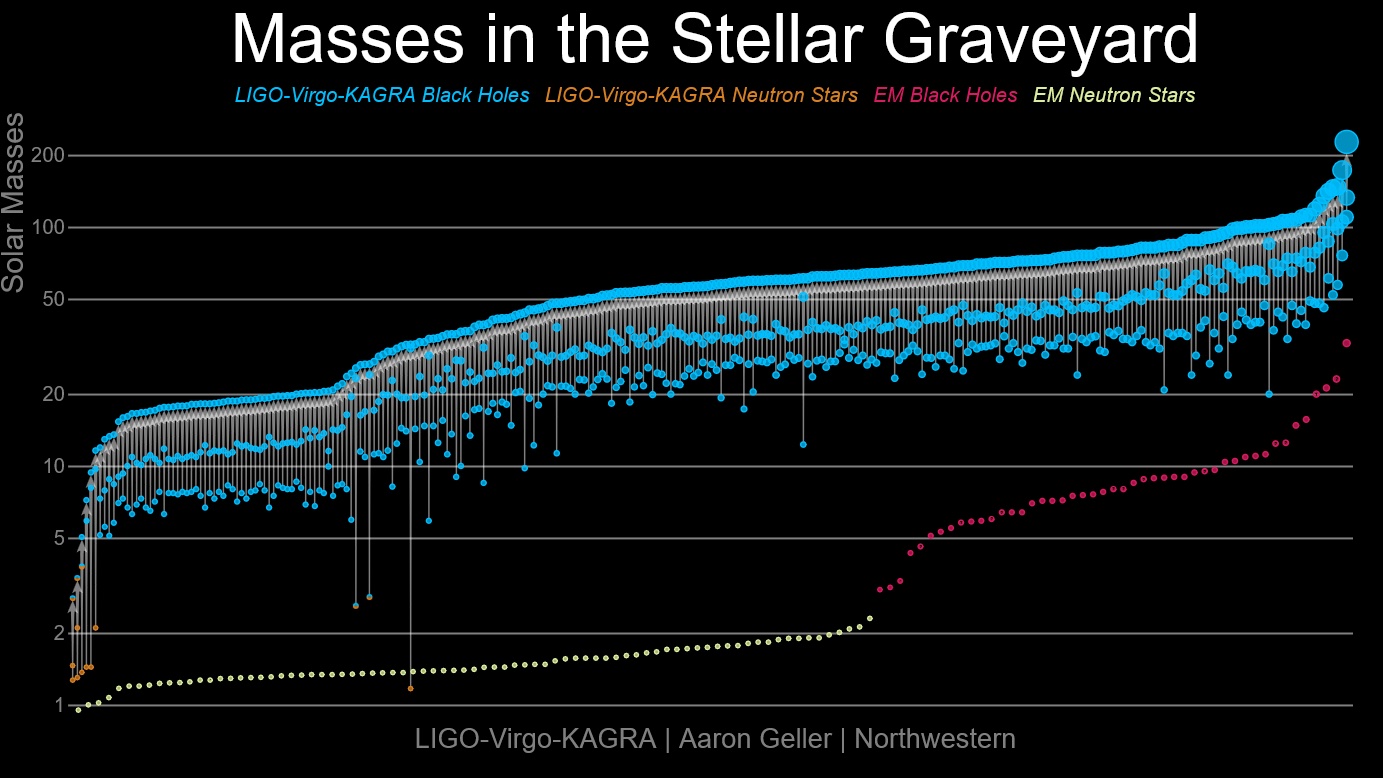
The GWTC-5.0 catalog (May 2026) lists GW250114 with a signal-to-noise ratio of 76.9, still the clearest signal ever, among 390 confirmed events from the LIGO-Virgo-KAGRA network. The fourth observing run ended on November 18, 2025, and a further run is planned to start in November 2026. See also GWTC-4 and our gravitational waves guide.
Who wrote it
The paper is signed by the LIGO Scientific Collaboration, the Virgo Collaboration and the KAGRA Collaboration, with individual authors starting with A. G. Abac and I. Abouelfettouh. It was published on September 10, 2025, close to the tenth anniversary of the first detection.
Read the original
LIGO Scientific Collaboration, Virgo Collaboration and KAGRA Collaboration, Abac, A. G., Abouelfettouh, I., et al. (2025). “GW250114: Testing Hawking’s Area Law and the Kerr Nature of Black Holes.” Physical Review Letters 135, 111403. doi:10.1103/kw5g-d732. Free on arXiv: 2509.08054. LIGO’s plain-language science summary is also free.
This week in papers
Five new results in one line each, plus one landmark like this one. Weekly.
Keep reading
LIGO Scientific Collaboration, Virgo Collaboration and KAGRA Collaboration, The Astrophysical Journal Letters, 2026
GWTC-4.0: 128 New Gravitational-Wave Events in One Catalog
Added 128 new gravitational-wave candidates from 2023-2024, bringing the catalog to 218. The LIGO-Virgo-KAGRA GWTC-4.0 catalog of black hole mergers.
NANOGrav Collaboration, The Astrophysical Journal Letters, 951, L8, 2023
NANOGrav: Evidence for the Gravitational Wave Background
Found evidence in 2023 for a background hum of gravitational waves by timing 67 pulsars for 15 years. The NANOGrav Collaboration's 15-year data set paper.
Pardo et al., Journal of Cosmology and Astroparticle Physics, 2018, 048, 2018
GW170817 Counts Spacetime Dimensions: The Answer Is Four
Showed in 2018 that GW170817's gravitational waves travel in 3+1 spacetime dimensions, with no leak into large extra ones. Pardo, Fishbach, Holz, Spergel.
Topic guide
Gravitational waves
Recent news in gravitational waves
GWTC-5.0 Catalog Brings the Gravitational-Wave Tally to 390 Events