NASA's Nancy Grace Roman Space Telescope Launches on a Falcon Heavy
Roman lifted off on August 30, 2026, bound for the Sun-Earth L2 point to survey dark energy, dark matter and planets around other stars.
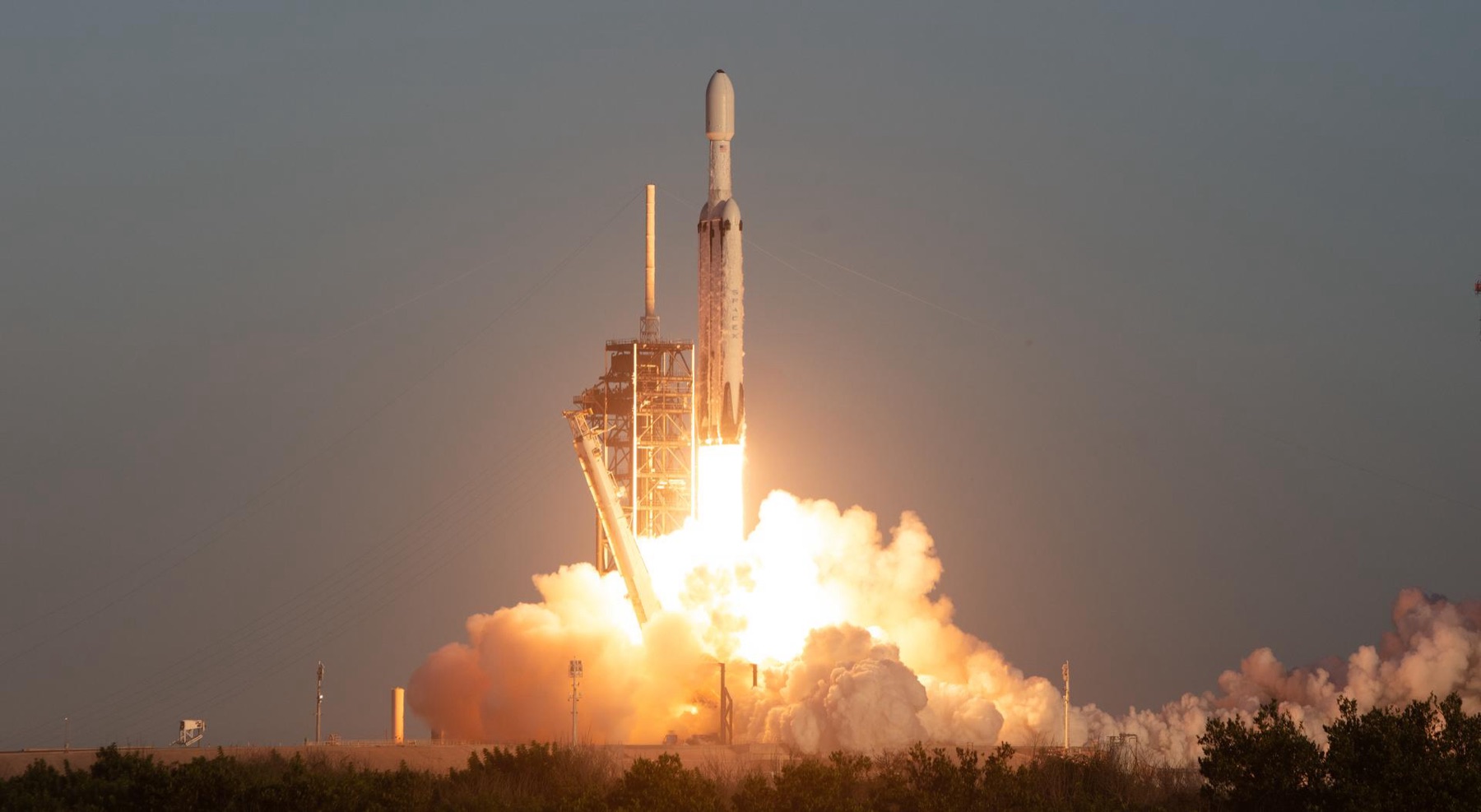
NASA’s Nancy Grace Roman Space Telescope launched at 7:26 a.m. EDT on August 30, 2026, aboard a SpaceX Falcon Heavy from Launch Complex 39A at Kennedy Space Center. NASA confirmed the launch the same day. Roman is now on a three-month, million-mile trip to the Sun-Earth L2 point, a gravitational balance point on the far side of Earth from the Sun.
The first hours went to plan. Telemetry arrived seven minutes after launch, the rocket released the observatory 31 minutes into flight, and the solar panels deployed 1 hour 23 minutes after liftoff.
Roman pairs a large field of view with sharp infrared vision, so it can survey wide areas of sky in depth rather than zooming in on single targets. Its Wide Field Instrument is a 300-megapixel infrared camera built from 18 4K detectors. The mission targets three questions: how dark energy has shaped cosmic expansion, the force behind the speed-up first found in 1998 with distant supernovae; how dark matter is distributed; and how common different kinds of planetary systems are, through a statistical census of exoplanets. Its Coronagraph Instrument will test technology for imaging planets like Jupiter around other stars by blocking the glare of their host star. That is a step toward the proposed Habitable Worlds Observatory.
Roman will send back about 1.4 terabytes of data every day, and NASA expects to release its first images by early 2027. Before any science, the observatory still has to reach L2 and complete its checkout. For how Roman fits with Webb, Euclid and Rubin, see our telescopes and missions guide.
What to watch next: Roman’s arrival at L2 and its first images, which NASA expects by early 2027.
Primary source
This summary is based on NASA. Read the original for full details, data and caveats.
This week in papers
The week's most important results, one line each, every week.