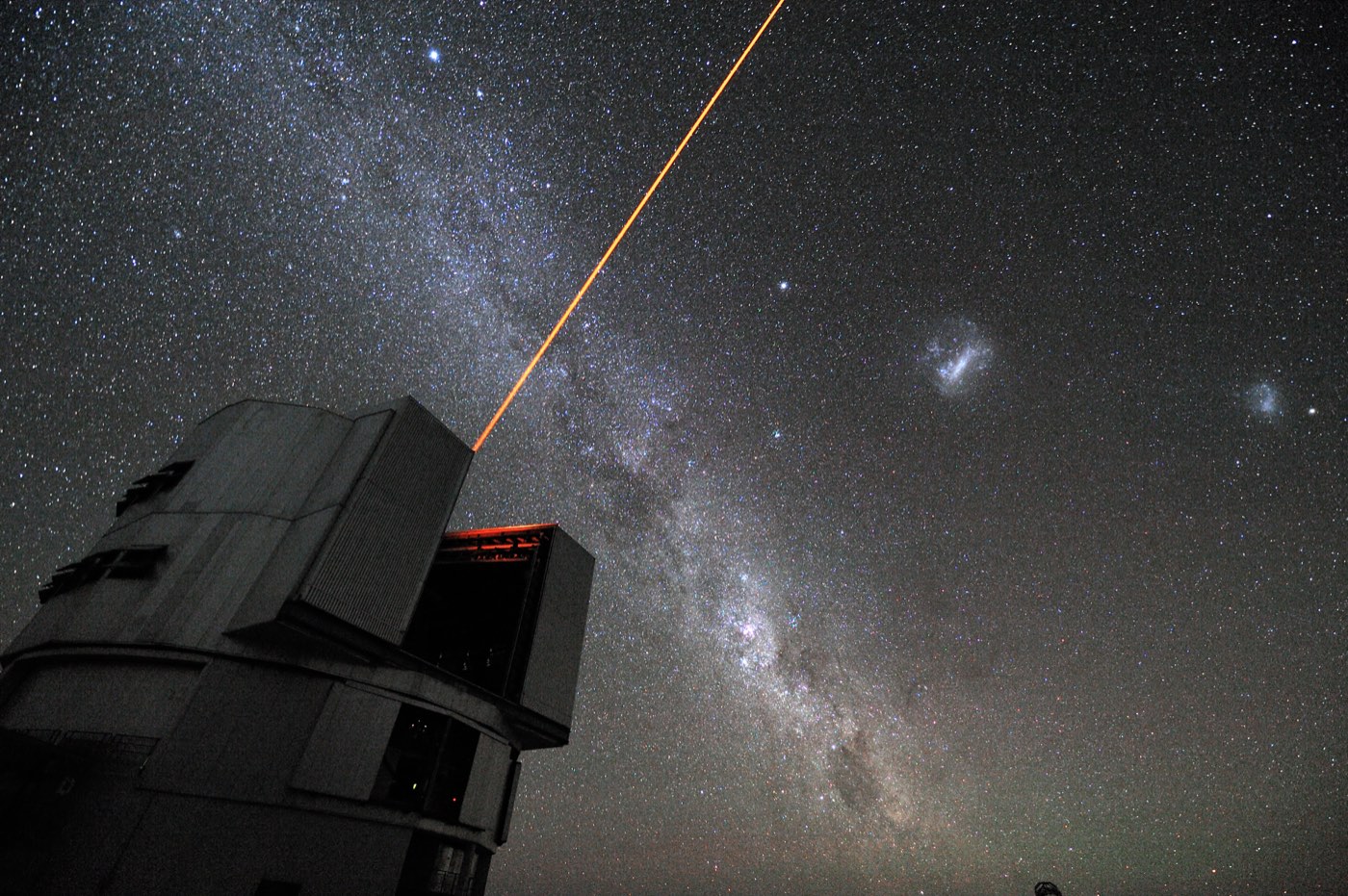
Space telescopes are observatories in orbit, above the atmosphere that blurs and blocks much of the light from space; the best known are Hubble (1990) and the James Webb Space Telescope (2021). Giant ground telescopes such as Rubin and the Extremely Large Telescope, and survey missions such as Euclid and Roman, complete the picture.
This guide is the map: which observatories are working in October 2026, what they have found, how they see back in time, and what switches on next. Each one has its own hub page; all of them are on the observatory map.
Space telescopes in operation today
As of October 2026, these are the major space telescopes doing science:
| Telescope | Agency | Launched | Light it sees | Known for |
|---|
| Hubble | NASA and ESA | 1990 | Ultraviolet, visible, near-infrared | Deep fields, the accelerating universe, 22,000+ papers |
| James Webb (JWST) | NASA, ESA and CSA | 2021 | Infrared | The earliest galaxies, exoplanet atmospheres |
| Chandra | NASA | 1999 | X-rays | Black holes, supernova remnants, hot gas in clusters |
| Euclid | ESA | 2023 | Visible and near-infrared | A 3D map of dark matter and dark energy |
| TESS | NASA | 2018 | Visible and red light | Transiting planets around nearby stars |
| XRISM | JAXA with NASA | 2023 | X-rays | High-resolution X-ray spectra of hot gas |
| SPHEREx | NASA | 2025 | Infrared, 102 colors | An all-sky spectral map of galaxies and ices |
| Roman | NASA | August 2026 | Infrared | Commissioning; dark energy and a planet census to come |
ESA’s Gaia, which mapped about a billion Milky Way stars, ended observations in January 2025 and was switched off in March 2025; its fourth data release is due on December 2, 2026.
What each one is doing now
- Hubble has worked in one-gyroscope mode since June 2024, losing about 12% of its observing efficiency, but it remains the only large telescope in space that sees ultraviolet light. NASA said in 2024 it expects Hubble to keep working into the mid-2030s.
- JWST began its fifth observing cycle on July 1, 2026, after a record 2,930 proposals asked for about twelve times more time than was available.
- Chandra, launched in 1999, is still NASA’s flagship X-ray telescope, though its budget was cut to a minimum-cost mission for fiscal 2026 and its future funding is under debate.
- Euclid is more than two years into a six-year survey and has already published its first “quick” data on 26 million galaxies.
- TESS has confirmed more than 1,000 planets around bright nearby stars, the best targets for follow-up by larger telescopes.
- SPHEREx completed its first map of the entire sky in 102 infrared colors in December 2025, and in October 2026 published spectra of dozens of brown dwarfs (SPHEREx brown dwarfs).
- XRISM continues with its X-ray spectrometer’s protective door still closed, and JAXA extended its operations through March 2030.
What has JWST discovered?
In four years, JWST has rewritten several chapters of astronomy. Five highlights:
- The most distant galaxies. MoM-z14, at redshift 14.44, about 280 million years after the Big Bang, is the record as of October 2026, after JADES-GS-z14-0 in 2024 (Carniani et al. 2024).
- Little red dots and early black holes. A population of compact red objects that may be young supermassive black holes in gas cocoons (little red dots).
- Exoplanet atmospheres. The first definitive carbon dioxide in an exoplanet atmosphere, on WASP-39b, in 2022 (WASP-39b).
- Rocky planets tested. TRAPPIST-1’s inner planets appear to lack thick atmospheres.
- The Hubble tension checked. Sharper infrared distances ruled out a simple measurement error in the local expansion rate.
The full, dated roundup is in what JWST has discovered.
JWST vs Hubble
JWST and Hubble are partners, not rivals.
| Hubble | JWST |
|---|
| Mirror | 2.4 m | 6.5 m, 18 segments |
| Light | Ultraviolet, visible, near-infrared | Infrared, 0.6 to 28.5 micrometers |
| Orbit | Low Earth orbit | Sun-Earth L2, about 1.5 million km away |
| Launched | 1990 | 2021 |
| Serviceable | Yes, five shuttle missions | No |
Hubble has worked in one-gyroscope mode since June 2024 but is still producing science. The side-by-side comparison, with what each sees best, is in JWST vs Hubble.
Why telescopes see back in time
Every telescope is a time machine because light takes time to travel. We see the Sun as it was about eight minutes ago, Andromeda as it was 2.5 million years ago, and the most distant galaxies as they were more than 13 billion years ago. Looking farther means looking earlier.
The expanding universe adds a twist: it stretches light on the way, shifting it toward longer, redder wavelengths. This redshift is how astronomers measure cosmic distances, following the relation Edwin Hubble published in 1929 (Hubble’s law). For the earliest galaxies, the stretch is so large that their ultraviolet light arrives as infrared, which is why JWST was built as an infrared telescope and why it is kept so cold.
The lookback has a limit. Before about 380,000 years after the Big Bang the universe was an opaque fog of hot plasma, so no telescope that uses light can see earlier than the cosmic microwave background, the afterglow released when that fog cleared. Galaxies themselves only began to form a few hundred million years later, and that is the era JWST now probes. To look further back than the microwave background, astronomers will need other messengers, such as gravitational waves from the very early universe.
The survey telescopes: mapping the whole sky
Some of the biggest discoveries come not from staring at one target but from mapping everything.
Vera C. Rubin Observatory and LSST
The Vera C. Rubin Observatory on Cerro Pachón, Chile, released its first images in June 2025, issued its first alerts in February 2026 and began its ten-year Legacy Survey of Space and Time (LSST) in mid-2026, announced on June 30 (Rubin begins the LSST). Its 8.4-meter telescope and 3,200-megapixel camera, the largest digital camera ever built, image the entire southern sky every few nights, revisiting each spot about 800 times and producing up to about 7 million alerts per night. In early tests alone it found more than 11,000 new asteroids. The survey design is set out in Ivezić et al. 2019, and the first data in Rubin Data Preview 1.
Euclid
ESA’s Euclid, launched in July 2023, is mapping 14,000 square degrees of sky to trace dark matter through weak gravitational lensing and galaxy clustering (the Euclid mission). In July 2026 Euclid and Keck reported 12 new quasars above redshift 7. Its first large data release covers about 1,900 square degrees from November 2026.
DESI
The Dark Energy Spectroscopic Instrument (DESI) on Kitt Peak, Arizona, uses 5,000 robotic fibers to measure distances to tens of millions of galaxies. Its 2025 results strengthened the hint that dark energy is weakening over time (DESI DR2), and in April 2026 it finished its planned five-year map ahead of schedule (DESI completes its 3D map).
Gaia
Gaia measured the positions, distances and motions of about a billion stars from 2014 to 2025 (the Gaia mission), transforming the study of the Milky Way. Its data release in December 2026 is expected to include the first large set of exoplanet candidates found by astrometry.
Coming next
Dated milestones, as published by each agency as of October 2026:
| Observatory | Type | Milestone | Date |
|---|
| Gaia | Space, retired | Data Release 4 | December 2, 2026 |
| Roman | Space, infrared | Commissioning, first images | Early 2027 |
| PLATO (ESA) | Space, planet hunter | Launch on Ariane 6 | March 2027 |
| SKA Observatory | Ground, radio | Science verification begins | From 2027 |
| Extremely Large Telescope | Ground, 39 m optical | First light / start of science | March 2029 / December 2030 |
| Giant Magellan Telescope | Ground, 25.4 m optical | Completion | 2030s |
| Ariel (ESA) | Space, exoplanet atmospheres | Launch | 2031 |
| PRIMA (NASA) | Space, far-infrared | Target launch | 2033 |
| LISA | Space, gravitational waves | Launch | Mid-2030s |
| Habitable Worlds Observatory | Space, Earth-like planets | Possible launch | 2040s |
NASA selected PRIMA in September 2026 as the first mission in its new Probe class (NASA advances PRIMA). Roman itself launched on August 30, 2026 (Roman launches).
The biggest telescopes in the world
Ranked by the diameter of the main mirror or dish:
- FAST (China), 500 m: the largest single-dish radio telescope, which has found more than 1,300 pulsars (FAST).
- Extremely Large Telescope (Chile, under construction), 39.3 m: will be the largest optical and infrared telescope ever built.
- Thirty Meter Telescope (proposed), 30 m: its future is uncertain after the US National Science Foundation chose to advance the GMT instead in 2025 (TMT).
- Giant Magellan Telescope (Chile, under construction), 25.4 m: seven giant mirrors acting as one.
- Gran Telescopio Canarias (La Palma, Spain), 10.4 m: the largest optical telescope operating today.
- Keck Observatory (Hawaii), two 10 m telescopes (Keck).
- Vera C. Rubin Observatory (Chile), 8.4 m, built to survey the whole southern sky.
- Very Large Telescope (Chile), four 8.2 m telescopes that can work together (VLT).
Radio arrays such as ALMA and the planet-sized Event Horizon Telescope work differently: they combine many dishes to act like one telescope as wide as the distance between them, which is how the EHT imaged the shadow of a black hole (M87*, 2019).
Beyond light: neutrinos and gravitational waves
Two new kinds of “telescope” do not use light at all.
- Neutrinos. The IceCube Neutrino Observatory turns a cubic kilometer of Antarctic ice into a detector. In 2013 it reported the first high-energy neutrinos from beyond the solar system (IceCube 2013), and in October 2026 its principal investigator, Francis Halzen, received the Nobel Prize in Physics (Nobel Prize for IceCube).
- Gravitational waves. The LIGO-Virgo-KAGRA network has confirmed 390 events since 2015, according to its GWTC-5.0 catalog of May 2026 (GWTC-5.0). A fifth detector, LIGO-India, broke ground in April 2026, and a six-month observing run is planned from November 2026. In space, ESA’s LISA will listen for the low-frequency waves of merging supermassive black holes. See our gravitational waves guide.
These messengers complement light. When two neutron stars collided in 2017, gravitational-wave detectors pinpointed the event and dozens of ordinary telescopes then caught the glow of freshly made heavy elements (GW170817). Combining all the messengers, light, neutrinos and gravitational waves, is now called multi-messenger astronomy.
For a look inside the world’s next giant, our video library includes ESO’s tour of the Extremely Large Telescope under construction and Scott Manley’s explainer on how JWST unfolded in space.
Key papers
Sources
- NASA (30 August 2026). NASA’s Nancy Grace Roman Space Telescope launches. https://www.nasa.gov/news-release/nasas-dark-universe-seeking-nancy-grace-roman-space-telescope-launches/ [press]
- NSF NOIRLab (30 June 2026). Rubin Observatory begins the LSST. https://noirlab.edu/public/news/noirlab2616/ [press]
- ESO (14 March 2025). ELT first light schedule. https://www.eso.org/public/announcements/ann25001/ [agency]
- ESA, PLATO mission page. https://www.esa.int/Science_Exploration/Space_Science/Plato [agency]
- STScI (2026). JWST Cycle 5 proposal selection. https://www.stsci.edu/contents/newsletters/2026-volume-43-issue-01/jwst-cycle-5-proposal-selection [agency]
- LIGO Caltech (26 May 2026). GWTC-5.0. https://www.ligo.caltech.edu/news/ligo20260526 [press]