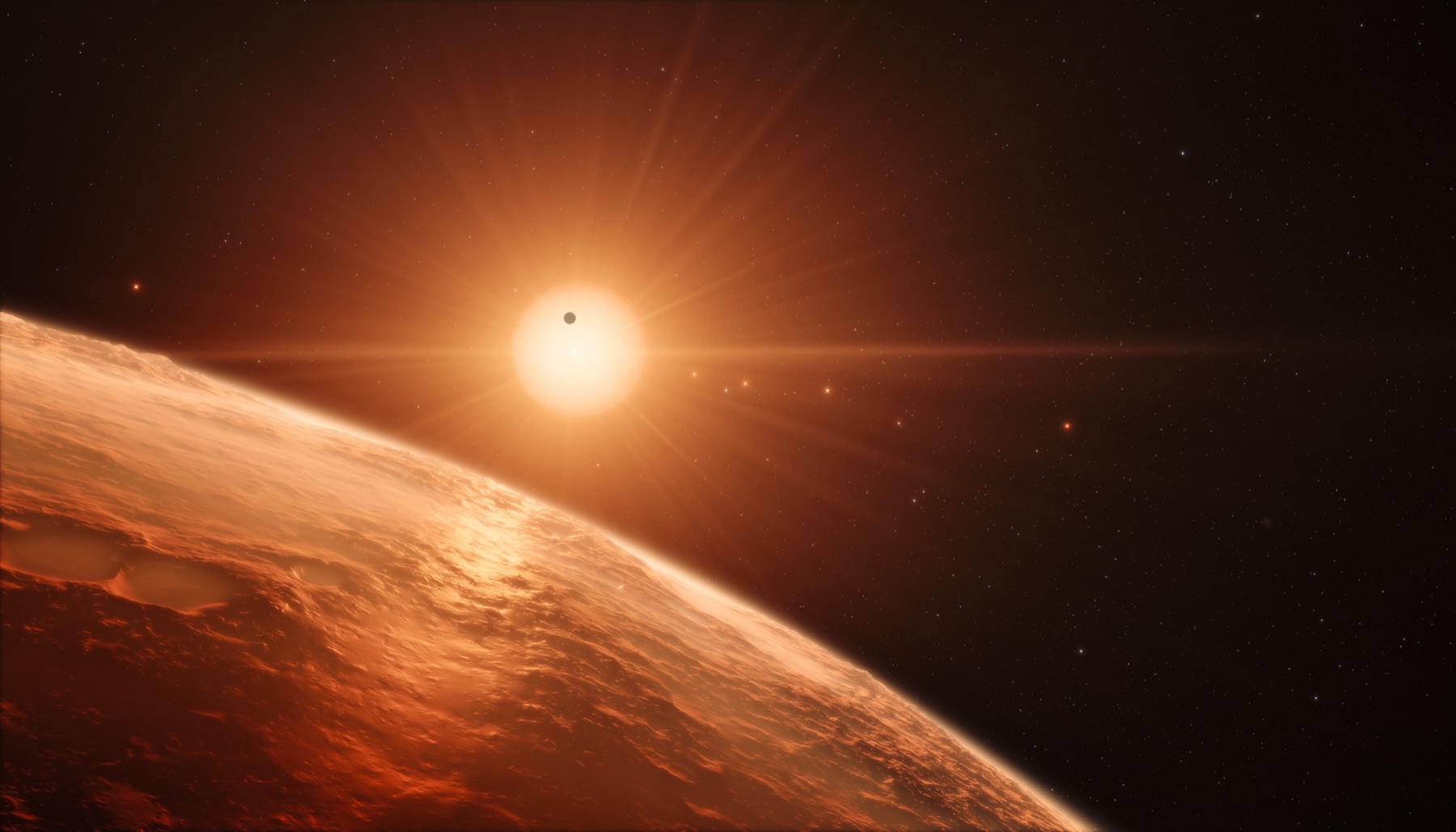
An exoplanet is any planet beyond our solar system, usually orbiting another star. As of October 2026, NASA’s Exoplanet Archive lists 6,445 confirmed exoplanets. The first were found in 1992 around a pulsar and in 1995 around a Sun-like star; most are detected by the dimming or wobbling they cause in their stars.
Thirty years ago no one knew whether planets were common. Now we know there are more planets than stars in the Milky Way, and the question has shifted to what they are like and whether any could host life. That second question is the subject of our astrobiology guide.
What is an exoplanet?
An exoplanet, short for extrasolar planet, is a planet outside the solar system. Most orbit other stars; a few orbit stellar remnants such as pulsars and white dwarfs, and some drift alone through space as rogue planets.
The boundary with stars is set by mass. Objects above about 13 Jupiter masses can briefly fuse deuterium and are usually classed as brown dwarfs, failed stars that sit between the biggest planets and the smallest stars. In October 2026 NASA’s SPHEREx mission published spectra of dozens of them (SPHEREx and brown dwarf atmospheres).
How many exoplanets have been discovered?
NASA’s Exoplanet Archive counted 6,445 confirmed exoplanets on October 8, 2026. The tally passed 6,000 in September 2025, with more than 8,000 candidates still awaiting confirmation at the time. NASA’s Transiting Exoplanet Survey Satellite (TESS) alone has now confirmed more than 1,000 planets.
The count climbs in jumps. The Kepler space telescope, which watched one patch of sky from 2009 to 2018, found 2,681 confirmed planets on its own (the Kepler mission). Gaia’s fourth data release, due in December 2026, is expected to add the first large set of candidates found by astrometry.
How are exoplanets discovered?
Most exoplanets are found indirectly, through their effect on their star. Here are the main methods, with each one’s share of the 6,445 confirmed planets in NASA’s archive:
- Transit (about 74%). A planet passing in front of its star blocks a tiny fraction of the light. Kepler and TESS found thousands this way. The first transit was caught in 1999, for the hot Jupiter HD 209458 b.
- Radial velocity (about 19%). A planet’s gravity makes its star wobble, shifting the star’s light slightly blue and red. This is how 51 Pegasi b was found in 1995.
- Gravitational microlensing (about 4.5%). When a star with a planet passes in front of a more distant star, its gravity acts as a lens, and the planet adds a brief extra spike. This method finds cold and rogue planets.
- Direct imaging (about 1.5%). Blocking the starlight reveals the planet itself, usually a young, hot giant far from its star. The first image of a multi-planet system, HR 8799, came in 2008 (Marois et al. 2008), and in July 2026 the VLT and JWST imaged Beta Pictoris d, the faintest exoplanet ever photographed from the ground (Beta Pictoris d).
- Timing (under 1%). Regular signals, such as pulsar pulses or a planet’s transit times, arrive early or late when another planet tugs on the system. The very first exoplanets were found this way.
- Astrometry (a handful so far). Precise measurements of a star’s position on the sky reveal a wobble. Gaia is expected to add many.
The first exoplanets
The first confirmed exoplanets were found in 1992 orbiting a dead star. Aleksander Wolszczan and Dale Frail timed the pulses of the millisecond pulsar PSR B1257+12 with the Arecibo radio telescope and found two planets a few times Earth’s mass (Wolszczan and Frail’s pulsar planets).
The first planet around a Sun-like star came three years later. In 1995 Michel Mayor and Didier Queloz used the ELODIE spectrograph in France to find 51 Pegasi b, a planet of about half Jupiter’s mass circling its star in just 4.2 days (the discovery of 51 Pegasi b). Nobody expected a giant planet that close and that hot. These “hot Jupiters” forced astronomers to accept that planets migrate after they form. Mayor and Queloz shared the 2019 Nobel Prize in Physics.
Types of exoplanets
Exoplanets come in kinds the solar system never prepared us for. The most common type of planet in the galaxy may be one we do not have at all.
| Type | Size or mass | What it is like | Example |
|---|
| Hot Jupiter | Jupiter-sized | Gas giant orbiting in days, scorching hot | 51 Pegasi b, WASP-39b |
| Super-Earth | About 1 to 1.5 Earth radii | Likely rocky, larger than Earth | LHS 1140 b (borderline) |
| Sub-Neptune (mini-Neptune) | About 2 to 4 Earth radii | Rock or ice core under thick gas, or a water world | K2-18b |
| Lava world | Earth-sized or larger | So close to its star the surface may be molten | 55 Cancri e |
| Cold giant | Jupiter-sized | Far from its star, like our gas giants | HR 8799 planets |
| Rogue planet | Any | No host star, drifting alone | Found by microlensing |
Sub-Neptunes are the puzzle. Kepler data show a gap in planet sizes between about 1.5 and 2 Earth radii: small planets tend to be either rocky super-Earths or gassy sub-Neptunes, with few in between (the Fulton radius gap). The leading explanation is that some planets lose their thin gas envelopes and some do not.
Habitable exoplanets: which are most like Earth?
The planets most often called Earth-like are rocky worlds orbiting in their star’s habitable zone, the range of distances where liquid water could exist on the surface. James Kasting and colleagues gave the zone its modern definition in 1993 (habitable zones around main sequence stars).
Leading candidates include Proxima b, the nearest exoplanet at about 4.2 light-years; TRAPPIST-1 e and its neighbors; TOI-700 d; LHS 1140 b; and Teegarden’s Star b. Being in the habitable zone does not mean a planet has water, an atmosphere or life. Our ranked comparison of the most Earth-like exoplanets explains each one and what JWST has found.
Most of these candidates orbit red dwarfs, small cool stars that make up most of the galaxy’s population. Their habitable zones are close in, which makes the planets easier to find but exposes them to violent stellar flares. The stars guide explains why red dwarfs live so long.
Reading exoplanet atmospheres with JWST
When a planet crosses its star, a sliver of starlight passes through its atmosphere, and molecules there absorb specific colors. Analyzing that filtered light is called transmission spectroscopy. In 2022 the James Webb Space Telescope used it to make the first definitive detection of carbon dioxide in an exoplanet atmosphere, on the hot Saturn-mass planet WASP-39b (JWST’s carbon dioxide detection).
Small rocky planets are much harder. JWST has found that several rocky planets around red dwarfs, including the two innermost TRAPPIST-1 planets, show no sign of thick atmospheres. The most publicized case is the sub-Neptune K2-18b, where a 2025 claim of a possible biosignature gas has not held up under independent reanalysis. We track that debate in K2-18b and the search for life.
Ground telescopes measure atmospheres too. In June 2026 a team using ESO’s Very Large Telescope measured winds on seven hot Jupiters and found the strongest evidence yet for exoplanet magnetic fields (exoplanet magnetic fields from winds).
Famous exoplanet systems
TRAPPIST-1
TRAPPIST-1 is an ultracool red dwarf about 40 light-years away with seven Earth-sized planets, announced in 2017 (Gillon et al. 2017). The planets orbit in 1.5 to about 19 days in a near-resonant chain, and three or four lie in or near the habitable zone. It is the best laboratory we have for asking whether rocky planets around small stars can keep their air. Planet-by-planet JWST results are in our TRAPPIST-1 explainer.
Proxima Centauri
Proxima Centauri, the Sun’s nearest stellar neighbor at about 4.2 light-years, hosts Proxima b, a planet of at least about one Earth mass orbiting every 11.2 days in the habitable zone. Proxima is a flare star, so whether its planet has kept an atmosphere is an open question. See our Proxima b explainer for its flares, its sibling planets and why it cannot yet be studied with JWST.
Moons and planets around brown dwarfs
No moon of an exoplanet has yet been confidently confirmed, despite more than 6,000 known planets. In July 2026 a team using the CRIRES+ instrument on ESO’s Very Large Telescope reported what it calls the first plausible detection of an exosatellite: an object at least as massive as Jupiter orbiting a brown dwarf, which in turn orbits the young star CD-35 2722 (VLT finds a possible exomoon). If confirmed, it would open a new class of objects to study, though at that mass it blurs the line between a moon and a planet.
51 Pegasi
51 Pegasi, about 50 light-years away in Pegasus, is a Sun-like star and the host of the first planet found around a normal star. Its planet, 51 Pegasi b, is the prototype hot Jupiter.
What comes next
The next decade will move from counting planets to characterizing them.
- Roman. NASA’s Nancy Grace Roman Space Telescope launched on August 30, 2026. Its microlensing survey will census cold planets and rogue planets across the galaxy, and its coronagraph will test technology for imaging planets directly.
- PLATO. ESA’s planet-hunting mission, built to find Earth-sized planets around Sun-like stars, is scheduled for launch in March 2027 on Ariane 6.
- Ariel. ESA’s mission to survey the atmospheres of about a thousand known exoplanets is now planned for 2031.
- The Extremely Large Telescope. ESO’s 39-meter ELT plans science observations from December 2030 and may detect molecules in the atmospheres of nearby rocky planets.
- Habitable Worlds Observatory. A NASA flagship concept for the 2040s, designed to image Earth-like planets around Sun-like stars and look for signs of life.
Planets are still being caught at every stage of life. In September 2026 astronomers confirmed Elias 2-24 b, about a million years old and still growing in its disk (the youngest exoplanet yet); Webb is studying dusty debris from planet-shattering collisions (extreme debris disks); and in October 2026 a white dwarf revealed what may be a “second-generation” planet born after its star died (HS 0209+0832).
For a visual introduction to detection methods, our video library includes Vox’s “How to find a planet you can’t see.”
Key papers
Where the research is happening
Sources
- NASA Exoplanet Archive, confirmed planet count (accessed 13 October 2026, counter dated 8 October 2026). https://exoplanetarchive.ipac.caltech.edu/ [database]
- NASA Exoplanet Archive, counts by discovery method. https://exoplanetarchive.ipac.caltech.edu/docs/counts_detail.html [database]
- NASA JPL (17 September 2025). NASA’s tally of planets outside our solar system reaches 6,000. https://www.jpl.nasa.gov/news/nasas-tally-of-planets-outside-our-solar-system-reaches-6000/ [press]
- Mayor, M. and Queloz, D. (1995). A Jupiter-mass companion to a solar-type star. Nature 378, 355. https://doi.org/10.1038/378355a0 [primary]
- ESA, PLATO and Ariel mission pages (accessed October 2026). https://www.esa.int/Science_Exploration/Space_Science/Plato [agency]