2008
K.-P. Schröder and Robert Connon Smith, Monthly Notices of the Royal Astronomical Society, 386, 155-163, 2008
Will the Sun Swallow Earth? Schröder and Smith (2008) Say Yes
Calculated in 2008 that the red giant Sun will engulf Earth about 7.6 billion years from now, despite losing a third of its mass. Schröder and Smith.
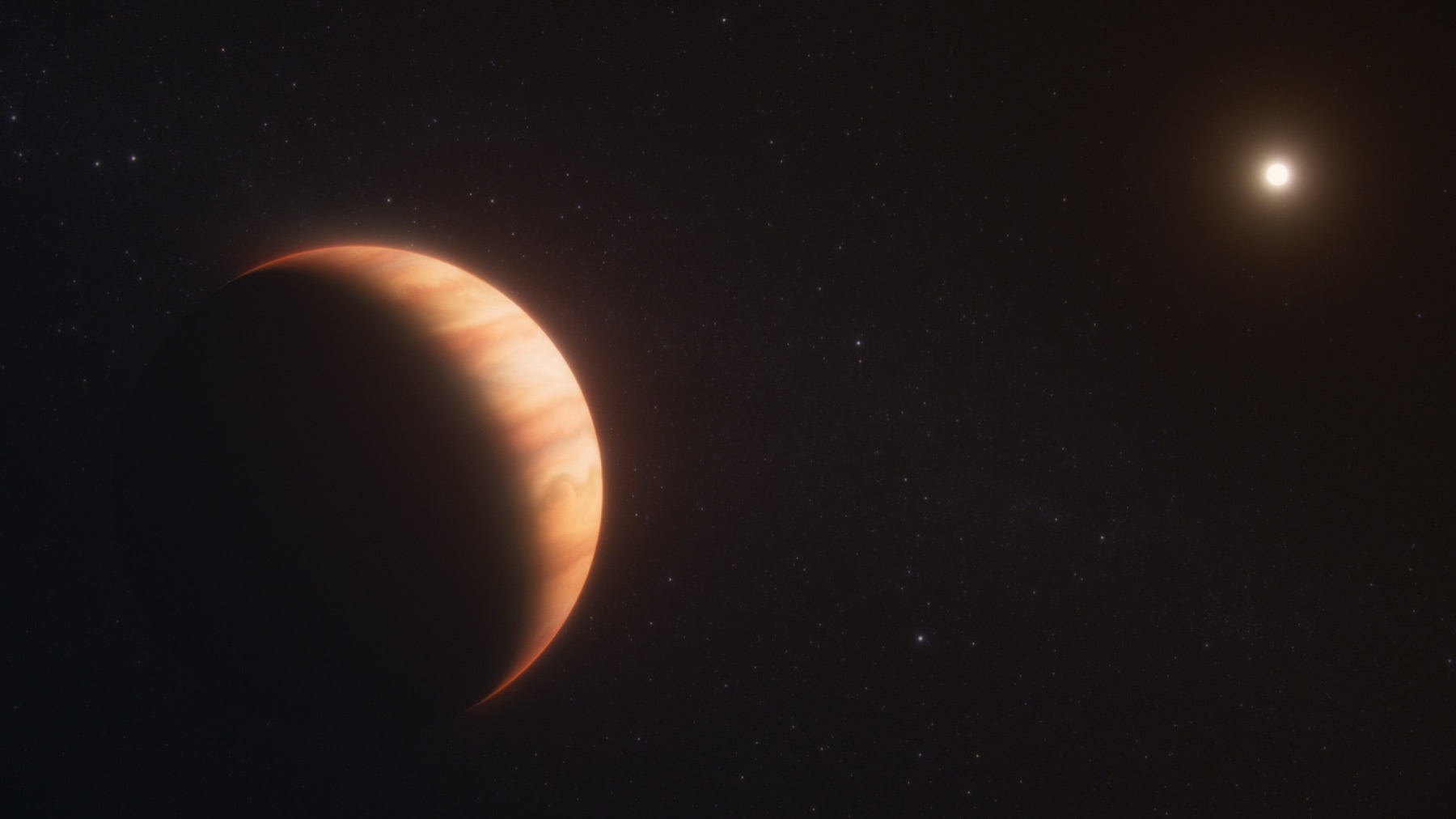
Will the Sun swallow the Earth? According to this 2008 study by K.-P. Schröder and Robert Connon Smith, yes. When the Sun swells into a red giant, about 7.6 billion years from now, Earth’s orbit will widen as the Sun loses mass, but not enough: tides and drag will pull our planet into the Sun’s outer layers.
The question before the paper
Stars like the Sun end their lives by swelling into red giants. As it expands, the Sun will also shed a large part of its mass in a strong wind, which weakens its gravity and lets the planets’ orbits drift outward. It is a race between the growing Sun and the retreating planet. Would Earth outrun the growing Sun, or be engulfed?
What the paper found
- The Sun loses a third of its mass. It is predicted to shed 0.332 solar masses during its red giant phase, reaching the tip of the red giant branch, its largest size, about 7.59 billion years from now.
- Earth’s orbit grows, but not enough. Mass loss lets Earth’s orbit expand, but tidal interaction with the giant Sun and drag from its extended outer atmosphere make Earth lose orbital momentum and spiral inward.
- Engulfment. Conclusion: Earth will not escape the red giant Sun.
- The survival line. A planet would need a present-day orbit of at least about 1.15 astronomical units, 15% farther out than Earth, to survive the red giant’s maximum size.
How they did it
The authors modeled the Sun’s evolution with a well-tested stellar evolution code and a calibrated formula for how fast red giants lose mass. They then followed Earth’s orbit through the red giant phase, including three effects: the outward drift from the Sun’s mass loss, the tidal pull of the swollen Sun, and drag as Earth moves through the thin outer layers of the solar atmosphere.
Why it mattered
This is the most cited modern estimate of Earth’s ultimate fate, with about 210 citations in Semantic Scholar as of October 2026. It shows that the end of our planet is set by stellar physics billions of years before any cosmic-scale event, long before the end of the Stelliferous Era.
What we know now
New work keeps refining the picture of the Solar System’s end. A September 2026 study by Batygin, Fuller and Adams, accepted in The Astrophysical Journal Letters, found that uneven mass loss as the Sun dies could break up the outer Solar System within a few billion years of the Sun becoming a white dwarf. Planets can survive their star’s death in some systems: see WD 1856 b. For the full timeline, read when will the Sun die? and our future of the universe guide.
Who wrote it
K.-P. Schröder and Robert Connon Smith wrote the paper together. As the title says, it revisits earlier estimates of the Sun’s and Earth’s distant future, this time with a calibrated description of red giant mass loss.
Read the original
Schröder, K.-P., and Smith, R. C. (2008). “Distant future of the Sun and Earth revisited.” Monthly Notices of the Royal Astronomical Society. doi:10.1111/j.1365-2966.2008.13022.x. Free on arXiv: 0801.4031.
This week in papers
Five new results in one line each, plus one landmark like this one. Weekly.
Keep reading
Krauss and Scherrer, General Relativity and Gravitation, 39, 1545-1550, 2007
The End of Cosmology: When the Big Bang's Evidence Fades
Argued in 2007 that accelerating expansion will erase the evidence of the Big Bang, leaving a static-looking universe. Krauss and Scherrer's essay.
Caldwell et al., Physical Review Letters, 91, 071301, 2003
The Big Rip: Phantom Energy and a Cosmic Doomsday
Showed in 2003 that dark energy with w below -1 would tear apart galaxies, planets and atoms in a finite time. Caldwell et al. on the Big Rip.
Adams and Laughlin, Reviews of Modern Physics, 69, 337-372, 1997
A Dying Universe: The Five Ages of the Universe Explained
Mapped the universe's future into eras, from the age of stars to a dark era beyond 10100 years. Fred Adams and Gregory Laughlin's 1997 review, explained.
Topic guide
Future of the universe
Recent news in future of the universe
Lopsided Mass Loss as the Sun Dies Could Wreck the Outer Solar System