2025
Falcke et al., Journal of Cosmology and Astroparticle Physics, 2025
Falcke et al. (2025): Could Dead Stars Evaporate Like Black Holes?
Proposed in 2025 that white dwarfs and neutron stars evaporate by Hawking-like radiation, the last within 1078 years. Falcke, Wondrak, van Suijlekom.
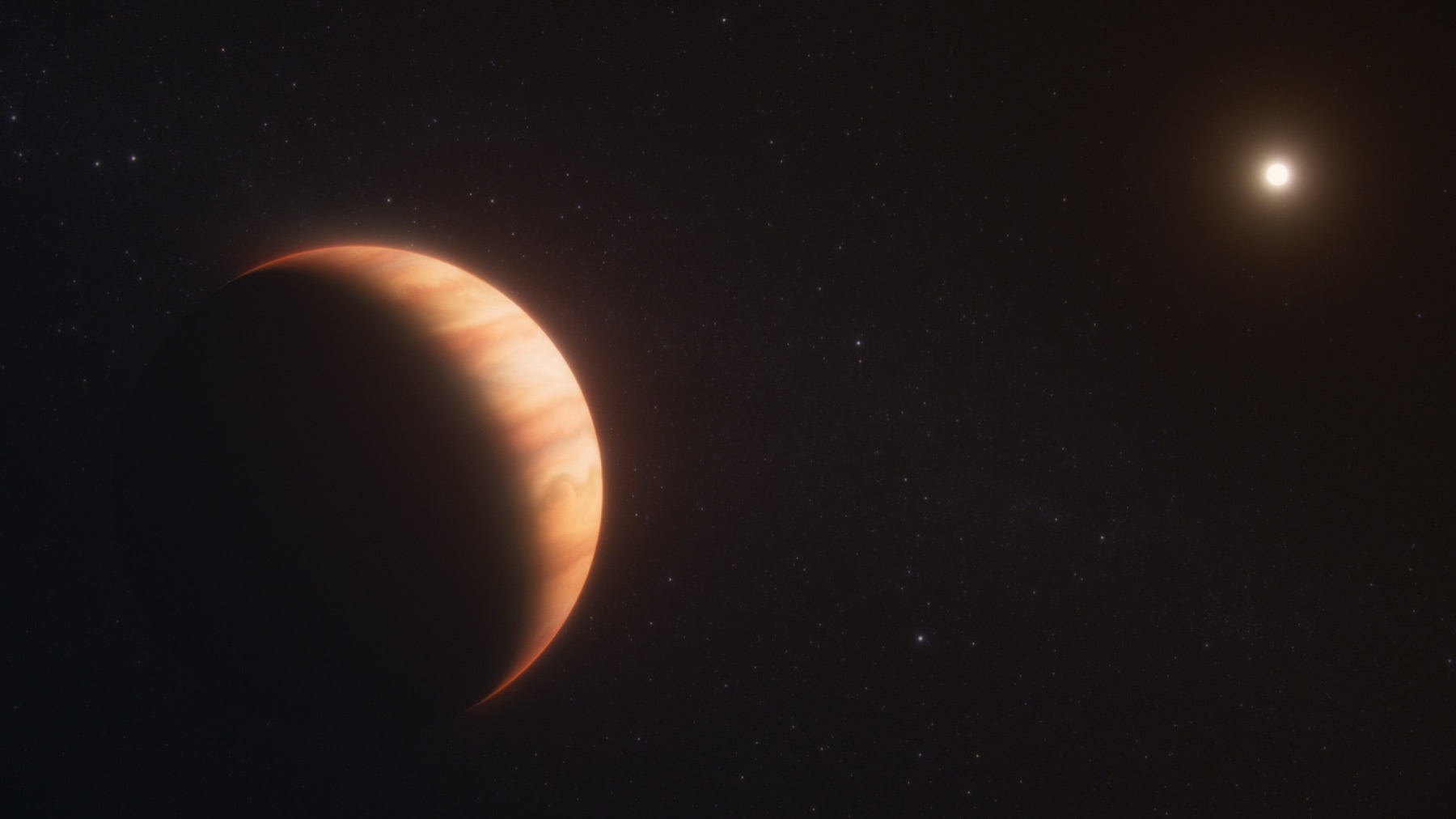
In a 2025 paper, Heino Falcke, Michael Wondrak and Walter van Suijlekom proposed that even dead stars slowly evaporate, through a process similar to Hawking radiation from black holes. If they are right, the last white dwarfs vanish after roughly 1078 years, vastly sooner than earlier estimates. The idea is theoretical and not yet widely tested.
The question before the paper
Stephen Hawking showed in 1974 that black holes radiate and evaporate, a quantum effect tied to their event horizons. The authors’ earlier work suggested something broader: that strong spacetime curvature alone, without any horizon, can create particle pairs and produce Hawking-like radiation. If so, any very dense object should slowly lose mass. How long would the densest dead stars, neutron stars and white dwarfs, survive?
What the paper found
- Evaporation depends on density. The evaporation time scales with an object’s average density as τ ∝ ρ-3/2: denser objects evaporate faster.
- Neutron stars: about 1068 years at most, comparable to the lifetime of low-mass stellar black holes.
- White dwarfs: roughly 1078 years. The last white dwarfs would vanish then, vastly sooner than the 101100 years previously suggested for the decay of stellar remnants through other processes.
How they did it
The authors calculated the rate of “gravitational pair production”, the creation of particle pairs by spacetime curvature, for compact objects such as neutron stars and white dwarfs. Adding up the energy carried away gives how fast each object loses mass, and so its maximum lifetime, as a function of its density.
Why it mattered
If correct, the universe’s long dark future is much shorter than earlier estimates, though still unimaginably long. It would change the far end of the Degenerate Era, the age of dead stars in Adams and Laughlin’s timeline of the far future. Until now, Hawking-type evaporation, quantified by Don Page’s emission rates, was treated as something only black holes do.
What we know now
As of October 2026 the mechanism is theoretical and not yet widely tested. It is a recent example of how speculative physics can change the timeline of the far future, and it should be read as a proposal, not an established result. For the bigger picture see the heat death of the universe, the future of the universe guide and Deep Time.
Who wrote it
Heino Falcke, Michael Wondrak and Walter van Suijlekom wrote the paper together. It was published in the Journal of Cosmology and Astroparticle Physics in May 2025, after appearing on arXiv in October 2024.
Read the original
Falcke, H., Wondrak, M. F., and van Suijlekom, W. D. (2025). “An upper limit to the lifetime of stellar remnants from gravitational pair production.” Journal of Cosmology and Astroparticle Physics. doi:10.1088/1475-7516/2025/05/023. Free on arXiv: 2410.14734. Radboud University’s press release has a plain-language summary.
This week in papers
Five new results in one line each, plus one landmark like this one. Weekly.
Keep reading
Sawala et al., Nature Astronomy, 2025
Milky Way-Andromeda Collision: Now Only a Coin Flip
Found in 2025 only about a 50% chance that the Milky Way and Andromeda merge in the next 10 billion years, using Hubble and Gaia data. Till Sawala's team.
Schröder and Smith, Monthly Notices of the Royal Astronomical Society, 386, 155-163, 2008
Will the Sun Swallow Earth? Schröder and Smith Say Yes
Calculated in 2008 that the red giant Sun will engulf Earth about 7.6 billion years from now, despite losing a third of its mass. Schröder and Smith.
Krauss and Scherrer, General Relativity and Gravitation, 39, 1545-1550, 2007
The End of Cosmology: When the Big Bang's Evidence Fades
Argued in 2007 that accelerating expansion will erase the evidence of the Big Bang, leaving a static-looking universe. Krauss and Scherrer's essay.
Topic guide
Future of the universe
Recent news in future of the universe
Lopsided Mass Loss as the Sun Dies Could Wreck the Outer Solar System