When will the Sun die?
The Sun will leave its stable phase in about 5 billion years, swell into a red giant and end as a white dwarf. The timeline, and what it means for Earth.
By The Orbital Record editorial teamPublished Last reviewed
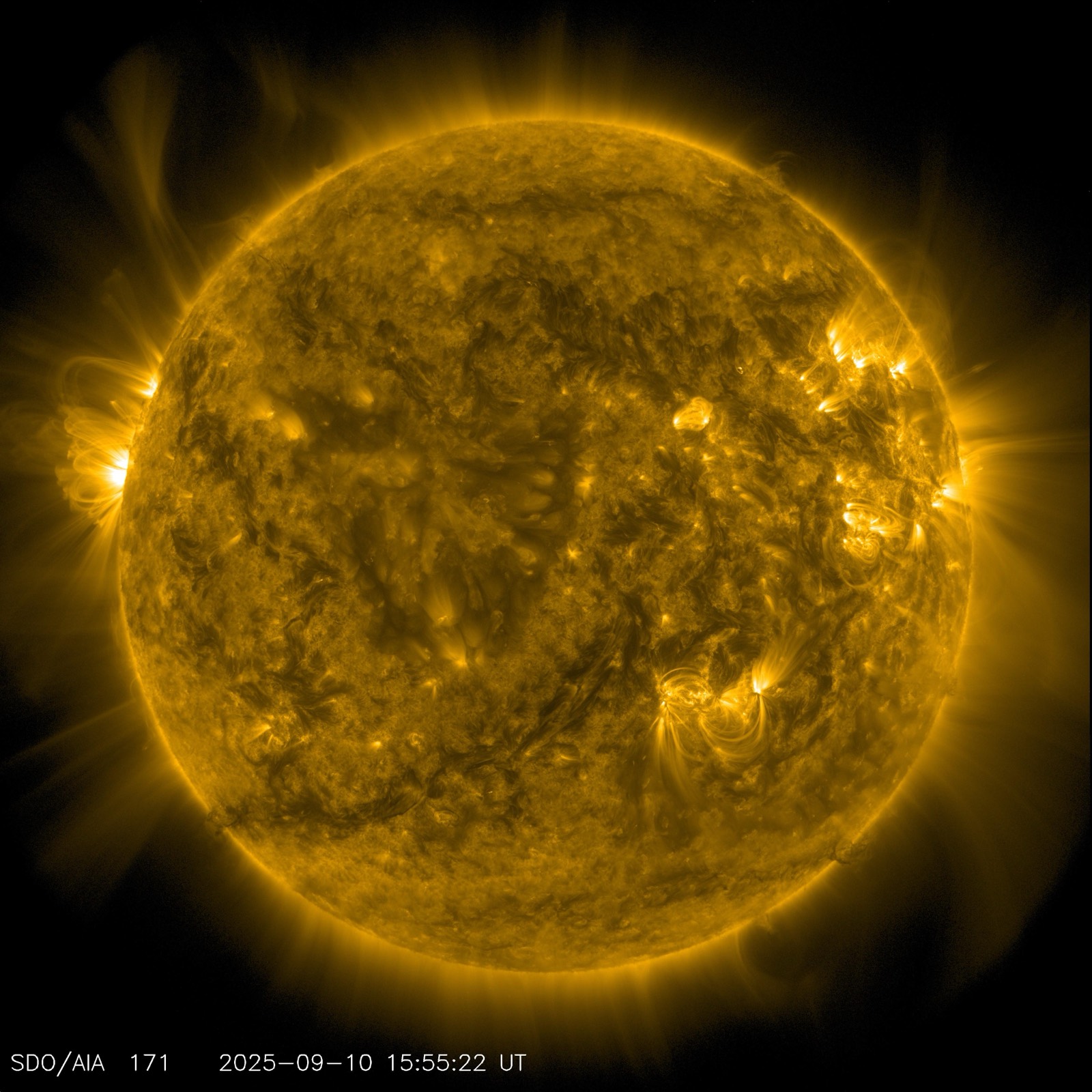
The Sun will begin to die in about 5 billion years, when it runs out of hydrogen in its core. It will swell into a red giant, probably engulfing Mercury, Venus and Earth, then shed its outer layers and end as a white dwarf about the size of Earth. It will never explode or become a black hole. Earth becomes uninhabitable much sooner, in roughly a billion years.
This is the solar system’s own ending, part of the long story told in how the solar system formed, and how it will end. It follows the same life cycle as every Sun-like star, described in our stars guide.
The timeline at a glance
Times are from now. The Sun is about 4.57 billion years old today.
| Time from now | Sun’s age | What happens |
|---|---|---|
| Now | 4.6 billion years | Stable middle age, fusing hydrogen into helium in the core |
| About 1 billion years | 5.6 billion years | About 10% brighter; Earth likely loses its oceans and habitability |
| About 3 to 4 billion years | 8 billion years | Surface temperature peaks, per ESA’s Gaia analysis |
| About 5 to 5.4 billion years | About 10 billion years | Core hydrogen runs out; the Sun leaves the main sequence |
| About 7.6 billion years | About 12.2 billion years | Red giant at its largest: about 256 times today’s radius, around 2,700 times brighter |
| Shortly after | Helium ignites in the core in a “helium flash” | |
| About 100 million years more | Calm helium burning, as a smaller, steadier star | |
| Then | Second giant phase; outer layers blown off as a planetary nebula | |
| Afterward, for trillions of years | A white dwarf of about 0.54 solar masses slowly cools |
The figures come mainly from a 2008 model of the Sun’s evolution by Klaus-Peter Schröder and Robert Connon Smith (Schröder and Smith 2008), with the phase lengths from earlier models by Juliana Sackmann and colleagues (1993) and the temperature peak from ESA’s Gaia study of Sun-like stars (2022). Different models shift these numbers by a few hundred million years.
Stage 1: the slow brightening
The Sun is already getting brighter. As hydrogen in its core turns into helium, the core contracts and heats up, and fusion speeds up. Schröder and Smith estimate the Sun brightens by about 1% every 110 million years, or about 10% over the next billion years.
That small change matters for Earth. A 10% brighter Sun is expected to start evaporating the oceans and push Earth beyond the inner edge of the habitable zone in about a billion years, a timing the authors call a rough estimate because it depends on clouds and climate. Life on Earth has a deadline far earlier than the Sun’s death.
Stage 2: the red giant
In about 5 billion years the core runs out of hydrogen. Fusion moves to a shell around the core, and the Sun’s outer layers swell enormously while cooling to a red color. Over several hundred million years it climbs the red giant branch, reaching its largest size about 7.6 billion years from now.
At its peak, the model gives:
- a radius of about 256 times today’s, roughly 1.2 AU (an astronomical unit is the Earth-Sun distance);
- a luminosity around 2,700 times today’s;
- a mass reduced by about a third, as the swollen Sun loses gas to a strong wind.
Will Earth be swallowed?
Probably. Mercury and Venus are engulfed for certain. Earth is the borderline case. As the Sun loses mass its grip weakens and Earth’s orbit drifts outward, which helps. But tidal forces from the bloated Sun and drag from its tenuous outer atmosphere pull Earth inward, which hurts more. Schröder and Smith concluded Earth will not escape, and that a planet would need to start at about 1.15 AU or farther to survive the red giant’s maximum. Mars, at 1.5 AU, likely survives, scorched.
Stage 3: the helium flash and a second life
When the core reaches about 100 million degrees, helium ignites, in a runaway event called the helium flash. The Sun then settles down, shrinks and burns helium into carbon and oxygen in its core for roughly 100 million years. When that core helium is exhausted, the Sun swells again as an asymptotic giant branch star, pulsing and shedding its outer layers.
Stage 4: planetary nebula and white dwarf
The final outer layers drift away as a planetary nebula, a glowing shell of gas lit by the exposed core. It lasts only a few tens of thousands of years before fading into space, seeding the galaxy with carbon and other elements made inside the Sun.
What remains is a white dwarf: about 0.54 times the Sun’s present mass packed into a sphere about the size of Earth, supported by the pressure of tightly packed electrons rather than by fusion. It is well under the Chandrasekhar limit of about 1.4 solar masses, the maximum a white dwarf can have (Chandrasekhar 1931). It starts extremely hot and then simply cools, for longer than the universe has existed so far, eventually becoming a cold, dark black dwarf.
Will the Sun become a black hole or a supernova?
No to both, and it is not close. A core-collapse supernova needs a star of roughly eight solar masses or more, and a black hole needs a collapsing core heavier than about two to three solar masses. The Sun has one solar mass and will leave a core of about half that. It will die quietly by stellar standards.
What happens to the rest of the solar system?
- Jupiter and the giants survive the red giant phase on wider orbits as the Sun loses mass. A September 2026 study, accepted by The Astrophysical Journal Letters, argues the Sun’s mass loss will be lumpy rather than smooth, and that in simulations most outer solar systems then break apart within about 3 billion years of the white dwarf forming (outer solar system instability).
- Planets can outlive their stars. In July 2026 JWST showed how the Jupiter-sized planet WD 1856 b came to orbit a white dwarf, likely after surviving its star’s red giant phase far out and migrating inward later (WD 1856 b).
- Chaos may strike first. In about 1% of simulated futures, Mercury’s orbit becomes unstable before the Sun even leaves the main sequence (Laskar 1989 and later work).
- Andromeda is a side story. A merger with the Andromeda Galaxy is now roughly a coin flip over the next 10 billion years (the Andromeda collision), but by then Earth’s fate will already have been decided by the Sun.
The Sun in cosmic context
The Sun is an ordinary star. Most stars in the galaxy are smaller red dwarfs that will outlive it by a factor of a thousand, and the universe will keep making stars for about 1014 years, the span Fred Adams and Gregory Laughlin called the Stelliferous Era (Adams and Laughlin 1997). Our Sun’s white dwarf will join the countless others of the Degenerate Era. Follow the whole span in Deep Time.
ESA’s Gaia mission, which measured the temperatures and brightness of millions of stars, is how astronomers checked these models against Sun-like stars at every stage of life.
Sources
- Schröder, K.-P. and Smith, R. C. (2008). Distant future of the Sun and Earth revisited. Monthly Notices of the Royal Astronomical Society 386, 155. https://arxiv.org/abs/0801.4031 [primary]
- Sackmann, I.-J., Boothroyd, A. I. and Kraemer, K. E. (1993). Our Sun. III. Present and Future. The Astrophysical Journal 418, 457. [primary]
- ESA (11 August 2022). Gaia reveals the past and future of the Sun. https://www.esa.int/Science_Exploration/Space_Science/Gaia/Gaia_reveals_the_past_and_future_of_the_Sun [agency]
- Batygin, K., Fuller, J. and Adams, F. C. (2026). Accepted, ApJ Letters. https://arxiv.org/abs/2609.12494 [primary]
Questions people ask
Will the Sun become a black hole?
No. Only stars born with many times the Sun's mass leave cores heavy enough to collapse into black holes. The Sun will instead shed its outer layers and leave a white dwarf of about half its present mass, roughly the size of Earth, supported by electron pressure.
Will the Sun explode as a supernova?
No. Core-collapse supernovae need stars of roughly eight solar masses or more, and the Sun has one. Its death will be gentle by comparison: its outer layers drift away as a glowing planetary nebula over tens of thousands of years, leaving a hot white dwarf at the center.
Will the Sun swallow Earth?
Probably. A widely cited 2008 model by Klaus-Peter Schröder and Robert Connon Smith found that when the red giant Sun reaches its largest size, about 7.6 billion years from now, tidal forces and drag will pull Earth inward and it will be engulfed. Mercury and Venus are certainly swallowed; Mars likely survives.
How long until Earth becomes uninhabitable?
Roughly a billion years, long before the Sun dies. The Sun brightens by about 10% every billion years, and that extra heat is expected to start evaporating the oceans and push Earth out of the habitable zone. The exact timing depends on climate feedbacks and is a rough estimate.
How long will the Sun last?
The Sun has spent about 4.6 billion years of a roughly 10-billion-year stable life fusing hydrogen, so it has about 5 billion years left in that phase. After that its subgiant, red giant and helium-burning stages last roughly another 2 billion years before it becomes a white dwarf, which then cools for trillions of years.
What will the Sun look like after it dies?
First a planetary nebula, a glowing shell of ejected gas lit up by the exposed hot core, visible for a few tens of thousands of years. Then a white dwarf: an Earth-sized ember about half the Sun's mass, slowly cooling and dimming for longer than the universe has existed so far.