Space telescope, founded 2024
Laser Interferometer Space Antenna (LISA)
LISA is ESA's planned space gravitational-wave observatory: three spacecraft 2.5 million km apart. Adopted in 2024, it should launch in the mid-2030s.
- Location
- Planned Earth-trailing heliocentric orbit (three spacecraft)
- Focus
- Gravitational waves, Black holes, Cosmology, Telescopes and missions
In space
Planned Earth-trailing heliocentric orbit (three spacecraft)
The Laser Interferometer Space Antenna (LISA) is a European Space Agency mission, with NASA as a partner, to detect gravitational waves from space. ESA’s Science Programme Committee formally adopted it on January 25, 2024. Three spacecraft will fly in an equilateral triangle with arms 2.5 million km long, about 6.5 times the Earth-Moon distance, trailing Earth around the Sun and exchanging infrared laser beams. LISA will measure changes in distance smaller than the width of a helium atom, enough to sense low-frequency gravitational waves that ground detectors cannot.
Flagship instruments
- Three spacecraft forming a laser interferometer in space.
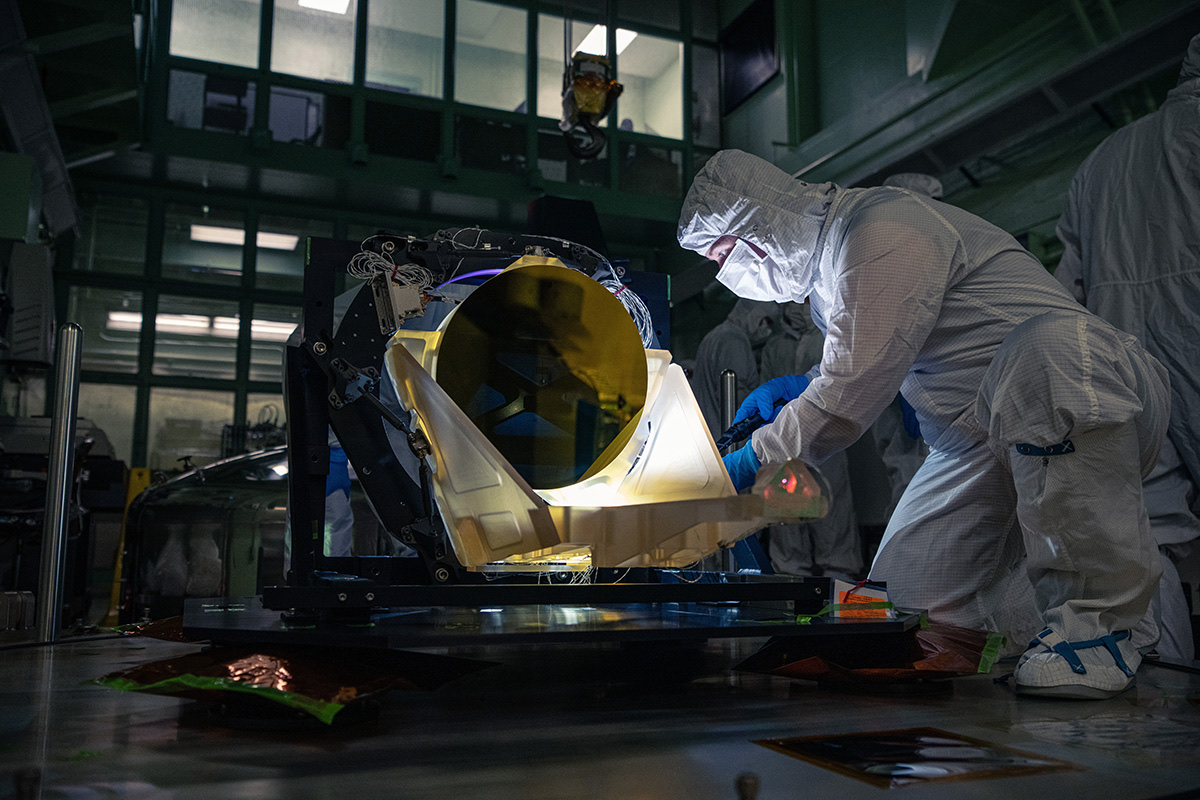
- Telescopes made of Zerodur glass-ceramic, two per spacecraft, provided by NASA; the material resists changes in shape with temperature.
Recent results
LISA has no data yet, so its recent milestones are hardware. The prime industrial contract went to OHB System AG, and construction began in 2025. In October 2026, NASA ordered an Engineering Test Unit telescope from L3Harris, the last step before flight hardware. The science case rests on results from the ground: the first direct detection in 2015 and, at much lower frequencies, the 2023 pulsar-timing evidence for a gravitational-wave background.
What to watch, 2026-2030
- 2025-2034: spacecraft and instrument construction, led industrially by OHB.
- 2026-2030: engineering test units, including the NASA telescope.
- Launch: planned for 2035 on Ariane 6 (NASA says “mid-2030s”).
Why scientists are converging here
LISA targets sources no other detector can reach: merging supermassive black holes, compact binaries across the Milky Way, possible primordial gravitational waves and an independent measure of cosmic expansion. Ground detectors keep raising the stakes: LIGO-Virgo-KAGRA has now confirmed 390 events. Europe is also spending more on space: at the November 2025 ministerial, ESA member states committed a record EUR 22.07 billion for three years, 32% more than in 2022. For gravitational-wave astronomy, LISA is the long-term anchor.