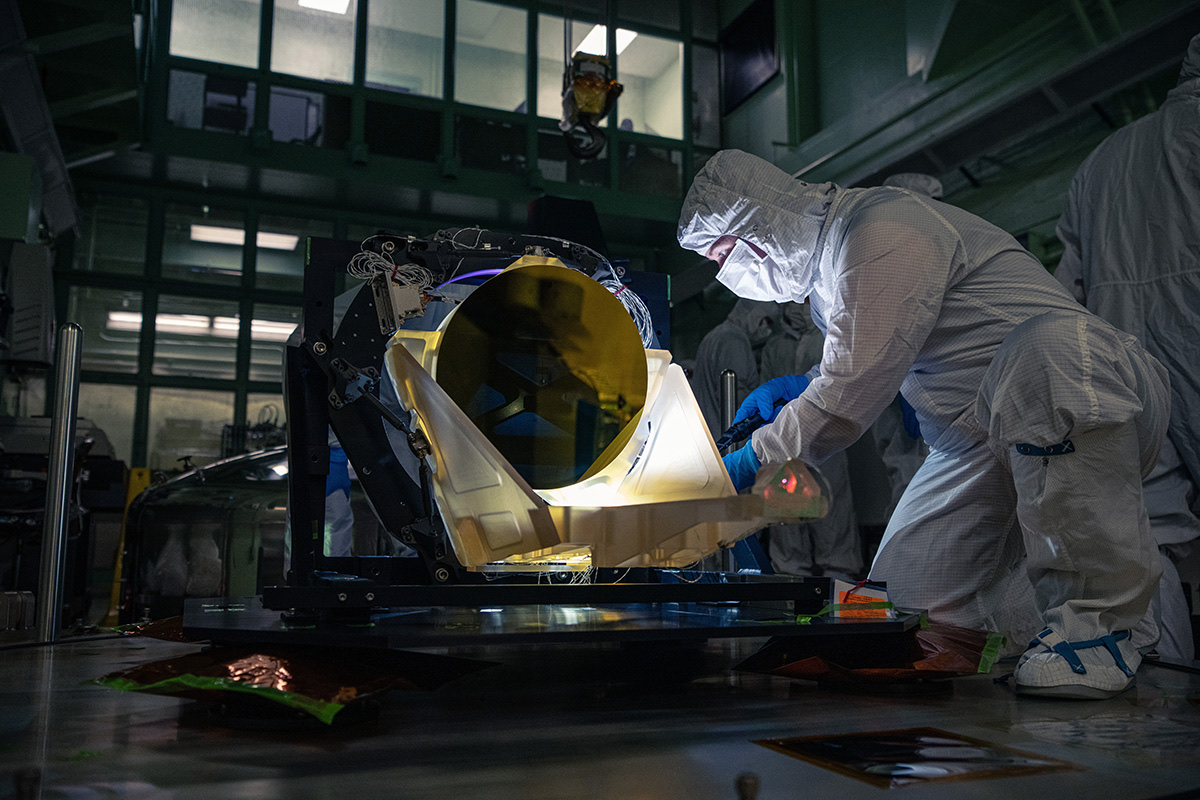
Collaboration
NANOGrav (North American Nanohertz Observatory for Gravitational Waves)
NANOGrav times millisecond pulsars to detect gravitational waves with periods of years. In 2023 it reported evidence for a gravitational-wave background.
- Location
- Pulsar timing with the Green Bank Telescope, the VLA and CHIME (North America)
- Focus
- Gravitational waves, Black holes, Stars, Cosmology
No single site
Pulsar timing with the Green Bank Telescope, the VLA and CHIME (North America)
NANOGrav, the North American Nanohertz Observatory for Gravitational Waves, uses the Milky Way as a detector. It times an array of millisecond pulsars, spinning neutron stars that tick with clock-like regularity, and looks for tiny, correlated shifts in their arrival times. Those shifts can reveal gravitational waves with periods of years to decades, far longer than ground detectors like LIGO can sense.
Flagship instruments
- Green Bank Telescope: the world’s largest fully steerable dish.
- Very Large Array and CHIME: additional radio telescopes for timing. NANOGrav previously used Arecibo.
- International Pulsar Timing Array: NANOGrav’s partnership with European, Australian (Parkes) and Indian pulsar timing arrays.
Recent results
In June 2023, the NANOGrav 15-year data set reported evidence for a gravitational-wave background: correlations among 67 pulsars that follow the Hellings-Downs pattern expected from gravitational waves, at about 3 to 4 sigma depending on the method. Similar evidence came the same day from European, Indian, Australian and Chinese arrays. NANOGrav’s site lists 75 pulsars and 677,000 times of arrival for the 15-year data set. The idea goes back to the first pulsars, found in 1967-1968, and the 1974 binary pulsar, which gave the first indirect evidence of gravitational waves.
What to watch, 2026-2030
Our sources list no dated NANOGrav milestones for 2026-2030. Watch for longer data sets: every added year of timing sharpens the background signal, and new millisecond pulsars, such as those found by FAST, add clocks to the array.
Why scientists are converging here
A leading candidate for the background’s source is pairs of supermassive black holes slowly spiraling together across the universe; LISA is designed to catch such black holes when they finally merge. In our Research Pulse count, “pulsar timing” appeared in 151 astro-ph abstracts from April to September 2026, up 11% on the previous six months. For gravitational-wave astronomy, pulsar timing is the low-frequency end of the spectrum.