2018
Pardo et al., Journal of Cosmology and Astroparticle Physics, 2018, 048, 2018
GW170817 Counts Spacetime Dimensions (2018): The Answer Is Four
Showed in 2018 that GW170817's gravitational waves travel in 3+1 spacetime dimensions, with no leak into large extra ones. Pardo, Fishbach, Holz, Spergel.
In 2018 Kris Pardo, Maya Fishbach, Daniel Holz and David Spergel used the neutron star merger GW170817 to count the dimensions of spacetime that gravitational waves travel through. If gravity leaked into extra, uncurled dimensions, the waves would arrive weaker than expected. They did not: the measured number of spacetime dimensions is 4.02 (+0.07, -0.10).
What the paper found
- Four dimensions, to a few percent. Using the SH0ES value of the Hubble constant, the number of spacetime dimensions D comes out at 4.02 (+0.07, -0.10); using the Planck value, 3.98 (+0.07, -0.09). Both match the three space plus one time dimensions of general relativity.
- No measurable leakage. The authors parametrize how fast the waves fade with distance by an exponent γ, which equals 1 in general relativity. They find γ = 1.01 (+0.04, -0.05) with SH0ES and 0.99 (+0.03, -0.05) with Planck.
- A screening scale beyond 20 megaparsecs. In some theories, gravity behaves normally up to a certain distance and only then starts to leak. That crossover must lie beyond about 20 megaparsecs, roughly 65 million light-years.
- A long-lived graviton. If gravitons could decay, the data require a lifetime longer than 4.50 × 10⁸ years.
How they did it
Gravitational waves carry their own distance information: the strength of the signal tells you how far away the source is, if you assume general relativity. Light from the same event gives a second, independent distance. For GW170817, the first neutron star merger seen in both gravitational waves and light, astronomers identified the host galaxy, NGC 4993, about 40 megaparsecs away, and could measure its distance from its redshift and the Hubble constant.
If gravity leaked into extra dimensions as the waves traveled, their amplitude would drop faster than in four dimensions, and the gravitational-wave distance would come out larger than the light-based distance. The authors compared the two and found they agree. The light-based distance depends on the expansion rate of the universe, which is why they quote results for both the local SH0ES and the early-universe Planck values of the Hubble constant (see the Hubble tension).
Why it mattered
Before 2017, nobody had a gravitational-wave source with a known distance from light. GW170817 made it possible to test, for the first time, whether gravitational waves fade over cosmic distances exactly as general relativity predicts. This paper turned that into a direct count of spacetime dimensions as felt by gravity, an elegant check on Minkowski’s four-dimensional spacetime.
The authors are careful about what the test can and cannot see. It constrains extra dimensions that are not curled up, or curled up on scales at least as large as the wavelength of the waves, about 100 kilometers. It says nothing about small compact dimensions such as those of string theory or the ADD large extra dimensions, and it constrains the Randall-Sundrum infinite-dimension variant only poorly. Those are tested instead by tabletop gravity experiments and colliders.
What we know now
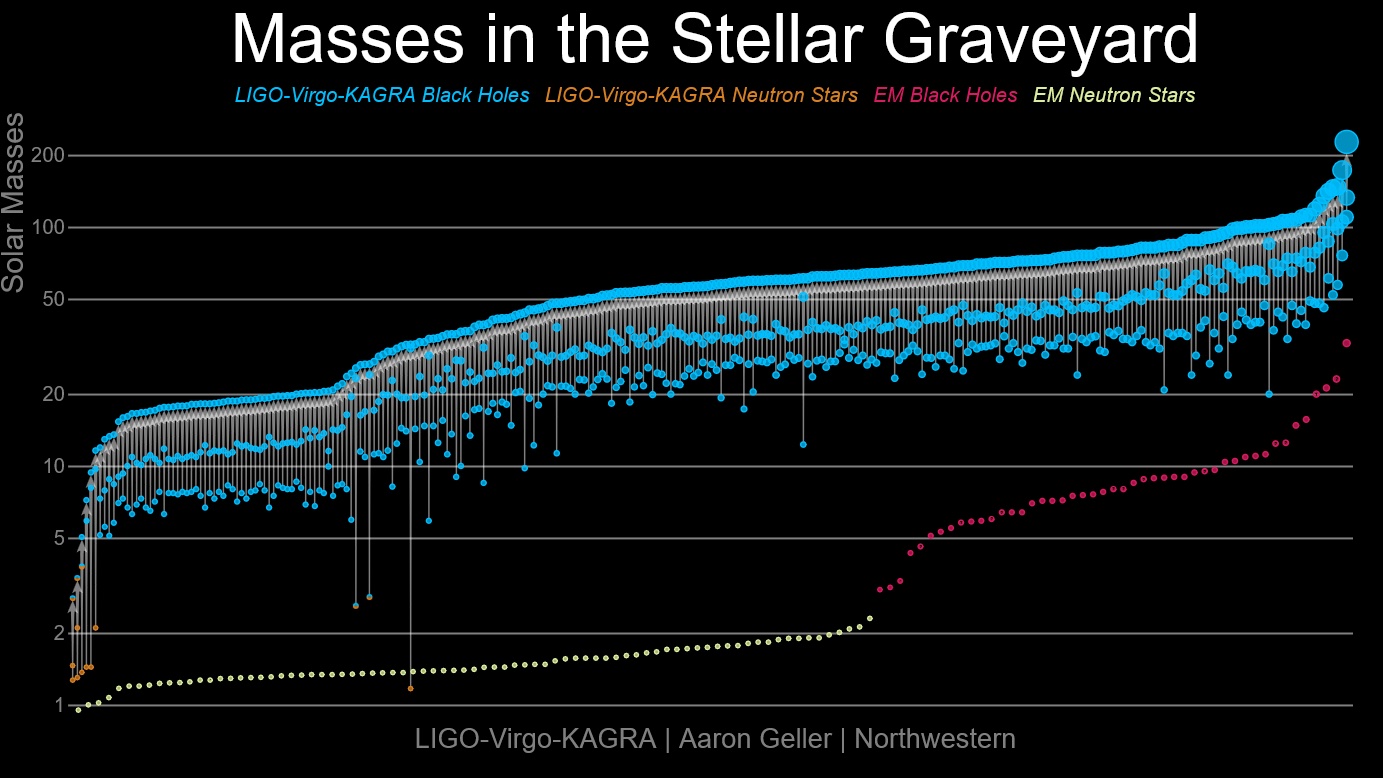
The result stands: as of October 2026, gravitational waves behave as expected in four spacetime dimensions. The LIGO-Virgo-KAGRA network has since confirmed 390 gravitational-wave events, as of the GWTC-5.0 catalog (May 2026). Repeating this test needs events with a light-based distance, which is what made GW170817 special. The authors noted that events at different distances would let future analyses pin down the screening scale directly. More in our gravitational waves guide and our explainer on the fourth dimension.
Who wrote it
Kris Pardo was at Princeton University. Maya Fishbach and Daniel Holz were at the University of Chicago, and David Spergel at Princeton and the Flatiron Institute’s Center for Computational Astrophysics. Spergel was also first author of the WMAP first-year cosmology paper.
Read the original
Pardo, K., Fishbach, M., Holz, D. E., and Spergel, D. N. (2018). “Limits on the number of spacetime dimensions from GW170817.” Journal of Cosmology and Astroparticle Physics 2018 (07), 048. DOI: 10.1088/1475-7516/2018/07/048. Free to read on arXiv (1801.08160).
This week in papers
Five new results in one line each, plus one landmark like this one. Weekly.
Keep reading
LIGO Scientific Collaboration and Virgo Collaboration, Physical Review Letters, 119, 161101, 2017
GW170817: The Neutron Star Merger Seen in Waves and Light
Detected in 2017 two neutron stars merging 40 megaparsecs away, also seen as a gamma-ray burst and a kilonova. The LIGO-Virgo GW170817 discovery paper.
LIGO Scientific Collaboration and Virgo Collaboration, Physical Review Letters, 116, 061102, 2016
First Gravitational Wave Detection: LIGO's GW150914 Paper
Detected gravitational waves for the first time, from two black holes merging 1.3 billion light-years away. The 2016 LIGO-Virgo GW150914 paper.
NANOGrav Collaboration, The Astrophysical Journal Letters, 951, L8, 2023
NANOGrav: Evidence for the Gravitational Wave Background
Found evidence in 2023 for a background hum of gravitational waves by timing 67 pulsars for 15 years. The NANOGrav Collaboration's 15-year data set paper.
Topic guide
Gravitational waves
Recent news in gravitational waves
GWTC-5.0 Catalog Brings the Gravitational-Wave Tally to 390 Events