The Hubble tension
The Hubble tension is a 5-sigma clash between two ways of measuring cosmic expansion, about 67 vs 73 km/s/Mpc. What each side measures, what might fix it.
By The Orbital Record editorial teamPublished Last reviewed
The Hubble tension is a disagreement between two ways of measuring how fast the universe is expanding today. Early-universe data from the cosmic microwave background predict about 67.4 kilometers per second per megaparsec; direct measurements of nearby galaxies give about 73. The gap is now significant at 5 sigma or more, and its cause is unknown.
It is the sharpest open problem in cosmology right now. Either one side has an error nobody has found despite a decade of searching, or the standard model of the universe is missing something.
What is the Hubble constant?
The Hubble constant, written H0, is the current expansion rate of the universe. Galaxies recede from us at speeds proportional to their distance, and H0 is the ratio. It is measured in kilometers per second per megaparsec (one megaparsec is 3.26 million light-years).
Georges Lemaître derived the relation in 1927 and Edwin Hubble measured it in 1929 (Hubble’s law of 1929). Hubble’s value, about 500, was roughly seven times too large because his distances were badly calibrated. For most of the 20th century astronomers argued over whether the true value was nearer 50 or 100. The fact that we now argue over 67 versus 73 is a measure of how far precision has come.
The two ways to measure it
The tension exists because there are two completely different routes to H0, and they do not meet.
The early-universe route
This route never looks at nearby galaxies. It measures the cosmic microwave background, the light released 380,000 years after the Big Bang, whose spots carry the imprint of sound waves of a known physical size. Planck measured the angular size of those spots to 0.03%. Combined with the standard Lambda-CDM model, that predicts how fast the universe should be expanding today: 67.4 ± 0.5 km/s/Mpc (Planck 2018 cosmological parameters).
The same sound-wave ruler, frozen into the pattern of galaxies as baryon acoustic oscillations, gives a consistent answer. The Dark Energy Spectroscopic Instrument (DESI) combined with the cosmic microwave background gave 67.97 ± 0.38 in its first-year analysis (DESI 2024 baryon acoustic oscillation cosmology), and in July 2026 its Lyman-alpha forest data gave 66.5 ± 1.3 (DESI’s Lyman-alpha full-shape result).
The distance-ladder route
This route measures distances and speeds directly, one rung at a time:
- Geometry. Parallaxes from ESA’s Gaia satellite, water masers in the galaxy NGC 4258 and eclipsing binaries in the Large Magellanic Cloud give true distances to nearby stars.
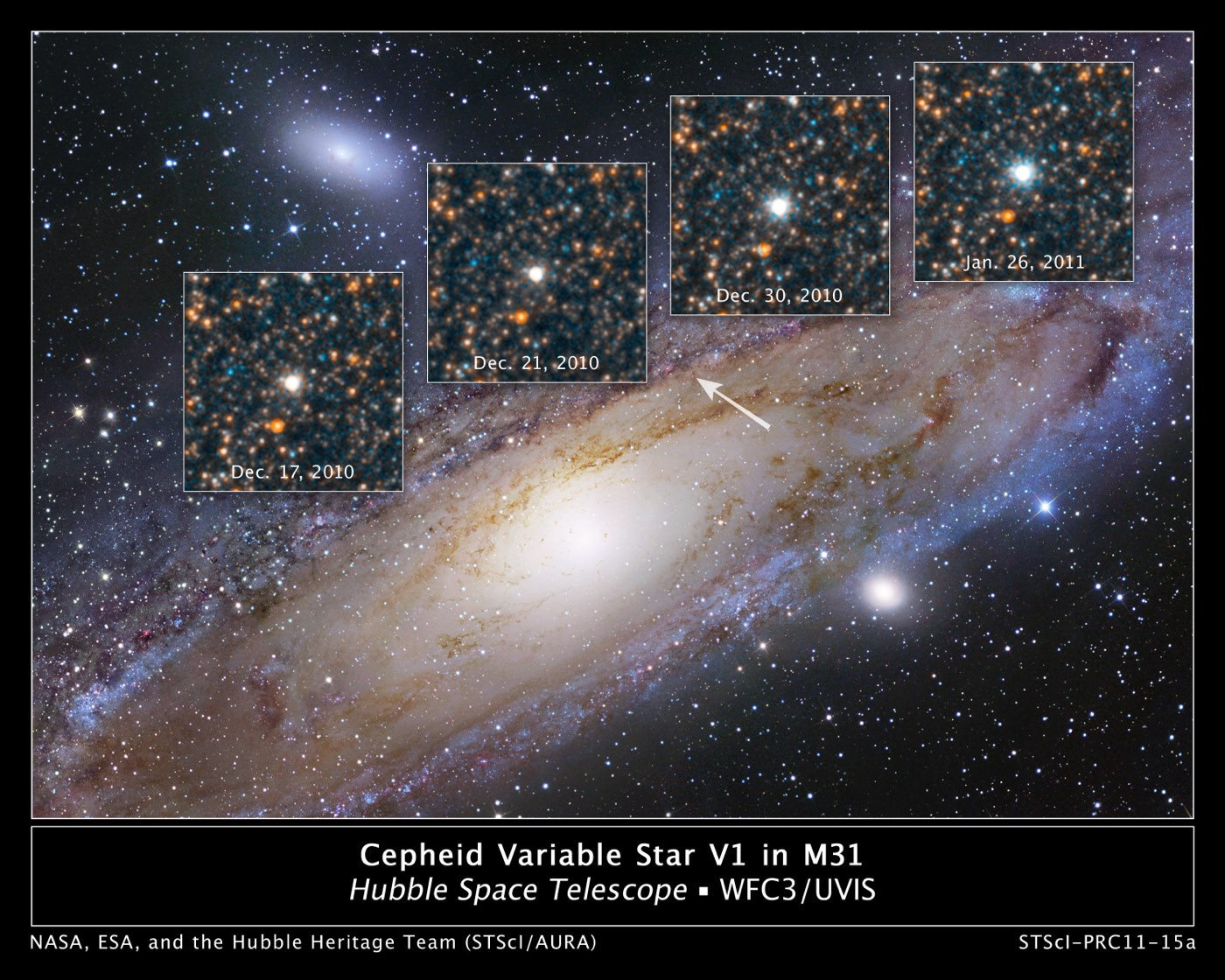
- Cepheid variables. These pulsating stars have a brightness that follows their pulse period, a law Henrietta Leavitt found in 1912 (Leavitt’s period-luminosity relation). Calibrated by geometry, they measure distances to galaxies that host supernovae.
- Type Ia supernovae. Calibrated by Cepheids, these exploding white dwarfs are visible far enough away that the expansion of the universe dominates their motion.
In 2022 the SH0ES team led by Adam Riess used more than 1,000 Hubble orbits on 42 supernova host galaxies and found 73.04 ± 1.04 km/s/Mpc, a 5-sigma difference from Planck (the SH0ES Hubble constant).
How big is the Hubble tension in 2026?
The Hubble tension is now somewhere between 5 and 7 sigma, depending on which measurements are combined. The latest values:
| Measurement | Method | H0 (km/s/Mpc) |
|---|---|---|
| Planck 2018 | Cosmic microwave background + Lambda-CDM | 67.4 ± 0.5 |
| DESI DR1 + CMB (2024) | Baryon acoustic oscillations + CMB | 67.97 ± 0.38 |
| SH0ES (2022) | Cepheids + type Ia supernovae (Hubble) | 73.04 ± 1.04 |
| H0 Distance Network (2026) | Eight local methods combined | 73.50 ± 0.81 |
| CCHP (2024 preprint) | Red giant stars + supernovae (Hubble and JWST) | 70.39 ± 1.22 (stat) ± 1.33 (sys) |
| Gravitational waves (GW170817, 2017) | “Standard siren” | about 70, with large errors |
The 2026 entry is the most comprehensive so far. The H0 Distance Network, a collaboration of nearly 40 experts led by Stefano Casertano and Antonella Nota and published in Astronomy & Astrophysics in April 2026, combined Cepheids, the tip of the red giant branch, Mira variables, megamasers, type Ia and type II supernovae, surface brightness fluctuations, the Tully-Fisher relation and the fundamental plane. It reached 1.1% precision and a value 5 to 7 standard deviations from early-universe determinations.
How JWST tested the Hubble tension
The James Webb Space Telescope was the obvious check. Cepheids in distant galaxies are crowded by neighboring stars, and Hubble’s blurrier infrared images could have blended their light and biased the distances. JWST’s sharper images let both camps look again.
The SH0ES team re-observed its Cepheids with JWST and found no hidden bias, keeping H0 near 73. Wendy Freedman’s Chicago-Carnegie Hubble Program (CCHP) took a different route, calibrating supernovae with red giant stars and carbon stars, and found 70.39, consistent with the standard model and not requiring new physics. Using only its new JWST data, the CCHP obtained 68.81 ± 1.79 (stat) ± 1.32 (sys).
So JWST did not settle the question. It ruled out the simplest error, Cepheid crowding, but the two teams still disagree on how other distance indicators line up.
What could explain the Hubble tension?
The candidate explanations fall into three groups:
- A hidden measurement error. Some rung of the distance ladder, such as supernova calibration or dust, could be biased. Every proposed error tested so far has been too small to close the gap, but the CCHP results keep this possibility alive.
- New physics before the cosmic microwave background. If something, often called “early dark energy”, added a brief extra push to the expansion in the first few hundred thousand years, the sound-wave ruler would be smaller and the inferred H0 larger. Precise new microwave data from the Atacama Cosmology Telescope and the South Pole Telescope have narrowed the room for these models.
- New physics after it. An evolving dark energy, like the one hinted at by DESI, changes the late expansion history. On its own, however, the DESI-preferred model does not raise H0 toward 73. See is dark energy weakening?
What would settle it?
Independent methods that skip both the Cepheid ladder and the cosmic microwave background are the best referee:
- Gravitational-wave “standard sirens”. Merging neutron stars and black holes announce their own distance. The LIGO-Virgo-KAGRA catalog GWTC-5.0 improved the gravitational-wave H0 precision by about 25% in May 2026 (the 390-event gravitational wave catalog), but it is not yet precise enough to choose.
- Strong lensing time delays. When a quasar is lensed into several images, the delays between them measure distance directly.
- More supernovae. The Vera C. Rubin Observatory and the Roman Space Telescope will find tens of thousands, shrinking statistical errors.
For a lively panel discussion of both sides, our video library includes the World Science Festival’s “Cosmology in Crisis? Confronting the Hubble Tension”. For what the expansion rate means for the universe’s age, see our explainer on the age of the universe.
Questions people ask
What is the Hubble tension?
The Hubble tension is the disagreement between two ways of measuring how fast the universe expands today. Predictions from the cosmic microwave background give about 67 kilometers per second per megaparsec, while direct measurements of nearby galaxies give about 73. The gap is now statistically significant at 5 sigma or more.
What is the Hubble constant?
The Hubble constant is the expansion rate of the universe today. It says how much faster a galaxy recedes for each extra unit of distance, in kilometers per second per megaparsec. A value of 70 means a galaxy one megaparsec (3.26 million light-years) farther away recedes 70 kilometers per second faster.
Is the Hubble tension real?
Most cosmologists now accept that the two measurement families genuinely disagree, because each side has been checked with independent data and telescopes. What is still debated is the cause: an undiscovered error in the distance ladder, an error in early-universe assumptions, or physics missing from the standard model.
What is the current value of the Hubble constant?
It depends on the method. Planck's cosmic microwave background analysis gives 67.4 plus or minus 0.5. The SH0ES team's Cepheid and supernova ladder gives 73.04 plus or minus 1.04, and a 2026 community combination of eight local methods gives 73.50 plus or minus 0.81 kilometers per second per megaparsec.
Could the Hubble tension be solved by new physics?
Possibly. The leading proposals change the early universe, for example a brief burst of 'early dark energy' before the cosmic microwave background was released, which shrinks the cosmic sound-wave ruler. None fits every data set cleanly, and newer microwave background data from ACT and SPT have tightened the room for such models.
How did JWST affect the Hubble tension?
The James Webb Space Telescope re-observed Cepheid stars with sharper infrared images to test whether crowding by neighboring stars had biased Hubble's measurements. SH0ES found no such bias and kept a value near 73. A separate team using other stars found about 70, so JWST sharpened the debate rather than ending it.
Why does the Hubble tension matter?
The expansion rate sets the age, size and future of the universe. If the standard cosmological model predicts it wrongly, the model is incomplete, which would be the first crack in a theory that has passed nearly every other test for 25 years. If the cause is a measurement error, astronomy's distance scale needs fixing.