1972
Alar Toomre and Juri Toomre, The Astrophysical Journal, 178, 623, 1972
Toomre and Toomre (1972): How Colliding Galaxies Grow Tails
Showed in 1972 that gravity alone carves the tails and bridges of colliding galaxies. Alar and Juri Toomre's simulations made mergers central.
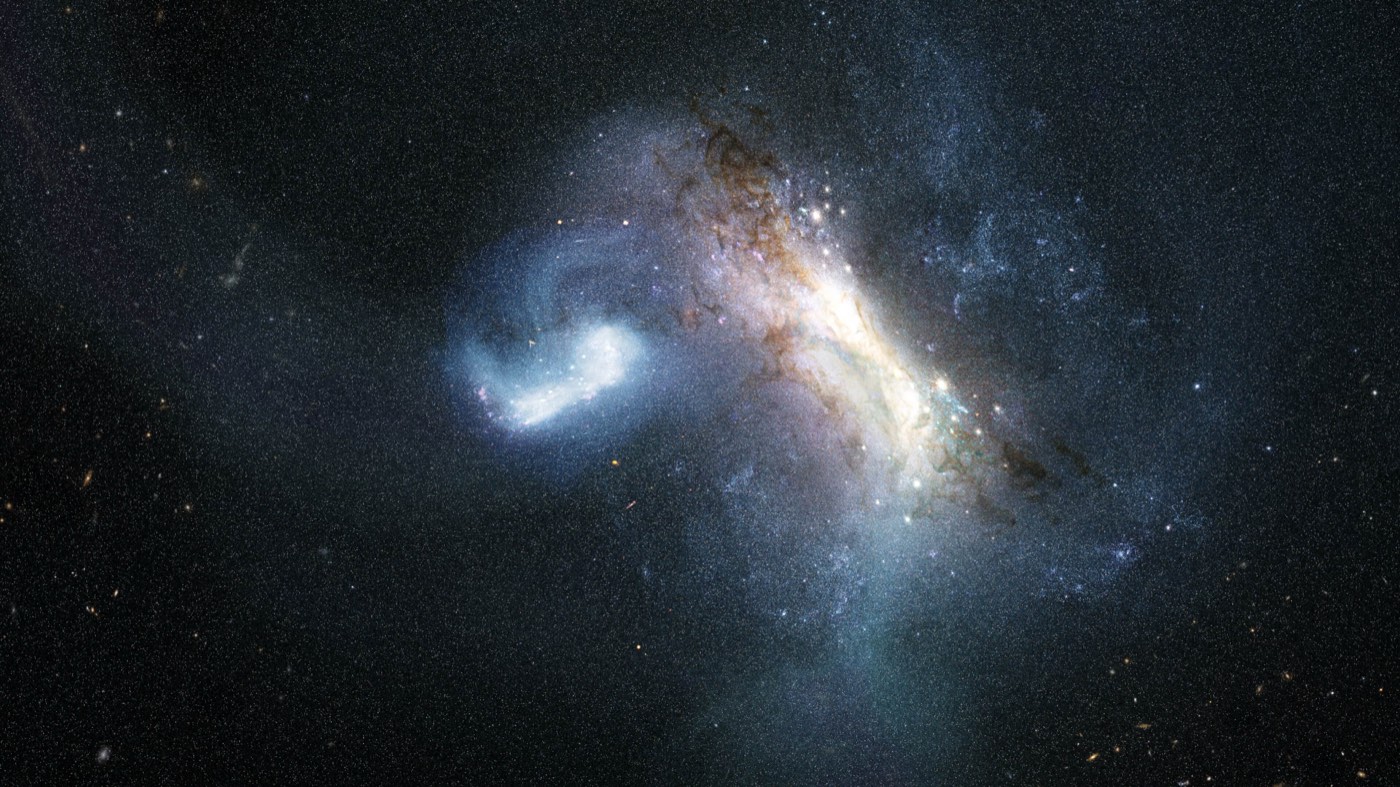
Alar and Juri Toomre showed in 1972 that the long tails and bridges of stars around some peculiar galaxies are made by gravity alone during close encounters. Their simple simulations reproduced systems such as the Antennae and the Mice, putting galaxy collisions at the center of galaxy evolution.
The question
Photographs of the sky showed a gallery of misfit galaxies: pairs linked by thin bridges of stars, or trailing long, curved tails. They did not fit Hubble’s 1926 classification and looked violent. Explanations on offer included magnetic fields and explosions. The Toomres asked a simpler question: could ordinary gravity, acting during a close passage of two galaxies, pull out these features on its own?
What the paper found
- Tidal forces alone, the stretching effect of one galaxy’s gravity on another, can explain bridges and tails. No magnetic fields or explosions are needed.
- Bridges form between the galaxies from material pulled toward the companion; tails are flung out on the far side.
- The simulations reproduced the shapes of well-known interacting systems, including the Whirlpool galaxy M51, the Antennae (NGC 4038/39) and the Mice (NGC 4676).
- Such encounters can lead the two galaxies to merge.
How they did it
In 1972 computers could not follow billions of stars, so the Toomres used a clever shortcut called a restricted three-body calculation. Each galaxy was a single central mass surrounded by a disk of massless test particles standing in for stars. The two central masses followed a roughly parabolic encounter, and the computer tracked how each test particle moved under their gravity. Because the particles did not pull on each other, the calculation was cheap enough to explore many encounter geometries and viewing angles, and to match each one to a real photograph.
Why it mattered
The paper established galaxy collisions as a central process in galaxy evolution, decades before supercomputer simulations could model them in full. The Toomres also discussed that encounters can end in mergers, and Alar Toomre later (1977) proposed that many elliptical galaxies are the remnants of merged spirals. The merger picture is now built into every model of how galaxies grow, including the two-stage theory of galaxy formation by White and Rees in 1978.
What we know now
Mergers are now read directly in our own galaxy’s history. In 2018, Gaia data revealed that the Milky Way’s inner halo is dominated by the debris of a single ancient merger, Gaia-Enceladus. And the long-predicted collision with our neighbor is less certain than once thought: a 2025 study of the Milky Way and Andromeda found only about a 50% chance that they merge within the next 10 billion years. Read more in will the Milky Way collide with Andromeda and our galaxies guide.
Who wrote it
The paper was written by Alar Toomre and Juri Toomre and has about 2,000 citations (Semantic Scholar, October 2026). A later review by Pierre-Alain Duc and Florent Renaud, “Tides in colliding galaxies”, traces how their idea grew from simulations with tens of particles to modern ones with tens of millions, and shows that tidal tails contain gas and dust and can host star-forming regions and even new dwarf galaxies.
Read the original
Toomre, A. and Toomre, J. (1972). “Galactic Bridges and Tails.” The Astrophysical Journal 178, 623. doi:10.1086/151823
Free to read: a scanned PDF on NASA ADS.
This week in papers
Five new results in one line each, plus one landmark like this one. Weekly.
Keep reading
White and Rees, Monthly Notices of the Royal Astronomical Society, 183, 341-358, 1978
White and Rees: Galaxies Form Inside Dark Matter Halos
Proposed in 1978 that galaxies form as gas cools inside larger dark matter halos. Simon White and Martin Rees set out the picture still used today.
Williams et al., The Astronomical Journal, 112, 1335, 1996
The Hubble Deep Field: 3,000 Galaxies in an Empty Sky
Revealed in 1996 about 3,000 galaxies in a tiny, empty-looking patch of sky. Robert Williams's Hubble Deep Field made deep fields a core tool.
Madau and Dickinson, Annual Review of Astronomy and Astrophysics, 52, 415-486, 2014
The Madau Plot: When the Universe Made Most of Its Stars
Showed in 2014 that cosmic star formation peaked 3.5 billion years after the Big Bang and has faded since. Madau and Dickinson's review is the reference.
Topic guide
Galaxies
Recent news in galaxies