The Andromeda-Milky Way collision
The Milky Way and Andromeda may never collide. A 2025 study put the odds of a merger within 10 billion years at about 50%. What changed, and why.
By The Orbital Record editorial teamPublished Last reviewed
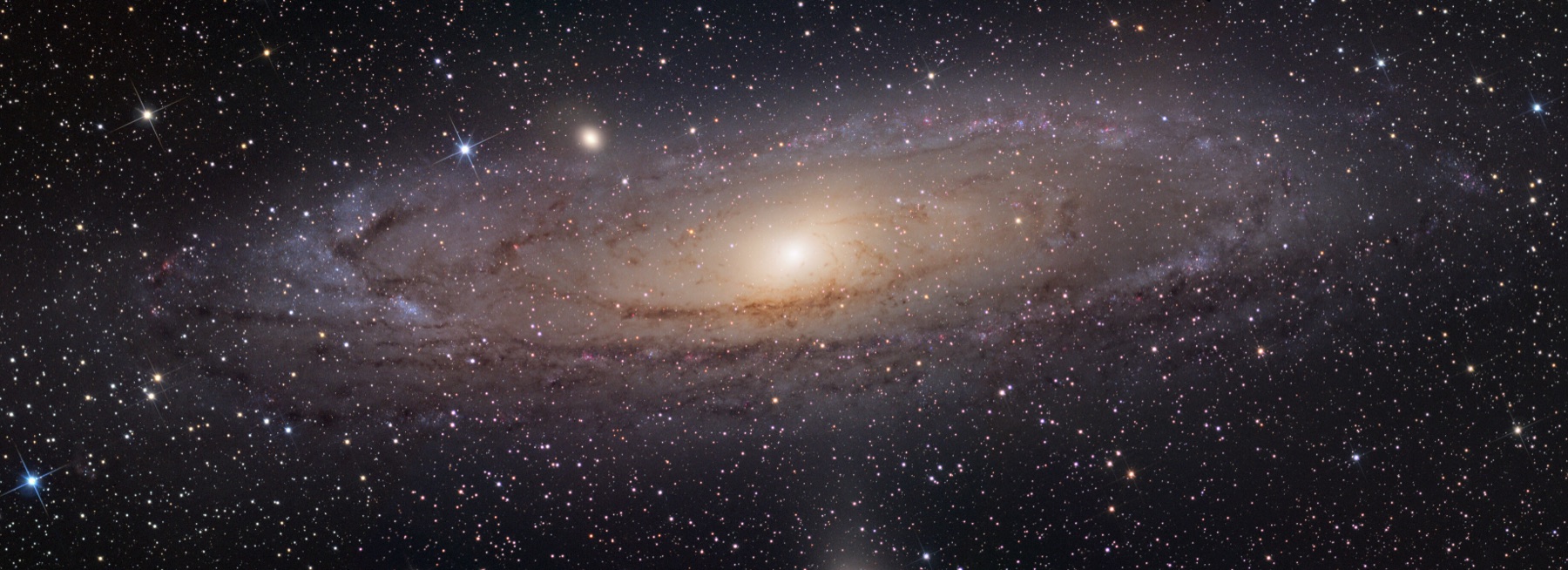
The Milky Way and Andromeda may collide, but it is far from certain. A June 2025 study in Nature Astronomy found only about a 50% chance that the two galaxies merge within the next 10 billion years, and about a 2% chance of a collision in the next 5 billion. A 2026 analysis argues the odds are higher. The famous “collision in 4.5 billion years” is now outdated.
This is one of the clearest recent examples of a textbook fact being revised by better data. Background on both galaxies is in our galaxies guide.
What we know for sure
Some facts are solid and not in dispute.
- Andromeda is close and big. It lies about 2.5 million light-years away and is the largest member of our Local Group of galaxies.
- It is coming toward us. Its spectrum shows it approaching at about 110 kilometers per second, measured precisely as about 109 km/s by Roeland van der Marel and colleagues in 2012.
- Its sideways motion is the hard part. Whether the galaxies hit or miss depends on how fast Andromeda drifts across the sky, a motion of a few millionths of a degree per year that only Hubble and Gaia can measure, and only with sizable uncertainty.
- Other galaxies matter. The Large Magellanic Cloud (LMC), a satellite of the Milky Way, and the Triangulum Galaxy (M33), a satellite of Andromeda, are massive enough to bend the paths of the two big spirals.
The old forecast: a collision in about 4 billion years
In 2012, using Hubble measurements of Andromeda’s sideways motion, van der Marel’s team predicted a first close passage in about 3.9 billion years and a full merger about 5.9 billion years from now, with the merged galaxy settling into an elliptical. NASA’s announcement, with striking illustrations of Andromeda filling Earth’s night sky, made “the Milky Way will collide with Andromeda in about 4 billion years” one of astronomy’s best-known facts.
Even then, the paper gave only about a 41% chance of a near head-on hit, closer than about 25,000 parsecs. The merger looked very likely; the direct hit did not.
The 2025 revision: a coin flip
In June 2025 Till Sawala of the University of Helsinki and colleagues revisited the question (Sawala et al. 2025). They combined the latest Hubble and Gaia measurements, included the LMC and M33, and ran Monte Carlo simulations, tens of thousands of runs each drawing slightly different starting values within the measurement errors. The ESA/Hubble release described about 100,000 runs in total.
Their main results:
| Scenario | Chance the Milky Way and Andromeda merge within 10 billion years |
|---|---|
| Milky Way and Andromeda alone | Just under 50% |
| Adding M33 | About two thirds |
| Adding the LMC only | Just over one third |
| Full model (M33 and LMC, all uncertainties) | About 50% |
Other findings:
- A collision in the next 5 billion years is unlikely: about 2%, according to Durham University’s release on the study.
- If they merge, it is later than thought: the median merger time in the simulations is about 7.6 billion years from now.
- The LMC merger is nearly certain: the Milky Way absorbs the Large Magellanic Cloud in almost every run, typically within about 1.3 to 2 billion years.
- M33 likely joins Andromeda: M33 merges with Andromeda in about 86% of runs.
The reason the LMC lowers the odds is geometry. Its pull acts roughly at right angles to the line between the Milky Way and Andromeda, nudging the Milky Way sideways so that a head-on approach becomes less likely. M33 adds mass to Andromeda’s side and increases the odds.
The 2026 counterpoint: back to likely
The question is not closed. In March 2026 a team led by Wu, using Gaia proper motions corrected for known systematic errors, posted an analysis accepted by The Astrophysical Journal Letters that puts the merger probability at about 90%, with a median merger time of about 6.5 billion years (Wu et al. 2026). The difference comes down to how Andromeda’s sideways motion is measured and corrected.
The honest summary for October 2026: a merger in the next 10 billion years is somewhere between a coin flip and likely, and a collision in the next 5 billion years is improbable either way. Gaia’s fourth data release, due in December 2026, should sharpen the numbers.
What a merger would look like
If it happens, a galaxy merger is slow and almost gentle on the scale of individual stars.
- First pass. The galaxies swing close, their disks distorted into long tidal tails, the shapes first reproduced by Alar and Juri Toomre’s 1972 simulations (Toomre and Toomre 1972).
- Fall back. Gravity pulls them together again over hundreds of millions of years, triggering bursts of star formation as gas clouds collide.
- Merge. The disks are destroyed and the stars settle into a single large elliptical galaxy, often nicknamed Milkomeda.
- Black holes. The two central black holes sink to the middle and eventually merge, releasing gravitational waves.
Stars themselves almost never collide: the gaps between them are tens of millions of times their diameters. The solar system would likely survive, possibly on a new orbit. By the time any merger happens, though, the Sun will already have left the main sequence and swollen into a red giant, so Earth’s fate will be settled by the death of the Sun, not by Andromeda.
Why it matters beyond the headline
The far future of our cosmic neighborhood shapes the long timeline in Deep Time. Whether or not the Milky Way and Andromeda merge, the Local Group will stay bound while accelerating expansion carries all other galaxies out of view over the next hundred billion years or so (Krauss and Scherrer 2007). The revision is also a lesson in method: far-future forecasts are only as good as today’s measurements, and a few microarcseconds per year of sideways motion turned a certainty into a coin flip.
Data for these studies come from the Hubble Space Telescope and ESA’s Gaia. Our video library includes Deep Sky Videos’ short film on M31, the Andromeda Galaxy.
Sources
- Sawala, T. et al. (2025). No certainty of a Milky Way-Andromeda collision. Nature Astronomy. https://doi.org/10.1038/s41550-025-02563-1 (arXiv: https://arxiv.org/abs/2408.00064) [primary]
- van der Marel, R. P. et al. (2012). The M31 Velocity Vector. III. Future Milky Way M31-M33 Orbital Evolution, Merging, and Fate of the Sun. The Astrophysical Journal 753, 9. https://arxiv.org/abs/1205.6865 [primary]
- Wu et al. (2026). The Fate of the Milky Way-Andromeda System: To Merge or Not? Accepted, ApJ Letters. https://arxiv.org/abs/2603.22863 [primary]
- Durham University (2 June 2025). New study casts doubt on the likelihood of Milky Way collision with Andromeda. https://dur.ac.uk/news-events/latest-news/2025/06/new-study-casts-doubt-on-the-likelihood-of-milky-way-collision-with-andromeda/ [press]
- ESA/Hubble (2 June 2025). https://esahubble.org/news/heic2508/ [press]
Questions people ask
When will Andromeda collide with the Milky Way?
Possibly never, and almost certainly not in the next 5 billion years. A 2025 study in Nature Astronomy found about a 50% chance the two galaxies merge within 10 billion years, with a typical merger time near 7.6 billion years if it happens. The older forecast of a collision in about 4 to 5 billion years is now considered unlikely.
What would happen to Earth if the Milky Way and Andromeda merged?
Probably nothing dramatic. Stars are so far apart that direct collisions would be extremely rare, and the solar system would most likely survive, perhaps flung into a new orbit. By then the Sun will have left the main sequence anyway, so Earth will already face a far more serious problem.
What is Milkomeda?
Milkomeda, sometimes written Milkdromeda, is the nickname for the single galaxy that would form if the Milky Way and Andromeda merge. Simulations suggest it would end up as a large elliptical galaxy, a smooth ball of mostly old stars, with the two central black holes eventually merging.
Why did the collision prediction change?
Because the measurements improved and more galaxies were included. Till Sawala and colleagues combined newer Hubble and Gaia data and added the gravity of the Large Magellanic Cloud and the Triangulum Galaxy, then ran tens of thousands of simulations covering the measurement uncertainties. About half produced no merger in 10 billion years.
Will the Milky Way merge with the Large Magellanic Cloud?
Almost certainly. The same 2025 study found the Large Magellanic Cloud, the Milky Way's biggest satellite galaxy, is set to merge with it in nearly all simulations, with a typical timescale of about 1.3 to 2 billion years. That merger will stir up the Milky Way long before any encounter with Andromeda.
How fast is Andromeda moving toward us?
Andromeda is approaching the Milky Way at about 110 kilometers per second, roughly 400,000 kilometers per hour. That speed toward us is well measured. The uncertain part is its sideways motion across the sky, which decides whether the galaxies hit head on or swing past each other.