1996
Williams et al., The Astronomical Journal, 112, 1335, 1996
The Hubble Deep Field (1996): 3,000 Galaxies in an Empty Sky
Revealed in 1996 about 3,000 galaxies in a tiny, empty-looking patch of sky. Robert Williams's Hubble Deep Field made deep fields a core tool.
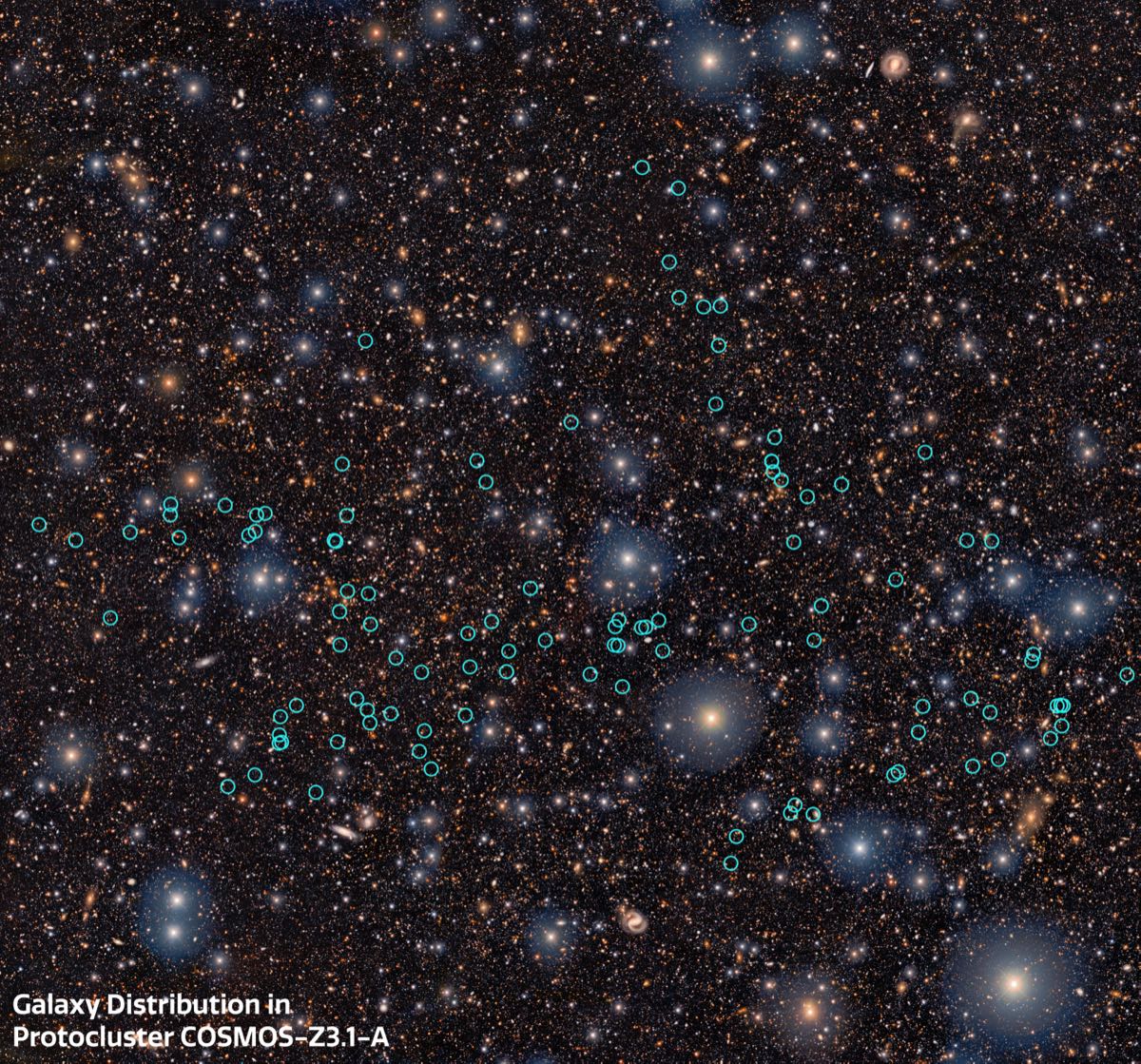
The Hubble Deep Field is a ten-day Hubble exposure of a tiny, empty-looking patch of sky, taken in December 1995 and described in a 1996 paper led by Robert Williams. It revealed roughly 3,000 distant galaxies, showing that even blank sky is crowded with galaxies across cosmic history.
The question
By the mid-1990s astronomers wanted to see what galaxies looked like when the universe was young, but distant galaxies are extremely faint. Not everyone expected Hubble to help: in 1990 the astrophysicist John Bahcall co-wrote a Science paper arguing that Hubble would not reveal galaxies that ground-based telescopes could not already see. Robert Williams, director of the Space Telescope Science Institute (STScI), decided to test it with a long stare at a single empty-looking patch of sky.
What the paper found
- Over ten consecutive days, from 18 to 28 December 1995, Hubble spent about 150 orbits on one small field in Ursa Major, near the handle of the Big Dipper.
- The final image, assembled from 342 exposures in four filters, revealed roughly 3,000 distant galaxies.
- The galaxies span a range of evolutionary stages, a direct look back through much of cosmic history.
- The paper described the observations, the data processing and the brightness measurements of the galaxies, setting the template for later deep fields.
How they did it
Williams controlled about 10% of Hubble’s observing time, the Director’s Discretionary time, and used it so that the data could be released immediately rather than waiting for the normal proposal process. His team spent nearly a year choosing the field. It had to be dark, with no nearby stars or bright objects, away from the plane of the Milky Way, and in Hubble’s “continuous viewing zone”, where Earth, Sun and Moon do not interrupt the view. The patch they picked is about the size of a pinhead held at arm’s length.
The WFPC2 camera then took hundreds of exposures through four filters, from blue to infrared. Combining them removes cosmic-ray hits and detector flaws, and the colors let astronomers estimate each galaxy’s distance, age and composition.
Why it mattered
The Hubble Deep Field showed that an “empty” sliver of sky is full of galaxies, and it made deep fields the standard tool for studying galaxy evolution. It also set an open-data precedent: raw and reduced data were made public immediately as a community service, an unusual choice at the time. Deep-field data fed directly into measurements of how fast the universe formed stars over time, summarized in the Madau-Dickinson cosmic star-formation history of 2014.
What we know now
The approach was repeated with the Hubble Ultra Deep Field and then with JWST deep fields such as JADES, which in 2024 confirmed JADES-GS-z14-0, a galaxy seen about 300 million years after the Big Bang. The Hubble Space Telescope itself is still observing as of October 2026. For how the two telescopes compare, see JWST vs Hubble, and for galaxy types and counts, our galaxies guide.
Who wrote it
Robert E. Williams led the paper with Brett Blacker, Mark Dickinson and the deep-field team he assembled at STScI. Dickinson later co-wrote the 2014 review of cosmic star formation with Piero Madau. The paper has about 760 citations (Semantic Scholar, October 2026).
Read the original
Williams, R. E., Blacker, B., Dickinson, M., et al. (1996). “The Hubble Deep Field: Observations, Data Reduction, and Galaxy Photometry.” The Astronomical Journal 112, 1335. doi:10.1086/118105
Free to read: the arXiv preprint.
This week in papers
Five new results in one line each, plus one landmark like this one. Weekly.
Keep reading
White and Rees, Monthly Notices of the Royal Astronomical Society, 183, 341-358, 1978
White and Rees: Galaxies Form Inside Dark Matter Halos
Proposed in 1978 that galaxies form as gas cools inside larger dark matter halos. Simon White and Martin Rees set out the picture still used today.
Madau and Dickinson, Annual Review of Astronomy and Astrophysics, 52, 415-486, 2014
The Madau Plot: When the Universe Made Most of Its Stars
Showed in 2014 that cosmic star formation peaked 3.5 billion years after the Big Bang and has faded since. Madau and Dickinson's review is the reference.
Helmi et al., Nature, 563, 85-88, 2018
Gaia-Enceladus: The Merger That Shaped the Milky Way
Found in 2018 that the Milky Way's inner halo is debris from one ancient galaxy, Gaia-Enceladus. Amina Helmi's team read the merger in Gaia star motions.
Topic guide
Galaxies
Recent news in galaxies