2024
Carniani et al., Nature, 633, 318-322, 2024
JADES-GS-z14-0 (2024): A Galaxy 300 Million Years After the Big Bang
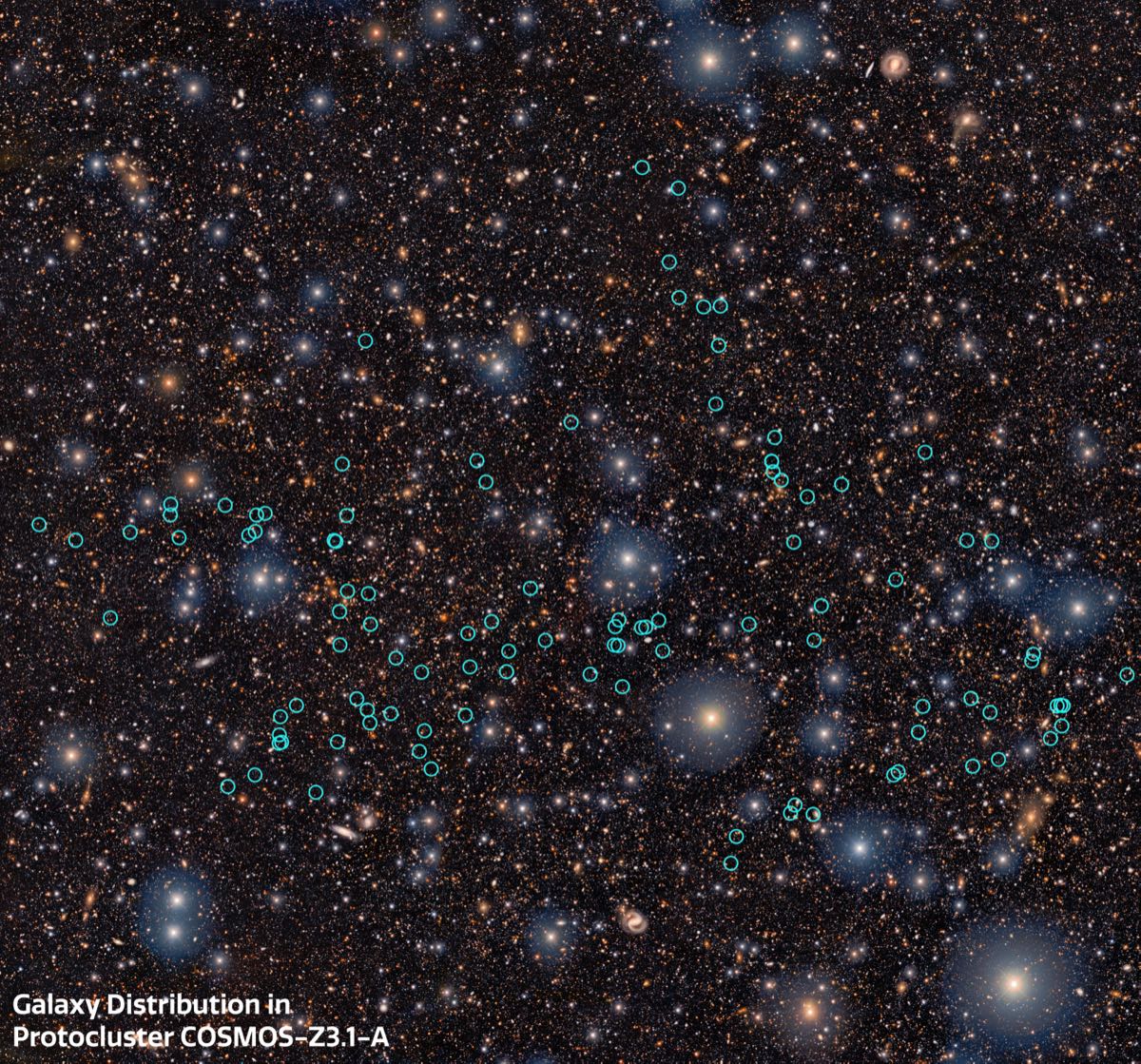
Confirmed in 2024 two bright galaxies at redshift 14, 300 million years after the Big Bang. Stefano Carniani's JADES team set the record of the time.
JADES-GS-z14-0 is a galaxy seen as it was about 300 million years after the Big Bang. Stefano Carniani and the JWST JADES team confirmed it in 2024 at redshift 14.32, making it the most distant galaxy known at the time. As of October 2026 the record has passed to MoM-z14, at redshift 14.44.
The question
How soon after the Big Bang did the first galaxies light up? Earlier JWST images had turned up many candidate galaxies at extreme distances, but candidates selected from colors alone can be wrong: a closer, dusty galaxy can mimic a very distant one. The only reliable test is a spectrum, which pins down the redshift, the amount by which cosmic expansion has stretched the light. Higher redshift means earlier in cosmic time. The question was whether any galaxies at redshift 14 or beyond could be confirmed, and how bright they were.
What the paper found
- Two luminous galaxies were confirmed at redshifts 14.32 (+0.08/-0.20) and 13.90 ± 0.17, about 300 million years after the Big Bang.
- Their spectra show smooth ultraviolet light with a sharp drop at the Lyman-alpha break, the wavelength below which hydrogen gas absorbs nearly all light. No emission lines were detected.
- JADES-GS-z14-0 became the most distant spectroscopically confirmed galaxy when announced in 2024.
- Its brightness shows that luminous galaxies were already in place 300 million years after the Big Bang, more common than many models predicted.
How they did it
The work is part of the JWST Advanced Deep Extragalactic Survey (JADES), which combines deep imaging with spectroscopy. The team first picked out candidates in JWST images, then pointed the NIRSpec spectrograph at them for long exposures. Because the galaxies show no emission lines, the redshift comes from the position of the Lyman-alpha break: at redshift 14, light emitted in the ultraviolet arrives at Earth in the infrared, stretched about 15 times, where JWST is most sensitive.
Why it mattered
A galaxy this bright, this early, means that stars and galaxies formed faster than many models assumed. Together with earlier JWST surprises such as the massive red galaxy candidates reported by Labbé and colleagues in 2023, it is forcing revisions to how quickly the first stars and galaxies formed. It also pushes the cosmic star-formation history back toward cosmic dawn.
What we know now
JWST keeps pushing the frontier. In 2025 Naidu and colleagues reported MoM-z14 at redshift 14.44, about 280 million years after the Big Bang, published in the Open Journal of Astrophysics in 2026. As of October 2026 it is the most distant spectroscopically confirmed galaxy, according to the James Webb Space Telescope team. The deep-field approach behind both discoveries began with the Hubble Deep Field of 1996. See JWST discoveries, how old the universe is and our galaxies guide.
Who wrote it
Stefano Carniani led the paper with Kevin Hainline, Francesco D’Eugenio and the JADES collaboration. The paper has about 180 citations (Semantic Scholar, October 2026).
Read the original
Carniani, S., Hainline, K., D’Eugenio, F., et al. (2024). “Spectroscopic confirmation of two luminous galaxies at a redshift of 14.” Nature 633, 318-322. doi:10.1038/s41586-024-07860-9
Free to read: the arXiv preprint.
This week in papers
Five new results in one line each, plus one landmark like this one. Weekly.
Keep reading
Labbé et al., Nature, 616, 266-269, 2023
JWST's Massive Early Galaxies: The Red Candidates Explained
Reported in 2023 six JWST candidates for massive galaxies 500 to 700 million years after the Big Bang. Ivo Labbé's team sparked a cosmology debate.
Helmi et al., Nature, 563, 85-88, 2018
Gaia-Enceladus: The Merger That Shaped the Milky Way
Found in 2018 that the Milky Way's inner halo is debris from one ancient galaxy, Gaia-Enceladus. Amina Helmi's team read the merger in Gaia star motions.
Madau and Dickinson, Annual Review of Astronomy and Astrophysics, 52, 415-486, 2014
The Madau Plot: When the Universe Made Most of Its Stars
Showed in 2014 that cosmic star formation peaked 3.5 billion years after the Big Bang and has faded since. Madau and Dickinson's review is the reference.
Topic guide
Galaxies
Recent news in galaxies