JWST vs Hubble
JWST has a mirror six times larger than Hubble's and sees infrared from 1.5 million km away; Hubble sees ultraviolet and visible light. Side by side.
By The Orbital Record editorial teamPublished Last reviewed
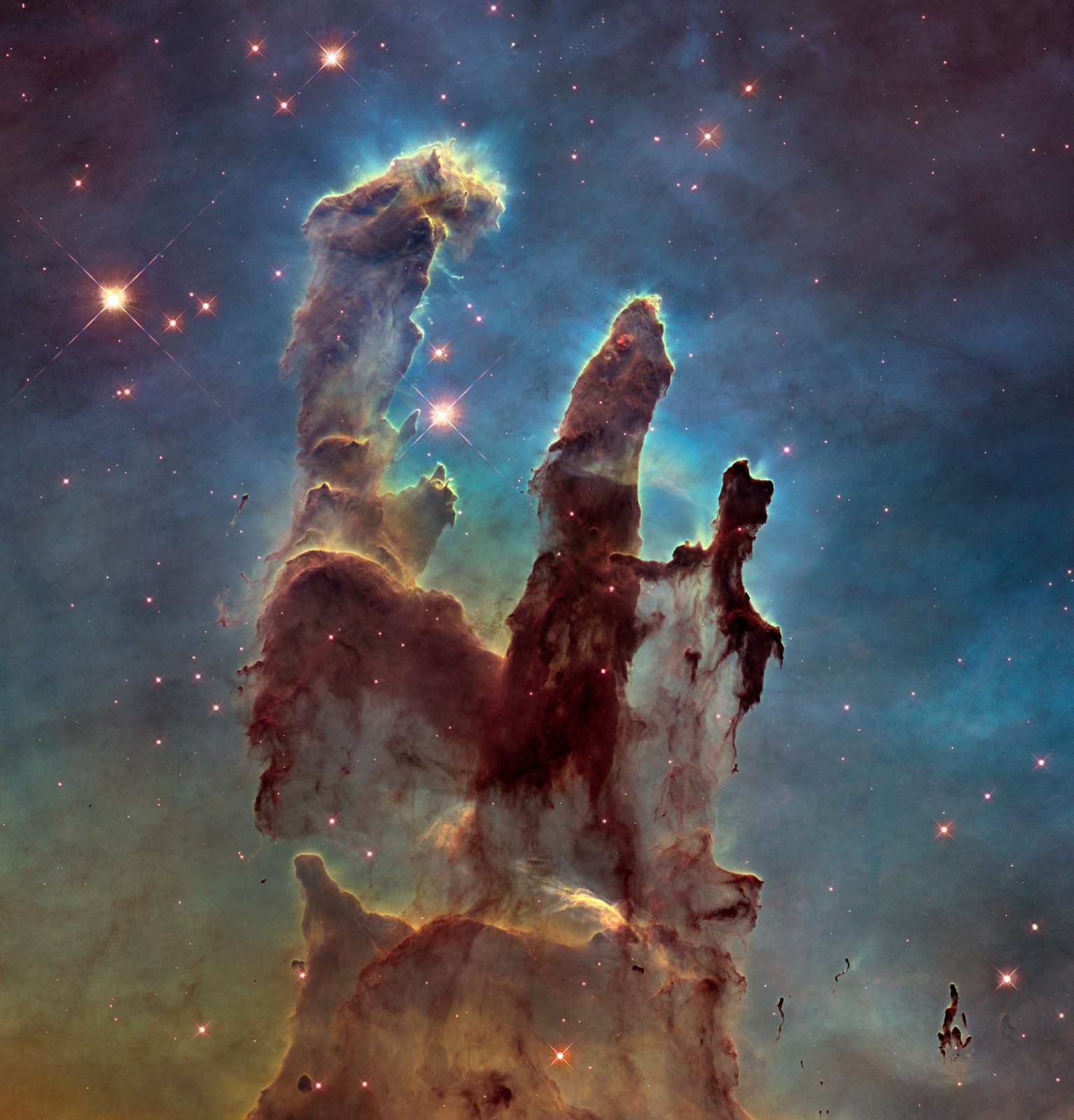
JWST and Hubble are complementary: Hubble sees mainly ultraviolet and visible light from low Earth orbit with a 2.4-meter mirror, while JWST sees infrared light from 1.5 million kilometers away with a 6.5-meter mirror. JWST collects more than six times as much light and sees farther back in time; Hubble covers wavelengths JWST cannot. Both are working as of October 2026.
Both are part of the larger fleet described in our guide to space telescopes and observatories.
JWST vs Hubble at a glance
| Hubble Space Telescope | James Webb Space Telescope | |
|---|---|---|
| Launched | 24 April 1990, Space Shuttle Discovery | 25 December 2021, Ariane 5 from Kourou |
| Partners | NASA and ESA | NASA, ESA and the Canadian Space Agency |
| Primary mirror | 2.4 m, single mirror, about 4.5 m² | 6.5 m, 18 gold-coated beryllium segments, about 25 m² |
| Light it sees | Ultraviolet, visible, near-infrared (about 0.1 to 2.5 micrometers, per NASA) | Infrared, 0.6 to 28.5 micrometers |
| Orbit | Low Earth orbit, now below about 500 km and slowly decaying | Around the Sun-Earth L2 point, about 1.5 million km away |
| Operating temperature | Instruments kept near room temperature (about 21 °C) | Below 50 K (about minus 223 °C); MIRI below 7 K |
| Mass | About 11,110 kg at launch | About 6,200 kg |
| Servicing | Five shuttle servicing missions, 1993 to 2009 | Cannot be serviced |
| Farthest galaxy confirmed | GN-z11, announced 2016 (redshift 11.1, later refined to 10.6 by JWST) | MoM-z14, redshift 14.44, about 280 million years after the Big Bang |
| Status, October 2026 | Science in one-gyro mode since June 2024 | Cycle 5 observations began 1 July 2026 |
Sources: NASA’s Webb fact sheet and Hubble-vs-Webb page, ESA’s Hubble fact sheet, and the ESA/Webb release of 28 January 2026.
Wavelength: why JWST uses infrared
The biggest difference is the light each telescope sees, and it follows from what JWST was built to do.
- The early universe. The universe is expanding, so light from the first galaxies has been stretched, or redshifted, from ultraviolet and visible into the infrared by the time it reaches us. To see galaxies within a few hundred million years of the Big Bang, you need infrared eyes.
- Through the dust. Infrared passes through clouds of dust that block visible light, revealing stars being born inside nebulae.
- Cool things. Planets, brown dwarfs and planet-forming disks glow mostly in the infrared.
Hubble, by contrast, is one of the few telescopes anywhere that can observe ultraviolet light, which Earth’s atmosphere blocks. That makes it essential for hot young stars, the chemistry of gas between galaxies, and auroras on planets.
Size: a mirror six times larger
JWST’s 6.5-meter mirror, made of 18 hexagonal beryllium segments coated with gold, has more than six times the collecting area of Hubble’s 2.4-meter mirror. It was too big to launch flat, so it was folded like origami and unfolded in space after launch. More collecting area means fainter objects in less time; during commissioning, JWST turned out to be better than its requirements almost across the board (Rigby et al. 2023).
Orbit: why JWST sits 1.5 million kilometers away
An infrared telescope must be colder than what it observes, or its own heat glow swamps the signal. JWST orbits near the second Lagrange point (L2), where it can keep the Sun, Earth and Moon permanently behind a five-layer sunshield about 21 by 14 meters, roughly the size of a tennis court. Its mirror cools passively below 50 kelvin, and a cryocooler takes the MIRI instrument below 7 kelvin.
Hubble orbits only a few hundred kilometers up, close enough for Space Shuttle crews to repair and upgrade it five times between 1993 and 2009, the first to correct the famous flaw in its mirror. JWST is far beyond the reach of any crewed spacecraft.
Pictures: how their images differ
Point both telescopes at the same target and you see different things. In Hubble’s 1995 image of the Pillars of Creation, the dusty columns are opaque and dark. In JWST’s 2022 near-infrared view (above), the dust turns translucent and hundreds of newborn red stars appear inside and around the pillars. Hubble shows the clouds; JWST shows what is forming in them. Astronomers often combine both, as in multi-wavelength views of the Crab Nebula.
Lifetime and health
- JWST launched so accurately that NASA estimated it has propellant for roughly 20 years of operations. A micrometeoroid hit one mirror segment in May 2022 without affecting its science requirements, and the long-wavelength channel of MIRI’s spectrometer has lost some sensitivity, which the data pipeline corrects. Demand is at a record: the Cycle 5 call drew 2,930 proposals.
- Hubble has run in one-gyroscope mode since June 2024, costing about 12% of its observing efficiency, and its orbit is slowly decaying. NASA said in 2024 that it expects Hubble to keep working into the mid-2030s. More than 22,000 peer-reviewed papers have used its data.
Which telescope made which discovery?
Hubble’s legacy includes the Hubble Deep Field (1996), the supernova measurements that revealed the accelerating universe (Riess et al. 1998) and precise measurements of the Hubble constant (SH0ES 2022). JWST’s include the most distant galaxies (JADES-GS-z14-0), the first clear carbon dioxide in an exoplanet atmosphere (WASP-39b) and early black holes. The full roundup is in what JWST has discovered.
They also work together. In July 2026 Hubble astrometry spanning two decades and refined with Webb data revealed the first stellar-mass black hole in the globular cluster Omega Centauri (Omega Centauri’s black hole).
Explore each mission on its hub page: Hubble Space Telescope and James Webb Space Telescope. Our video library includes Scott Manley’s explainer on how JWST’s folded mirror and sunshield unfold.
Sources
- NASA, Webb fact sheet. https://science.nasa.gov/mission/webb/fact-sheet/ [agency]
- NASA, Hubble vs Webb. https://science.nasa.gov/mission/hubble/observatory/hubble-vs-webb/ [agency]
- ESA, Hubble fact sheet. https://sci.esa.int/web/hubble/-/47358-fact-sheet [agency]
- Rigby, J. et al. (2023). The Science Performance of JWST as Characterized in Commissioning. PASP 135, 048001. https://doi.org/10.1088/1538-3873/acb293 [primary]
- ESA/Webb (28 January 2026). Release on MoM-z14, the most distant confirmed galaxy. https://esawebb.org/news/weic2603/ [press]
- ESA/Hubble (3 March 2016). Release on GN-z11, Hubble’s distance record. https://esahubble.org/news/heic1604/ [press]
Questions people ask
What is the main difference between JWST and Hubble?
Wavelength. Hubble mainly sees ultraviolet and visible light, plus some near-infrared, while JWST sees infrared from 0.6 to 28.5 micrometers. That lets JWST see through dust and detect the most distant galaxies, whose light has been stretched into the infrared. JWST's mirror also collects more than six times as much light.
Is JWST better than Hubble?
For infrared work, yes: deeper, sharper at long wavelengths and able to see the early universe and cool objects. But Hubble is still unmatched in ultraviolet and visible light, which JWST cannot see. The two are complementary, and many studies combine them, as with the Pillars of Creation images.
Is Hubble still working?
Yes. As of October 2026 Hubble is still doing science. Since June 2024 it has operated in one-gyroscope mode after a gyro fault, which costs about 12% of its observing efficiency. Its orbit is slowly decaying from atmospheric drag, and no servicing or reboost mission has been approved.
Why does JWST orbit so far from Earth?
Because infrared telescopes must be extremely cold. Near the Sun-Earth L2 point, about 1.5 million kilometers from Earth, JWST can keep the Sun, Earth and Moon on one side of its tennis-court-sized sunshield, cooling its mirror and instruments below 50 kelvin, and its coldest instrument below 7 kelvin.
Can JWST be repaired like Hubble?
No. Hubble orbits a few hundred kilometers up and was serviced by Space Shuttle astronauts five times between 1993 and 2009. JWST is about 1.5 million kilometers away, far beyond the reach of any crewed spacecraft, so it was designed to work without repairs.
How long will JWST last?
Its accurate launch in December 2021 left enough propellant for roughly 20 years of operations, according to NASA, well beyond the original 5 to 10 year mission goal. Its lifetime will be set mainly by fuel for keeping its orbit near L2 and pointing the observatory.