The Great Attractor
The Great Attractor is a mass concentration hidden behind the Milky Way that pulls our galaxy and thousands of others. What it is, and how Laniakea fits.
By The Orbital Record editorial teamPublished Last reviewed
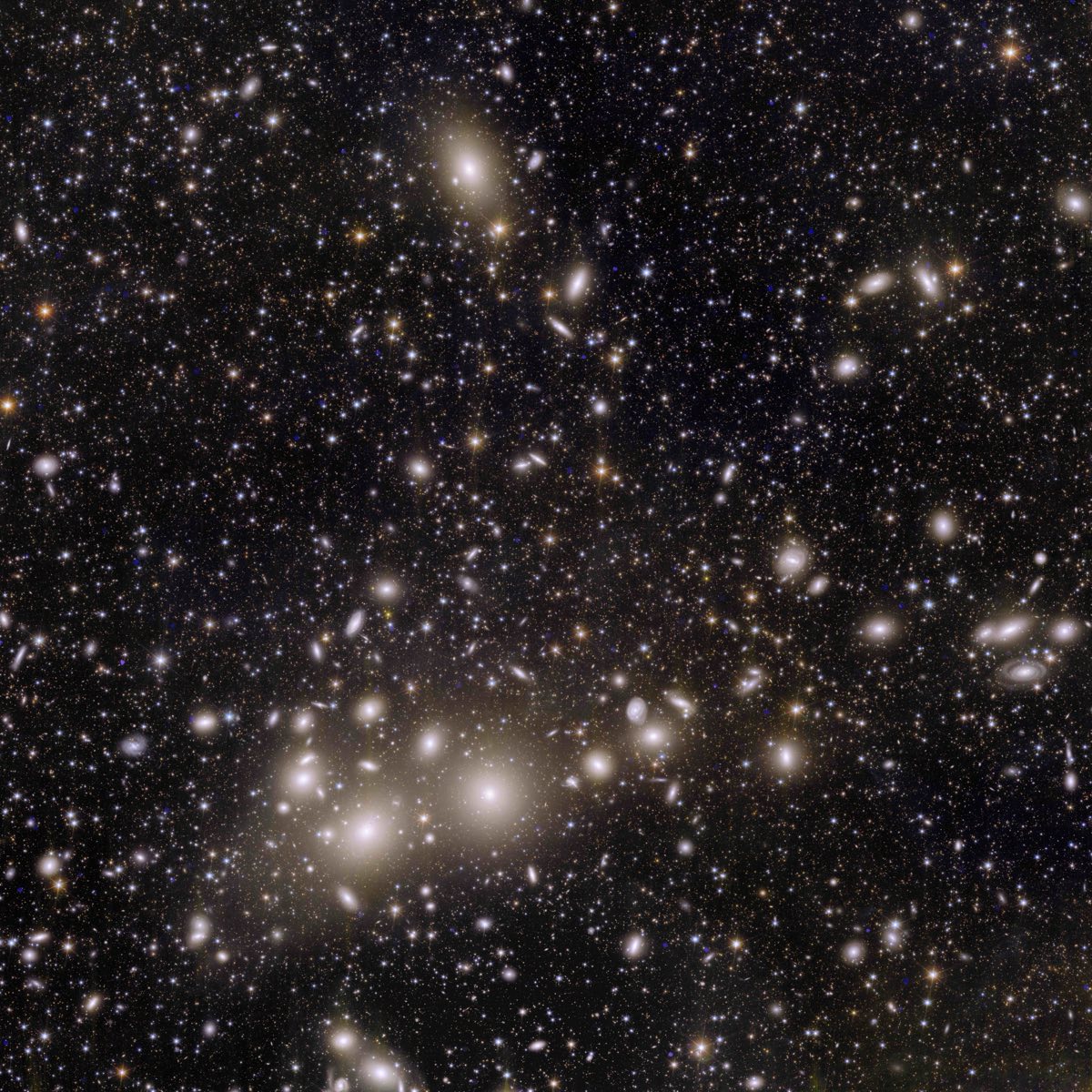
The Great Attractor is a vast concentration of mass in the nearby universe, hidden behind the plane of the Milky Way, toward which our galaxy and thousands of others are drifting. It is not one object but a crowded region of galaxy clusters, including the massive Norma cluster. It lies within Laniakea, our home supercluster, and is itself part of a larger flow toward the Shapley Supercluster.
The Great Attractor is one piece of the cosmic web described in our galaxies guide.
What is the Great Attractor?
The Great Attractor is a gravitational center revealed by how galaxies move rather than by what astronomers could see. In a 1991 Nature article, the astronomer Alan Dressler wrote that the local universe “seems to be dominated by a single region of above-average mass density: the Great Attractor.”
Key facts, as of October 2026:
- Mass: about 5 × 10¹⁶ solar masses in the region, according to a 1996 Nature study by Kraan-Korteweg and colleagues.
- Direction: toward the southern Milky Way, close to the plane of our galaxy.
- Core: the Norma cluster (Abell 3627), about 5 × 10¹⁵ solar masses, lies only 9 degrees from the predicted center and “at or near the bottom” of the attractor’s gravitational well.
- Distance: the Norma cluster recedes at about 4,800 km/s; for a Hubble constant near 70 km/s per megaparsec, that is roughly 70 megaparsecs, or about 220 million light-years.
How was the Great Attractor discovered?
The Great Attractor was found through peculiar velocities, the motions of galaxies left over after subtracting the smooth expansion of the universe. If the universe expanded perfectly evenly, every galaxy’s speed away from us would match its distance, following Hubble’s law. Galaxies in our neighborhood do not quite follow it: they show a systematic extra motion toward one part of the sky.
In 1988 a team led by Lynden-Bell published a study of elliptical galaxies in The Astrophysical Journal, titled in part “Galaxy streaming toward the new supergalactic center”, that mapped this flow and located its source. Further work in the late 1980s and 1990s confirmed a large mass concentration in that direction. The problem was that astronomers could barely see it.
Why is the Great Attractor hidden?
Because it lies behind the disk of our own galaxy. Stars, gas and dust in the Milky Way’s plane block much of the light from galaxies beyond, creating a band across the sky that astronomers call the Zone of Avoidance. As Kraan-Korteweg and colleagues put it in 1996, the Great Attractor “is largely hidden by the disk of the Milky Way.”
Deeper surveys gradually revealed the galaxies behind it. The 1996 study showed that Abell 3627, the Norma cluster, is very massive and close to the predicted center, making it the most likely core of the Great Attractor.
Laniakea: the Great Attractor’s supercluster
In September 2014 R. Brent Tully, Hélène Courtois, Yehuda Hoffman and Daniel Pomarède redrew the map of our cosmic neighborhood in Nature. Instead of defining a supercluster by where galaxies cluster on the sky, they used motion. They traced where the flows of galaxies diverge, like water at a watershed divide, and defined our supercluster as everything inside that boundary whose galaxies flow inward. They called it Laniakea.
| Property | Laniakea Supercluster |
|---|---|
| Size | About 160 megaparsecs (roughly 500 million light-years) across |
| Mass | About 1017 solar masses |
| Galaxies | About 100,000 large galaxies |
| Includes | The Virgo cluster, the Norma, Hydra and Centaurus clusters (the Great Attractor region), the Pavo-Indus filament, many voids |
| Name | Hawaiian for “immense heaven” (from lani, heaven, and akea, spacious) |
Sources: Tully et al. 2014, Nature 513, 71; University of Hawaiʻi.
The name was suggested by Nawa’a Napoleon, an associate professor of Hawaiian language at Kapiʻolani Community College. Within Laniakea, the Great Attractor region acts as what the University of Hawaiʻi described as a large, flat-bottomed gravitational valley, the place toward which the supercluster’s galaxies flow.
Beyond the Great Attractor: Shapley and the dipole repeller
The Great Attractor is not the end of the story. The flow maps behind Laniakea already showed that, on larger scales, “all flows appear to drain towards Shapley”, the Shapley Supercluster, a much larger concentration of galaxies farther away.
Our galaxy’s motion also has a push, not just a pull. In 2017 Hoffman, Pomarède, Tully and Courtois identified the “dipole repeller” in Nature Astronomy: a large, underdense region of space, predicted to be associated with a void in the distribution of galaxies. Underdense regions push as much as dense ones attract, and the repeller and the Shapley concentration contribute roughly equally to our motion.
That motion is measured against the cosmic microwave background, the afterglow of the Big Bang. COBE found that the Local Group moves at 627 ± 22 km/s relative to it (Kogut et al. 1993); the 2017 paper used 631 ± 20 km/s.
The boundaries are still being redrawn. A 2024 Nature Astronomy study by Valade, Tully and colleagues, using the larger Cosmicflows-4 catalog of about 38,000 galaxy groups, found a slight probabilistic preference for Laniakea being part of a much larger basin of attraction centered on Shapley. In other words, our “home supercluster” may be a district of something bigger. Maps of the cosmic web keep growing: in 2026 astronomers reported the most distant proto-supercluster known, assembling when the universe was 2.1 billion years old (the most distant proto-supercluster).
What the Great Attractor means for our future
Very little, on human timescales. The pull acts over hundreds of millions of years and is slowed on large scales by cosmic expansion, which dark energy is accelerating. The Milky Way’s more immediate encounter is with its neighbor, the Andromeda Galaxy, now a roughly even chance within 10 billion years (the Andromeda collision).
Questions people ask
What is the Great Attractor?
The Great Attractor is a region of unusually high mass in the nearby universe, in the direction of the southern Milky Way, toward which the Milky Way and thousands of other galaxies are drifting. It is a crowd of galaxy clusters, including the massive Norma cluster, estimated in 1996 at about 50 quadrillion solar masses in total.
Why can't we see the Great Attractor?
Because the Milky Way is in the way. The Great Attractor lies close to the plane of our galaxy, where stars, gas and dust block much of the view in visible light. Astronomers call this region the Zone of Avoidance. Deeper surveys, including at longer wavelengths that pass through dust more easily, have gradually revealed the galaxies behind it.
Is the Great Attractor dangerous?
No. The pull is gentle and acts over hundreds of millions of years, and it is overwhelmed on large scales by the expansion of the universe. The Milky Way's motion toward it is a slow drift on top of cosmic expansion, not a fall. Nothing about it threatens Earth or the solar system.
What is the Laniakea Supercluster?
Laniakea is the supercluster containing the Milky Way, defined in 2014 by Brent Tully and colleagues from the motions of galaxies. It spans about 160 megaparsecs, roughly 500 million light-years, and holds about 100 quadrillion solar masses in about 100,000 galaxies. Its name means 'immense heaven' in Hawaiian.
How fast is the Milky Way moving?
Relative to the cosmic microwave background, the Local Group of galaxies, which includes the Milky Way, moves at about 627 kilometers per second (COBE, 1993), or about 631 km/s in a 2017 analysis. Part of that motion comes from the Great Attractor and the more distant Shapley Supercluster pulling, and part from empty regions pushing.
What is the dipole repeller?
The dipole repeller is a large, nearly empty region of space, identified in 2017 by Yehuda Hoffman, Brent Tully and colleagues, that effectively pushes the Milky Way away. Underdense regions push about as much as dense ones pull, and the repeller and the Shapley concentration contribute roughly equally to our motion.