VLT Finds Evidence of a Jupiter-Mass Exomoon Orbiting a Brown Dwarf
CRIRES+ radial velocities reveal a planet-mass object circling a brown dwarf companion of the star CD-35 2722, the first plausible exosatellite.
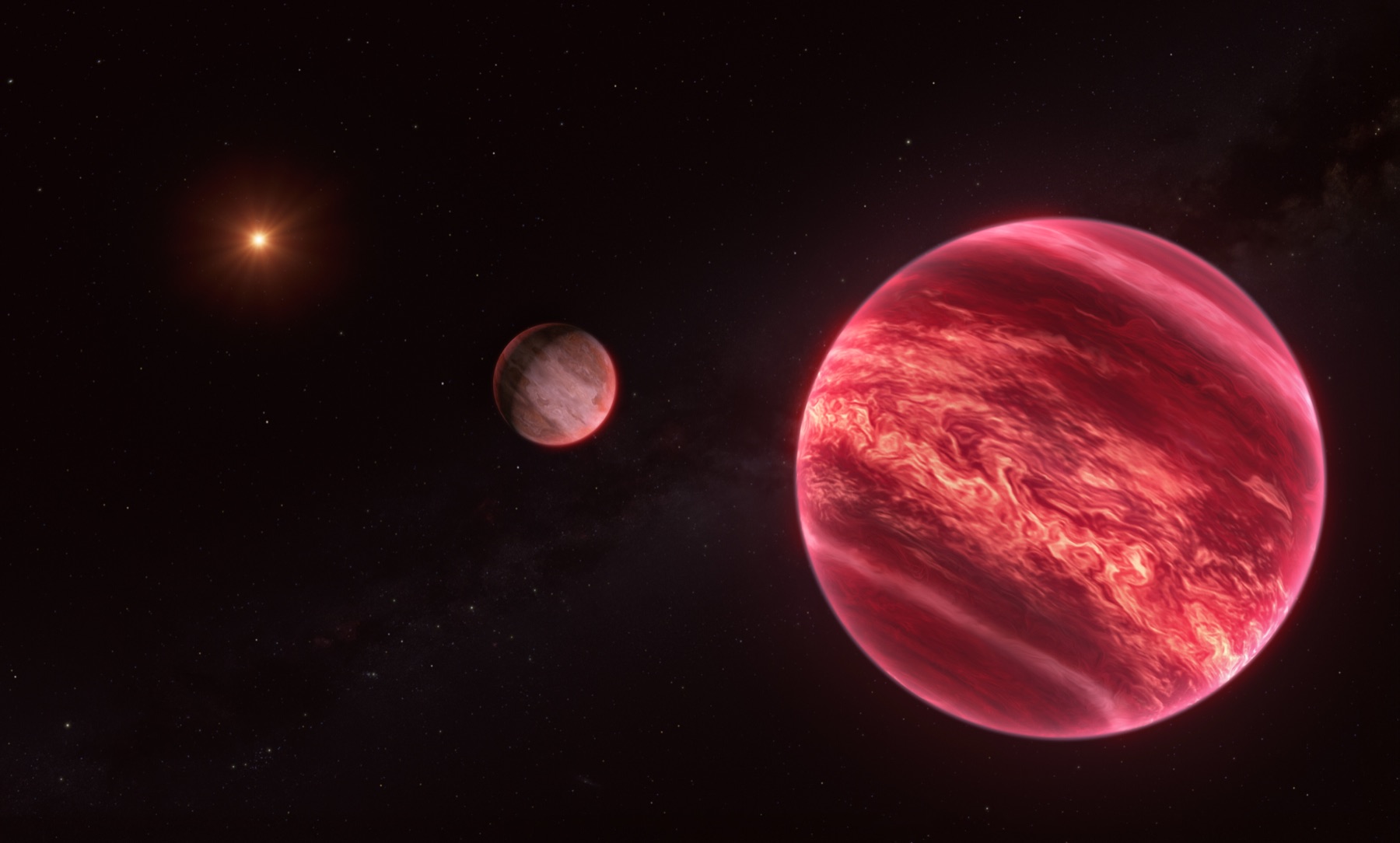
Astronomers have found evidence of a Jupiter-mass object orbiting a brown dwarf, which in turn orbits the young star CD-35 2722. The team calls it the first plausible detection of an exosatellite, a moon outside the Solar System. The study, led by Kevin Hoy, was published in Nature as “Planetary-mass exosatellite detected around the substellar companion of a star”, and ESO announced it on July 22, 2026.
The system is nested like a set of orbits within orbits. The host star has about half the mass of the Sun. The brown dwarf, an object too heavy to be a planet but too light to burn hydrogen like a star, has more than 30 times Jupiter’s mass. The newly detected satellite is at least as massive as Jupiter.
It was found with the radial velocity method: as the satellite orbits, it tugs the brown dwarf back and forth, shifting the brown dwarf’s light slightly toward blue and then red. The team measured that wobble with the CRIRES+ instrument on ESO’s Very Large Telescope. It is the same basic technique that found the first planet around a Sun-like star, 51 Pegasi b, in 1995, applied here to a much fainter target.
No exomoon has yet been confidently confirmed among more than 6,000 known exoplanets. If this one holds up, it would be the first moon found outside the Solar System and would open a new class of objects to study. The wording matters: “plausible” and “if confirmed” are the team’s own. A Jupiter-mass companion to a brown dwarf also blurs the line between a moon and a planet. More in our exoplanets guide.
What to watch next: independent observations that confirm the signal and pin down the satellite’s orbit.
Primary source
This summary is based on ESO and the peer-reviewed paper. Read the original for full details, data and caveats.
This week in papers
The week's most important results, one line each, every week.