1995
Landmark paper
Michel Mayor and Didier Queloz, Nature, 378, 355-359, 1995
51 Pegasi b (1995): The First Planet Around a Sun-Like Star
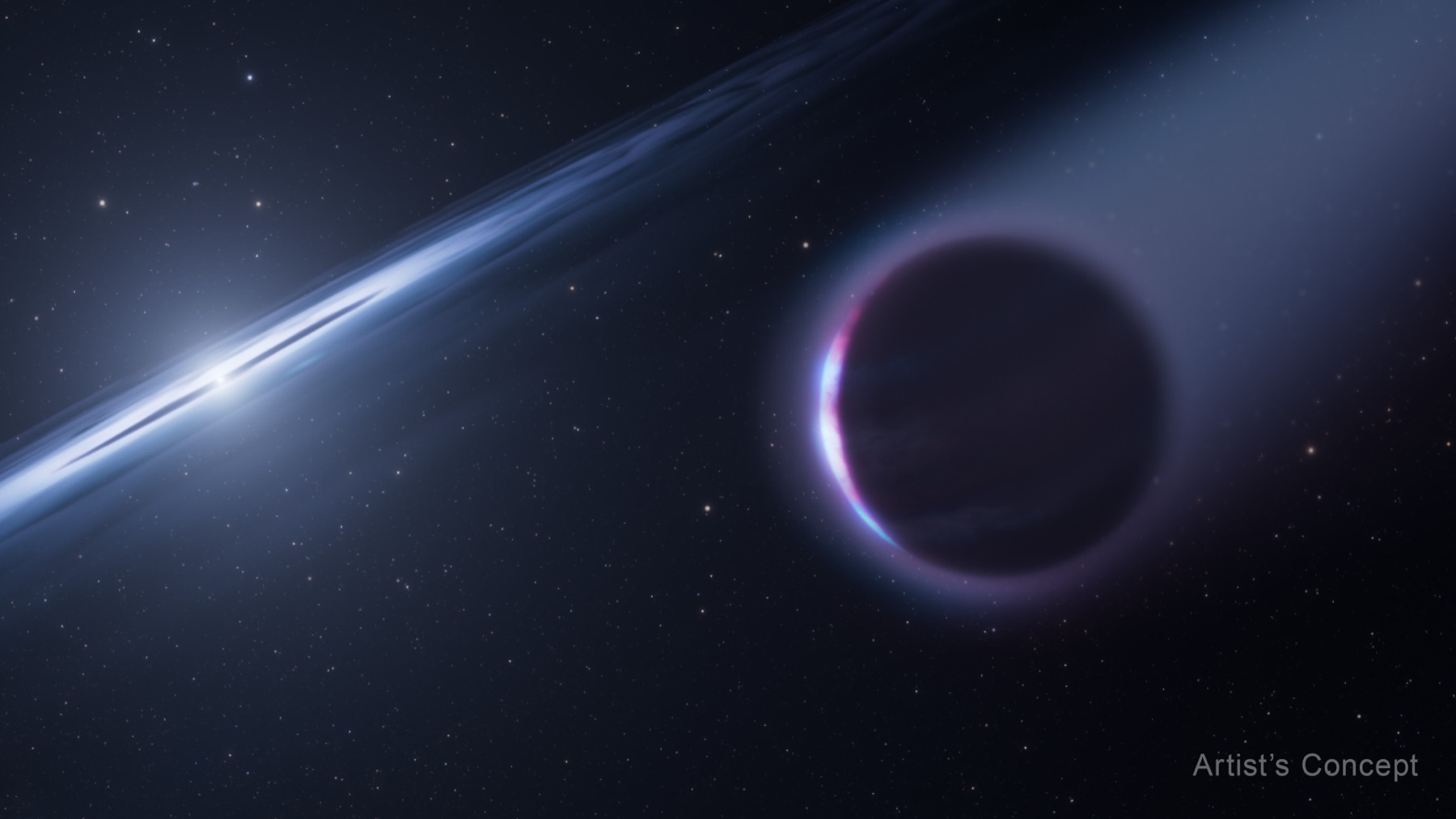
Found in 1995 the first planet orbiting a Sun-like star. Mayor and Queloz detected 51 Pegasi b, a hot Jupiter that circles its star every 4.23 days.
Michel Mayor and Didier Queloz discovered 51 Pegasi b in 1995, the first planet found orbiting a Sun-like star. This giant, about half Jupiter’s mass, circles its star every 4.23 days, which no theory predicted. The find launched modern exoplanet science and won the 2019 Nobel Prize.
What was known before 1995?
For centuries, the only planets anyone knew were the Sun’s own. In 1992 radio astronomers had found planets around a pulsar, the burned-out core of an exploded star, but no planet had been confirmed around an ordinary star like the Sun. Searches assumed other systems would look like ours, with giant planets orbiting far from their stars, where Jupiter and Saturn sit. Such planets move slowly and take years to complete an orbit, so a search would need years of data.
What the paper found
- A star that wobbles. The Sun-like star 51 Pegasi moves back and forth along our line of sight in a regular cycle.
- A period of just 4.23 days. The companion completes an orbit in a little over four days. Mercury, the Sun’s innermost planet, needs 88.
- A planet, not a star. The companion has a minimum mass of about half that of Jupiter, far too small to be a star.
- A new kind of world. A giant planet this close to its star, now called a “hot Jupiter”, did not fit theories built on our Solar System. It forced astronomers to accept that planets can migrate inward after they form.
How they did it
Mayor and Queloz used the ELODIE spectrograph at the Observatoire de Haute-Provence in southern France. A spectrograph spreads starlight into a rainbow crossed by dark lines, the fingerprints of elements in the star’s atmosphere. The pair tracked those lines with extreme care.
The technique is called radial velocity. A planet and its star both orbit their shared center of mass, so the star sways toward us and away from us. When it approaches, its light is squeezed slightly toward blue; when it recedes, stretched toward red. This is the Doppler shift, the same effect that changes the pitch of a passing siren. Plotting those tiny shifts over time revealed a clean 4.23-day rhythm.
The method gives only a minimum mass, because we do not know how the orbit is tilted toward us. That is why the paper’s title speaks of a “Jupiter-mass companion” rather than an exact mass.
Why it mattered
51 Pegasi b showed that planets around Sun-like stars could be found, and that planetary systems can look nothing like ours. Hot Jupiters became a major research topic, and the idea of planetary migration moved from speculation to the center of planet-formation theory.
The discovery opened exoplanet science as a field. Radial velocity later found Proxima b around the nearest star, while the Kepler mission’s transit survey turned planet hunting into statistics. Hot Jupiters also became the first planets whose air could be read in detail, as in Webb’s 2022 detection of carbon dioxide on WASP-39b.
In 2019 Mayor and Queloz shared half of the Nobel Prize in Physics “for the discovery of an exoplanet orbiting a solar-type star”. The other half went to cosmologist James Peebles.
What we know now
As of October 2026, NASA’s Exoplanet Archive lists more than 6,400 confirmed exoplanets. Radial-velocity work continues on far sharper instruments, such as ESPRESSO at the ESO Very Large Telescope. In 2026 it helped measure winds on seven hot Jupiters blowing at about 7,200 to more than 25,000 km/h.
Who wrote it
Michel Mayor was a professor at the University of Geneva observatory, and Didier Queloz was his PhD student. They announced the discovery on 6 October 1995 at a conference in Florence, and the paper appeared in Nature that November.
Questions people ask
Who discovered the first exoplanet?
Aleksander Wolszczan and Dale Frail found the first confirmed exoplanets in 1992, orbiting a pulsar, the dead core of an exploded star. Michel Mayor and Didier Queloz found 51 Pegasi b in 1995, the first planet around a normal Sun-like star. That second discovery won the 2019 Nobel Prize in Physics.
When was the first exoplanet discovered?
The first confirmed exoplanets were announced in January 1992, around the pulsar PSR 1257+12. The first planet around a Sun-like star, 51 Pegasi b, was announced on 6 October 1995 at a conference in Florence and published in Nature in November 1995 by Michel Mayor and Didier Queloz.
What is a hot Jupiter?
A hot Jupiter is a gas giant planet that orbits very close to its star, completing a lap in days rather than years. 51 Pegasi b, with its 4.23-day orbit, was the first known. Our Solar System has nothing like it, so hot Jupiters showed that giant planets can migrate inward after forming.
Read the original
Mayor, M. and Queloz, D. (1995). “A Jupiter-mass companion to a solar-type star.” Nature 378, 355-359. doi:10.1038/378355a0
The journal version may require a subscription. Semantic Scholar lists about 3,500 citations (October 2026).
This week in papers
Five new results in one line each, plus one landmark like this one. Weekly.
Keep reading
Wolszczan and Frail, Nature, 355, 145-147, 1992
The First Exoplanets: Planets Around a Dead Star
Found in 1992 the first confirmed planets beyond the Solar System. Wolszczan and Frail timed pulsar PSR 1257+12 and caught two worlds a few Earths in mass.
Charbonneau et al., The Astrophysical Journal Letters, 529, L45-L48, 2000
First Transiting Exoplanet: HD 209458 b Crosses Its Star
Detected the first planet crossing in front of its star in 2000. Charbonneau and colleagues measured HD 209458 b's size, the start of the transit method.
Marois et al., Science, 322, 1348-1352, 2008
HR 8799: The First Photo of a Multi-Planet System
Photographed in 2008 three giant planets orbiting the young star HR 8799. Marois and colleagues used Keck and Gemini to image a whole planetary system.
Topic guide
Exoplanets
Recent news in exoplanets