2008
Ghez et al., The Astrophysical Journal, 689, 1044-1062, 2008
Andrea Ghez (2008): Weighing the Milky Way's Black Hole With Stars
Weighed the Milky Way's central black hole at about 4 million Suns by tracking the star S0-2 for 12 years with Keck. Andrea Ghez's team, 2008.
Andrea Ghez and her team weighed the supermassive black hole at the center of the Milky Way by tracking stars orbiting it. In this 2008 paper, the orbit of a single star, S0-2, gave a mass of about 4 million Suns packed into a tiny region and a distance to the galactic center of about 8 kiloparsecs. The work shared the 2020 Nobel Prize in Physics.
The question before the paper
Astronomers had long suspected that a massive black hole sits at the heart of our galaxy, at the radio source Sagittarius A*. A black hole cannot be seen directly, but its gravity can be measured. Could anyone follow single stars close enough to the center to weigh what they orbit, and prove it is too compact to be anything but a black hole?
What the paper found
- One star does the weighing. A fully unconstrained fit to its orbit gave a distance to the galactic center of 8.0 ± 0.6 kiloparsecs (about 26,000 light-years) and an enclosed mass of 4.1 ± 0.6 million solar masses.
- A tighter answer with one assumption. Assuming the black hole is at rest gave a distance of 8.4 ± 0.4 kiloparsecs and a mass of 4.5 ± 0.4 million solar masses.
- Almost nothing else there. Any extended dark mass around the black hole, such as a cluster of dead stars, must be less than 300,000 to 400,000 solar masses within 0.01 parsecs. The mass is concentrated in a point.
How they did it
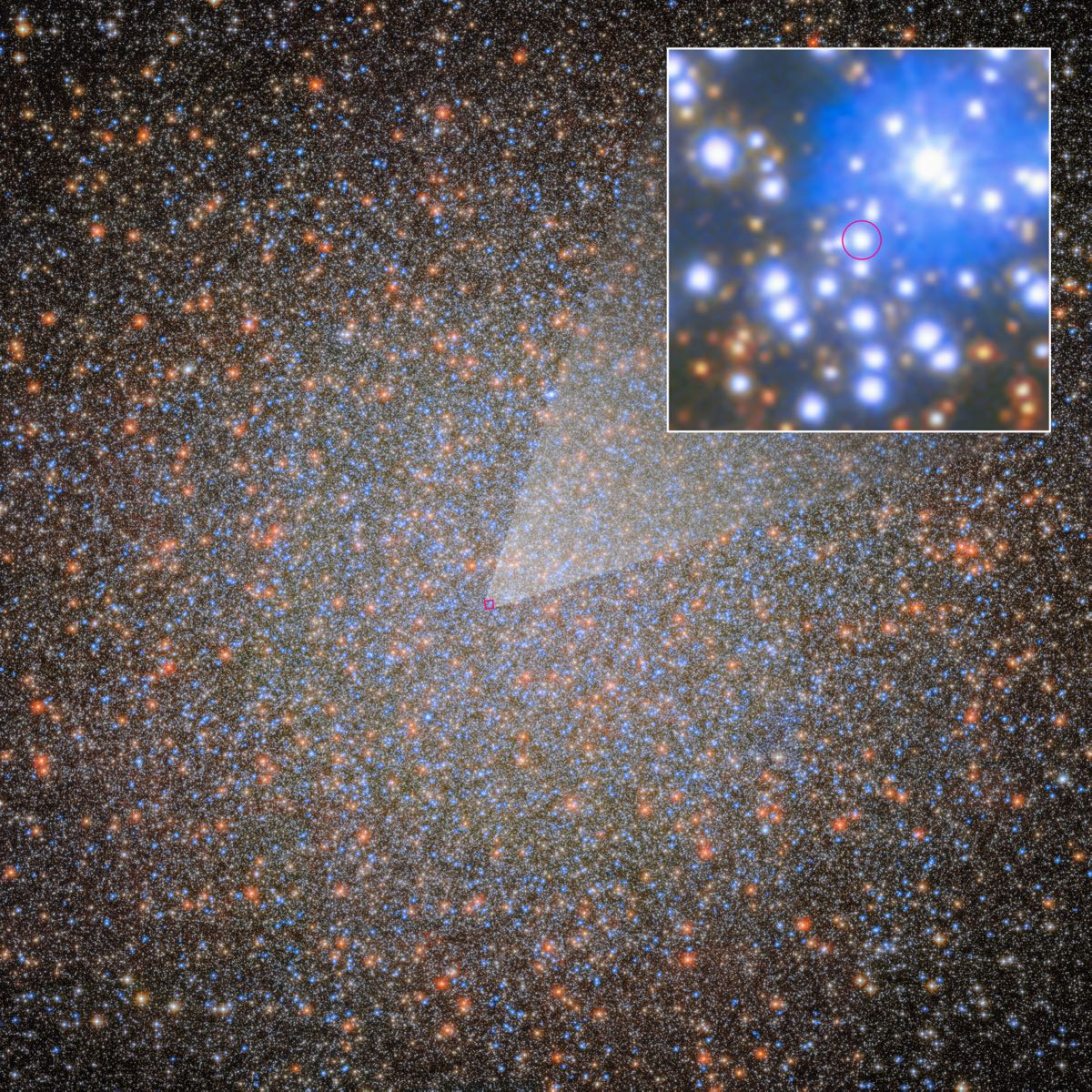
The team used the twin 10-meter telescopes of the W. M. Keck Observatory on Maunakea. They measured the positions of stars on the sky (astrometry) from 1995 to 2007 and their line-of-sight velocities from spectra from 2000 to 2007. S0-2 is ideal because it is a short-period star: its orbit is small and fast enough that the curve of its path could be followed over the years of the campaign. Fitting a Keplerian orbit, the same physics that governs planets around the Sun, gives the central mass and, combining motion on the sky with velocity in kilometers per second, the distance.
Why it mattered
Watching individual stars whip around an invisible mass gave the most convincing evidence that a supermassive black hole sits at the heart of the Milky Way. Andrea Ghez and Reinhard Genzel, whose team at the Max Planck Institute for Extraterrestrial Physics made parallel measurements with ESO telescopes, shared half of the 2020 Nobel Prize in Physics “for the discovery of a supermassive compact object at the centre of our galaxy”. Roger Penrose received the other half for showing that black hole formation is a robust prediction of general relativity.
What we know now
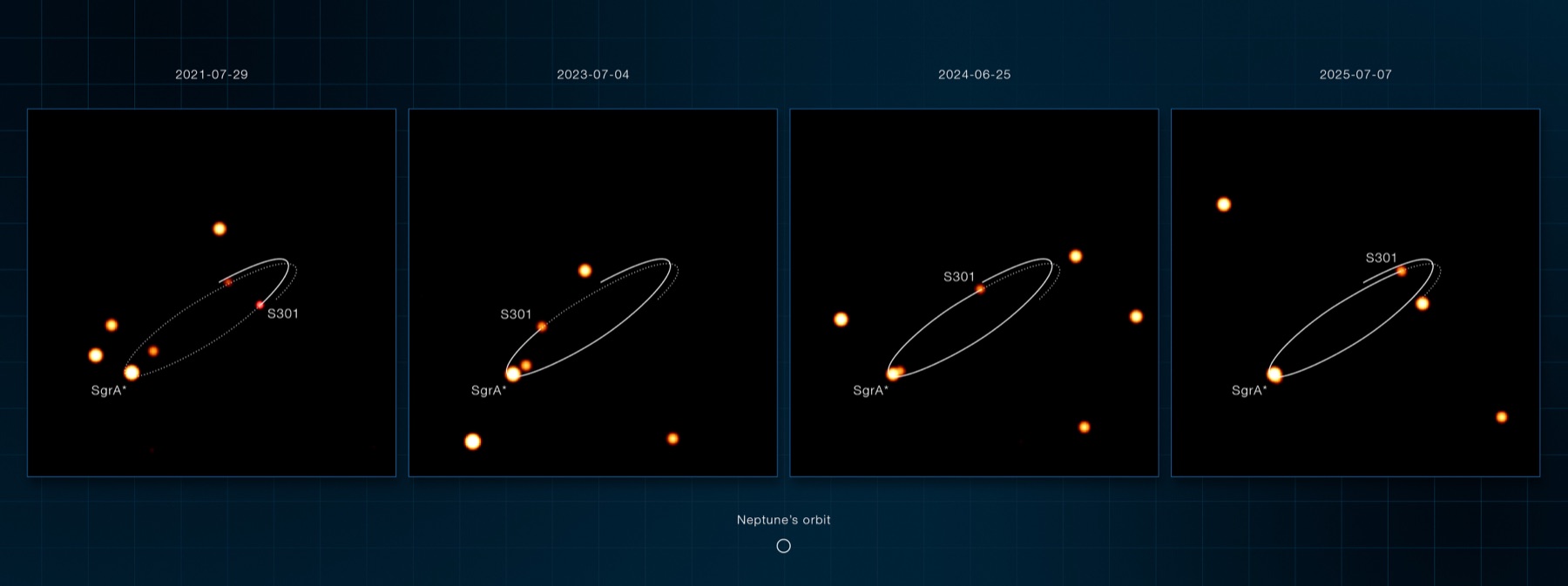
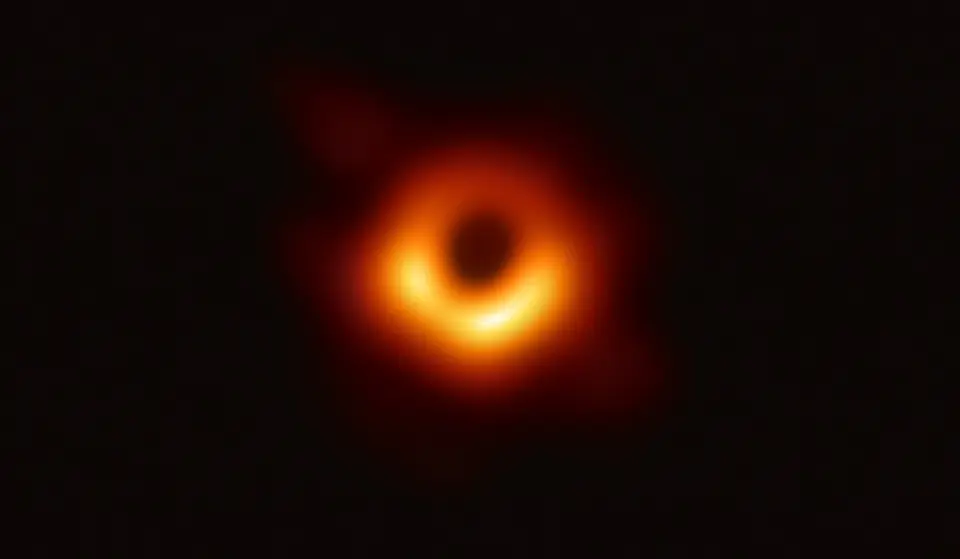
In 2022 the Event Horizon Telescope published the first image of Sagittarius A*, confirming by a completely independent method a black hole of about 4 million solar masses. Star tracking has continued with ESO’s Very Large Telescope: in August 2026 its GRAVITY instrument revealed S301, the fastest known star in the Milky Way, which may allow the black hole’s spin to be measured within about a decade. See our black holes guide.
Who wrote it
Andrea Ghez led the work, with S. Salim, N. N. Weinberg and colleagues in her group. The paper has about 1,400 citations in Semantic Scholar as of October 2026.
Read the original
Ghez, A. M., Salim, S., Weinberg, N. N., et al. (2008). “Measuring Distance and Properties of the Milky Way’s Central Supermassive Black Hole with Stellar Orbits.” The Astrophysical Journal. doi:10.1086/592738. Free on arXiv: 0808.2870.
This week in papers
Five new results in one line each, plus one landmark like this one. Weekly.
Keep reading
Event Horizon Telescope Collaboration, The Astrophysical Journal Letters, 875, L1, 2019
First Image of a Black Hole: The M87* Shadow Explained
Captured in 2019 the first image of a black hole: a ring of light around the shadow of M87*, 6.5 billion Suns. The Event Horizon Telescope's paper.
Event Horizon Telescope Collaboration, The Astrophysical Journal Letters, 930, L12, 2022
Sagittarius A* Image: The Milky Way's Black Hole, Seen
Imaged in 2022 the shadow of Sagittarius A*, the 4-million-Sun black hole at the Milky Way's center. The Event Horizon Telescope's first Sgr A* paper.
Maiolino et al., Nature, 627, 59-63, 2024
GN-z11's Black Hole: Feeding Fast in the Early Universe
Found with JWST a 1.6-million-Sun black hole feeding at five times the usual limit in GN-z11, at redshift 10.6. Roberto Maiolino's team, Nature 2024.
Topic guide
Black holes
Recent news in black holes