2016
Anglada-Escudé et al., Nature, 536, 437-440, 2016
Proxima b (2016): A Temperate Planet Around the Nearest Star
Found in 2016 Proxima b, a planet of at least 1.3 Earth masses orbiting the nearest star. Anglada-Escudé's team caught the star wobbling every 11.2 days.
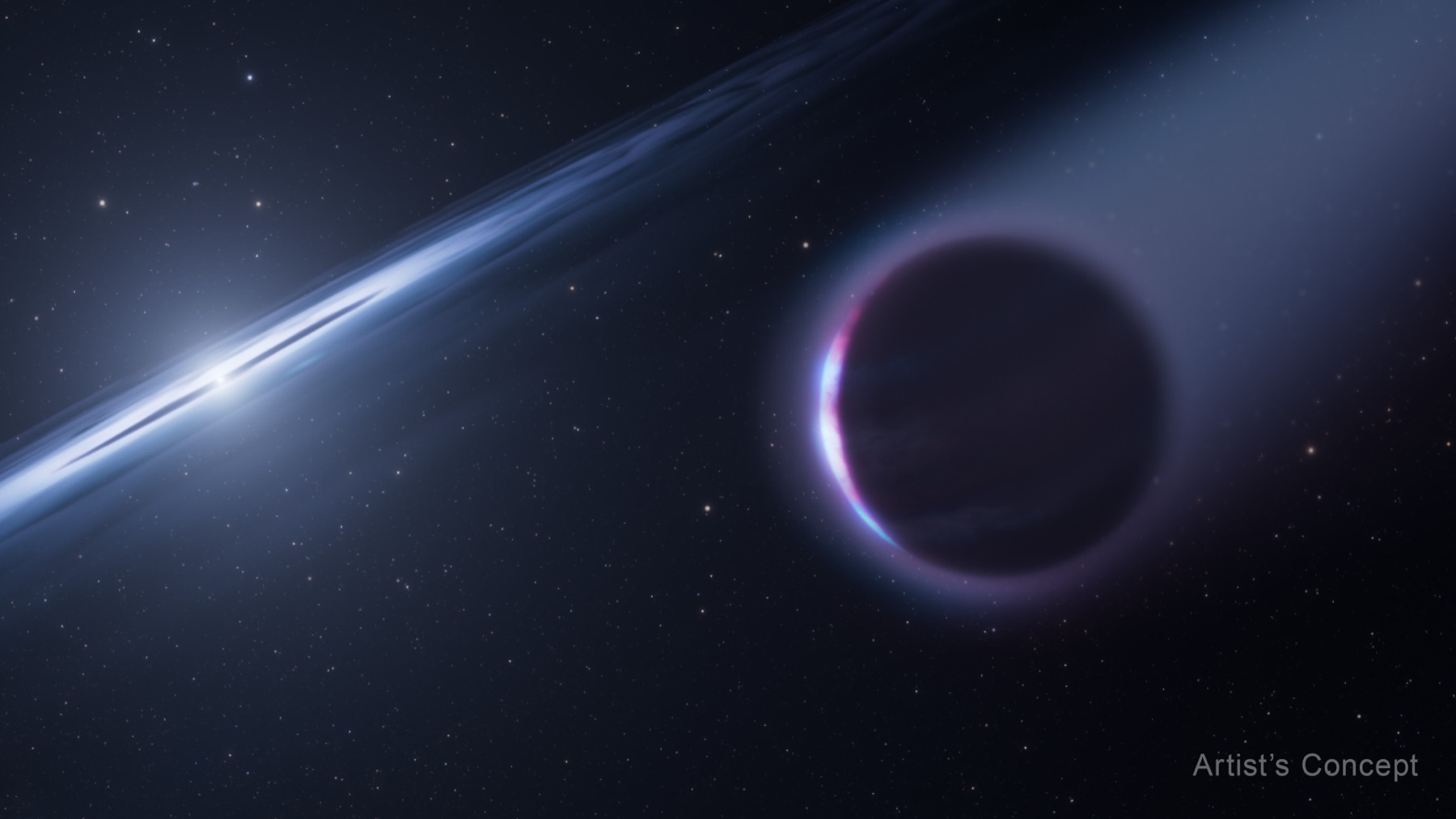
Guillem Anglada-Escudé and colleagues discovered Proxima b in 2016, a planet at least 1.3 times Earth’s mass orbiting Proxima Centauri, the Sun’s nearest stellar neighbor. It circles every 11.2 days at a distance where liquid water could exist on its surface, and it is the closest known exoplanet.
The question
Proxima Centauri is a small red dwarf 1.295 parsecs away, just over four light-years. It has about 12% of the Sun’s mass, 14% of its radius and only about 0.15% of its luminosity. Too faint to see with the naked eye, it is still the closest star to the Sun. Did it have planets? A first hint of a signal appeared in 2013, but it was not convincing. Red dwarfs are also active stars whose natural variations can mimic the signal of a planet, so any claim had to rule that out.
What the paper found
- A steady rhythm. Proxima moves toward and away from us in a cycle that repeats every 11.2 days, at roughly 5 km/h, about human walking pace.
- A planet of at least 1.3 Earth masses. That is the minimum mass, since the tilt of the orbit is unknown.
- A very tight orbit. The planet sits about 0.05 AU from its star, roughly 7 million kilometers, only 5% of the Earth-Sun distance.
- Temperate, at least on paper. Because the star is so dim, the planet’s equilibrium temperature falls in the range where liquid water could exist on its surface.
- The nearest exoplanet. No known planet beyond the Solar System is closer.
How they did it
The team used the radial-velocity method, the same technique behind the 1995 discovery of 51 Pegasi b. A planet and its star orbit a shared center, so the star sways back and forth, and that motion shifts the colors of its light slightly blue, then slightly red.
The key data came from the Pale Red Dot campaign. During the first half of 2016, Proxima was observed regularly with the HARPS spectrograph on ESO’s 3.6-meter telescope at La Silla, Chile, for 60 nights. Those data were combined with earlier observations from ESO and elsewhere. To rule out stellar activity, other telescopes monitored the star’s brightness at the same time. The campaign was shared with the public in real time on its own website and on social media.
Why it mattered
A potentially temperate, Earth-mass planet around the very nearest star made exoplanets feel local. The paper’s title is careful: a “terrestrial planet candidate”. The minimum mass fits a rocky world, but nobody has measured its size, atmosphere or surface.
Proxima b also became a natural test case for the idea of the habitable zone defined by Kasting and colleagues in 1993, and for planets around red dwarfs, the most common stars in the galaxy, a question sharpened a year later by the seven planets of TRAPPIST-1.
What we know now
The planet has held up. In 2020 an independent study with the ESPRESSO spectrograph confirmed the 11.2-day signal, refined the minimum mass to about 1.17 Earth masses, and found no sign that stellar activity caused it.
Proxima b remains a prime target for future telescopes and is the destination studied by the Breakthrough Starshot project. ESO’s Extremely Large Telescope, a 39-meter telescope under construction in Chile, expects first light in 2029 and the start of science in December 2030.
Who wrote it
The team was led by Guillem Anglada-Escudé, then at Queen Mary University of London, with Pedro Amado, John Barnes and many colleagues. The Pale Red Dot campaign took about two years to plan.
Read the original
Anglada-Escudé, G., Amado, P. J., Barnes, J., et al. (2016). “A terrestrial planet candidate in a temperate orbit around Proxima Centauri.” Nature 536, 437-440. doi:10.1038/nature19106
Free to read: arXiv preprint.
This week in papers
Five new results in one line each, plus one landmark like this one. Weekly.
Keep reading
Fulton et al., The Astronomical Journal, 154, 109, 2017
The Fulton Gap: A Missing Size of Small Planets
Found in 2017 a gap in the sizes of small planets between 1.5 and 2 Earth radii. Fulton's team split close-in worlds into super-Earths and sub-Neptunes.
Gillon et al., Nature, 542, 456-460, 2017
TRAPPIST-1: Seven Earth-Size Planets Around One Star
Found in 2017 seven Earth-size planets transiting TRAPPIST-1, a tiny star 40 light-years away. Gillon's team showed several could hold liquid water.
Borucki et al., Science, 327, 977-980, 2010
Kepler's First Results: Hunting Earth-Size Planets
Found in 2010 Kepler's first five planets after watching 156,000 stars for six weeks. William Borucki's NASA mission went on to confirm 2,681 planets.
Topic guide
Exoplanets
Recent news in exoplanets