What has JWST discovered?
JWST has found the most distant galaxies known, surprising early black holes and the chemistry of exoplanet air. Its biggest results to October 2026.
By The Orbital Record editorial teamPublished Last reviewed
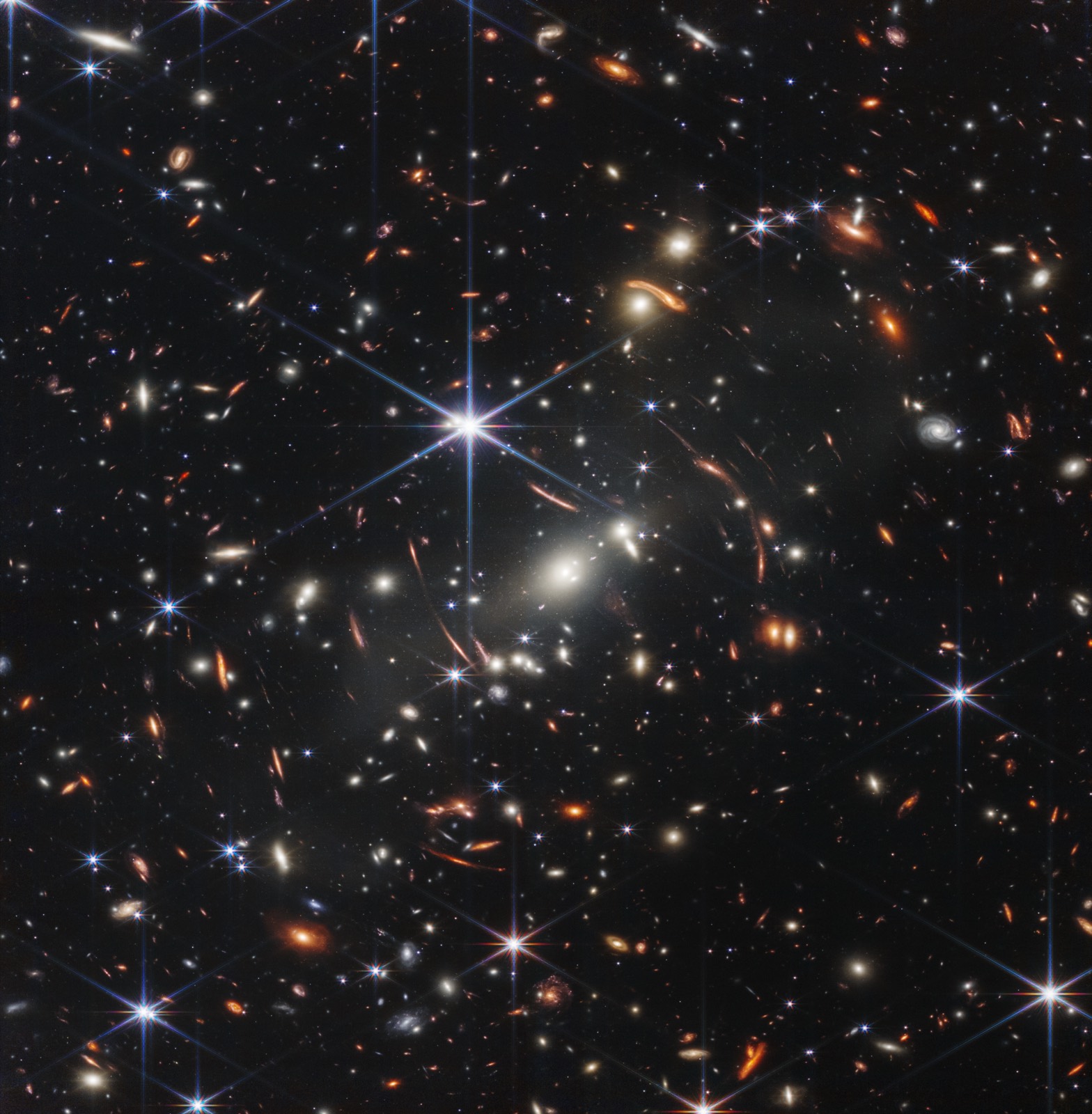
JWST’s biggest discoveries are the most distant galaxies ever confirmed, a surprising abundance of bright galaxies and black holes in the early universe, and the first detailed chemistry of exoplanet atmospheres. Since its first images in July 2022, the James Webb Space Telescope has also checked the Hubble tension, imaged a new planet and traced ices that build planets. Here are the major results through October 2026.
JWST is one of several observatories in our guide to space telescopes and observatories; for how it compares with its predecessor, see JWST vs Hubble.
JWST’s biggest discoveries at a glance
| Year | Discovery | Why it matters |
|---|---|---|
| 2022 | First images, including the SMACS 0723 deep field | Showed JWST performing better than required |
| 2022 | Carbon dioxide on the exoplanet WASP-39b | First definitive CO2 in an exoplanet atmosphere |
| 2023 | Ices in a dark molecular cloud | The frozen ingredients of planets, mapped |
| 2023 | TRAPPIST-1 b and c lack thick atmospheres | First tests of rocky planets around red dwarfs |
| 2023 | Carbon-rich dust within a billion years of the Big Bang | Dust formed earlier than expected |
| 2023 to 2024 | Black holes in GN-z11 and UHZ1 | Supermassive black holes grew very early |
| 2024 | Neutron star evidence inside SN 1987A | The remnant of a famous supernova found |
| 2024 | JADES-GS-z14-0 at redshift 14.32 | A bright galaxy 300 million years after the Big Bang |
| 2024 | A “dead” galaxy at redshift 7.3 | Star formation shut down surprisingly early |
| 2024 to 2025 | Hubble tension checks with JWST distances | Ruled out a simple measurement error |
| 2025 | TWA 7 b, a planet discovered by JWST imaging | The lightest planet imaged directly at the time |
| 2025 to 2026 | MoM-z14 at redshift 14.44 | Current record for the most distant galaxy |
| 2024 to 2026 | Little red dots as buried young black holes | A new population of early objects |
1. The first images (July 2022)
JWST’s first deep field, of the galaxy cluster SMACS 0723, was released on July 11, 2022, followed the next day by images of the Carina Nebula, Stephan’s Quintet, the Southern Ring Nebula and a spectrum of the exoplanet WASP-96 b. The commissioning report showed the telescope exceeded its requirements almost across the board (Rigby et al. 2023).
2. The most distant galaxies
JWST was built to find the first galaxies, and it has pushed the frontier back to about 280 million years after the Big Bang.
- JADES-GS-z14-0 (2024). The JADES team confirmed a galaxy at redshift 14.32 and another at 13.90, about 300 million years after the Big Bang (Carniani et al. 2024).
- MoM-z14 (2025 to 2026). A team led by Rohan Naidu reported MoM-z14 at redshift 14.44, about 280 million years after the Big Bang, the current record as of October 2026, announced by ESA/Webb on January 28, 2026.
The surprise was not just distance but brightness. Early galaxies are more numerous and luminous than many models predicted, prompting the “too bright, too early” debate. In 2023 Ivo Labbé and colleagues flagged red candidate galaxies that seemed too massive for their age (Labbé et al. 2023); follow-up showed some are actually growing black holes. This is not a crisis for the Big Bang, but it is forcing faster recipes for early star formation. More in our galaxies guide.
JWST also found a galaxy at redshift 7.3 that had already stopped forming stars, a “dead” galaxy only about 700 million years after the Big Bang (Looser et al., Nature, 2024), and carbon-rich dust grains at redshifts up to about 7 (Witstok et al., Nature, 2023).
3. Early black holes and little red dots
JWST revealed that supermassive black holes were already large and hungry in the young universe.
- GN-z11 (2024). A black hole of about 1.6 million solar masses feeding vigorously at redshift 10.6, about 430 million years after the Big Bang (Maiolino et al. 2024).
- UHZ1 (2023). Combined JWST and Chandra X-ray data revealed a black hole at redshift about 10.1 that seems to have started heavy, supporting the idea that some black holes are born from collapsing gas clouds rather than stars (Bogdán et al., Nature Astronomy, 2024).
- Little red dots. JWST found large numbers of compact, very red objects in the first billion or two years. A January 2026 Nature paper argued they are young supermassive black holes inside dense cocoons of ionized gas, which would make them about 100 times less massive than first estimated. Other interpretations remain in play. See our explainer on little red dots.
4. Exoplanet atmospheres
JWST reads the chemistry of exoplanet air by splitting the starlight that filters through it.
- WASP-39b (2022). The first definitive detection of carbon dioxide in an exoplanet atmosphere, at 26 sigma (JWST’s WASP-39b result).
- Rocky planets (2023 to 2025). TRAPPIST-1 b and c show no thick atmospheres; TRAPPIST-1 d lacks an Earth-like one; TRAPPIST-1 e may or may not have a nitrogen atmosphere. Details in the most Earth-like exoplanets.
- K2-18b (2023 to 2025). Methane and carbon dioxide on a temperate sub-Neptune, then a disputed 2025 claim of a possible biosignature gas that independent reanalyses did not support (K2-18b).
- TWA 7 b (2025). JWST’s coronagraph imaged a planet of about 0.3 Jupiter masses in the debris disk of a young star, the first planet discovered through JWST imaging (Lagrange et al., Nature, June 2025).
5. The Hubble tension
JWST was used to test whether the “Hubble tension”, the disagreement between the expansion rate measured locally and predicted from the early universe, comes from measurement errors. Adam Riess’s SH0ES team used JWST’s sharper infrared view to rule out crowding of Cepheid stars as the cause at high confidence and found a value near 73 km/s/Mpc, as in their Hubble work (SH0ES 2022). Wendy Freedman’s team, using other kinds of stars, found about 70 km/s/Mpc. The tension is not resolved.
6. Stars, ices and the solar system
- Ices (2023). JWST mapped frozen water, carbon dioxide, ammonia, methane and other molecules in a dark cloud in Chamaeleon I, the raw materials of planets (McClure et al., Nature Astronomy, 2023).
- SN 1987A (2024). Emission lines from argon in the heart of the 1987 supernova pointed to a neutron star hidden there (Fransson et al., Science, 2024).
- Europa (2023). Carbon dioxide on Europa’s surface, concentrated in a young region, likely from its ocean.
- Interstellar comet 3I/ATLAS (2025 to 2026). JWST found a carbon-dioxide-rich coma in 2025, and in 2026 high deuterium levels that point to an origin around a very old star (3I/ATLAS).
7. Results from 2026
JWST is in its fifth observing cycle, which began on July 1, 2026, after a record 2,930 proposals. Recent results include:
- July 2026: how the giant planet WD 1856 b survived the death of its star (WD 1856 b), and, with Hubble, the first stellar-mass black hole in Omega Centauri (Omega Centauri).
- August 2026: water and fresh dust around a dying star just 0.55 light-years from the Milky Way’s central black hole (IRS 3).
- October 2026: extreme debris disks from planet-shattering collisions (extreme debris disks) and the tiny host galaxy of the most distant fast radio burst yet (FRB 20240304B).
This page is updated as new results appear. Follow the mission on its hub page, James Webb Space Telescope, and see our video library for explainers on how Webb works.
Sources
- Rigby, J. et al. (2023). The Science Performance of JWST as Characterized in Commissioning. PASP. https://doi.org/10.1088/1538-3873/acb293 [primary]
- Carniani, S. et al. (2024). Spectroscopic confirmation of two luminous galaxies at a redshift of 14. Nature 633, 318. https://doi.org/10.1038/s41586-024-07860-9 [primary]
- Naidu, R. P. et al. (2025). MoM-z14. Open Journal of Astrophysics. https://arxiv.org/abs/2505.11263 [primary]
- Maiolino, R. et al. (2024). A small and vigorous black hole in the early Universe. Nature. https://doi.org/10.1038/s41586-024-07052-5 [primary]
- Rusakov, V. et al. (2026). Little red dots as young supermassive black holes in dense ionized cocoons. Nature 649, 574. https://doi.org/10.1038/s41586-025-09900-4 [primary]
- Lagrange, A.-M. et al. (2025). Evidence for a sub-Jovian planet in the young TWA 7 disk. Nature 642, 905. https://doi.org/10.1038/s41586-025-09150-4 [primary]
- Riess, A. G. et al. (2024). ApJL 962, L17. https://arxiv.org/abs/2401.04773 [primary]
- Freedman, W. L. et al. (2025). Status Report on the Chicago-Carnegie Hubble Program. https://arxiv.org/abs/2408.06153 [primary]
Questions people ask
What is the farthest thing JWST has seen?
As of October 2026, the most distant galaxy JWST has confirmed is MoM-z14, at a redshift of 14.44, seen as it was about 280 million years after the Big Bang. It took the record from JADES-GS-z14-0, confirmed in 2024 at redshift 14.32. Unconfirmed candidates at even higher redshifts await spectroscopy.
Has JWST disproved the Big Bang?
No. JWST found more bright galaxies in the early universe than many models predicted, which led to headlines claiming the Big Bang was in trouble. Researchers have instead revised how fast stars and black holes formed in young galaxies. The Big Bang framework and the 13.8-billion-year age of the universe stand.
What are the little red dots JWST found?
Little red dots are compact, very red objects that JWST found in large numbers in the first one to two billion years of cosmic history. The leading interpretation in 2026 is that many are young supermassive black holes buried in dense cocoons of gas, though their exact nature is still being debated.
Did JWST find signs of life?
No. JWST has measured gases such as carbon dioxide and methane in exoplanet atmospheres, but none is confirmed evidence of life. A 2025 claim of a possible biosignature gas on the planet K2-18b was not supported by independent reanalyses and remains unconfirmed.
How far back in time can JWST see?
To roughly 280 million years after the Big Bang for confirmed galaxies, about 98% of the way back to the beginning. Its infrared instruments were designed to see the first galaxies, whose light has been stretched to infrared wavelengths by the expansion of the universe.
Has JWST resolved the Hubble tension?
Not yet. JWST observations ruled out crowded Cepheid stars as the explanation, supporting the high value of about 73 km/s/Mpc from one team. Another team using different stars found values near 70, closer to the early-universe prediction. The disagreement in how fast the universe expands is still open.