1963
Roy P. Kerr, Physical Review Letters, 11, 237, 1963
The Kerr Black Hole (1963): The Exact Math of a Spinning Black Hole
Found in 1963 the exact solution of Einstein's equations for a spinning mass, describing real black holes by mass and spin alone. Roy Kerr's letter.
The Kerr black hole comes from a short 1963 paper in which the mathematician Roy Kerr found the exact solution of Einstein’s equations for a spinning mass. It describes every uncharged, rotating black hole in nature with just two numbers, mass and spin, and it is the solution astronomers use to model real black holes.
The question before the paper
Since 1916, general relativity had one famous exact solution for a compact mass: Karl Schwarzschild’s, for an object that does not rotate. But stars spin, and a collapsing star spins faster as it shrinks, just as a skater pulls in their arms. A realistic black hole should rotate. Finding an exact solution for a spinning mass had resisted physicists for nearly half a century.
What the paper found
- The rotating solution. Kerr found an exact solution of Einstein’s field equations for a spinning mass, nearly 50 years after Schwarzschild’s non-rotating one.
- Two numbers are enough. The Kerr metric describes an uncharged, rotating black hole completely by its mass and its spin.
- A short letter. The result fit in a brief paper in Physical Review Letters, volume 11, page 237.
How he did it
As the title says, Kerr found the rotating solution as an example within a special mathematical class of spacetimes, the “algebraically special” metrics. Restricting the search to spacetimes with that extra structure made Einstein’s equations manageable enough to solve exactly.
Why it mattered
Astrophysical black holes are expected to rotate, so the Kerr solution is the one used to model real systems, from black holes in binary star systems to the giant black hole M87* at the center of a distant galaxy. Spin lets a black hole store and release energy, which underpins models of quasars, jets and the black hole mergers detected by gravitational waves since LIGO’s first detection in 2015. Together with Penrose’s 1965 singularity theorem, it turned black holes from a mathematical curiosity into physical objects.
Kerr, of the University of Canterbury in New Zealand, shared the 2016 Crafoord Prize in Astronomy with Roger Blandford “for fundamental work on rotating black holes and their astrophysical consequences”. Blandford was the first director of Stanford and SLAC’s KIPAC.
What we know now
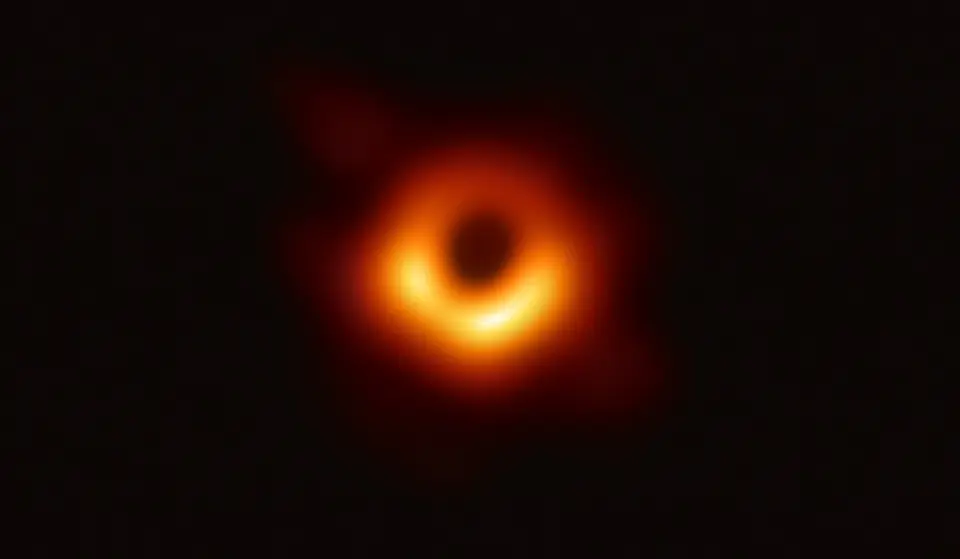
Observations now test whether real black holes are truly Kerr black holes. The Event Horizon Telescope found the shadow of M87* consistent with a Kerr black hole. Gravitational-wave “ringdown” signals, the fading vibrations of a newly merged black hole, provide another test: the 2025 signal GW250114, the clearest yet, was consistent with the Kerr prediction, as were measurements of Sagittarius A*. See our black holes guide.
Who wrote it
Roy Kerr wrote the paper alone. With about 2,800 citations in Semantic Scholar as of October 2026, this brief letter is one of the most influential results in general relativity.
Read the original
Kerr, R. P. (1963). “Gravitational Field of a Spinning Mass as an Example of Algebraically Special Metrics.” Physical Review Letters 11, 237. doi:10.1103/PhysRevLett.11.237. The journal version requires a subscription; a free review of what the Kerr solution describes is on arXiv: 1503.02172.
This week in papers
Five new results in one line each, plus one landmark like this one. Weekly.
Keep reading
Schmidt, Nature, 197, 1040, 1963
The First Quasar: How Maarten Schmidt Decoded 3C 273
Identified in 1963 the star-like radio source 3C 273 as a distant, enormously luminous object: the first quasar. Maarten Schmidt's Nature paper, explained.
Penrose, Physical Review Letters, 14, 57-59, 1965
Penrose's Singularity Theorem: Why Black Holes Must Form
Proved in 1965 that once a trapped surface forms, collapse to a singularity is unavoidable in general relativity. Roger Penrose's Nobel-winning theorem.
Hawking, Nature, 248, 30-31, 1974
Hawking Radiation: How Black Holes Slowly Evaporate
Showed in 1974 that black holes glow faintly and evaporate, ending in a burst. Stephen Hawking's two-page Nature letter on Hawking radiation, explained.
Topic guide
Black holes
Recent news in black holes