Neutron star mergers
When two neutron stars merge they shake spacetime and explode as a kilonova that forges gold and platinum. What GW170817 showed and what LIGO saw since.
By The Orbital Record editorial teamPublished Last reviewed
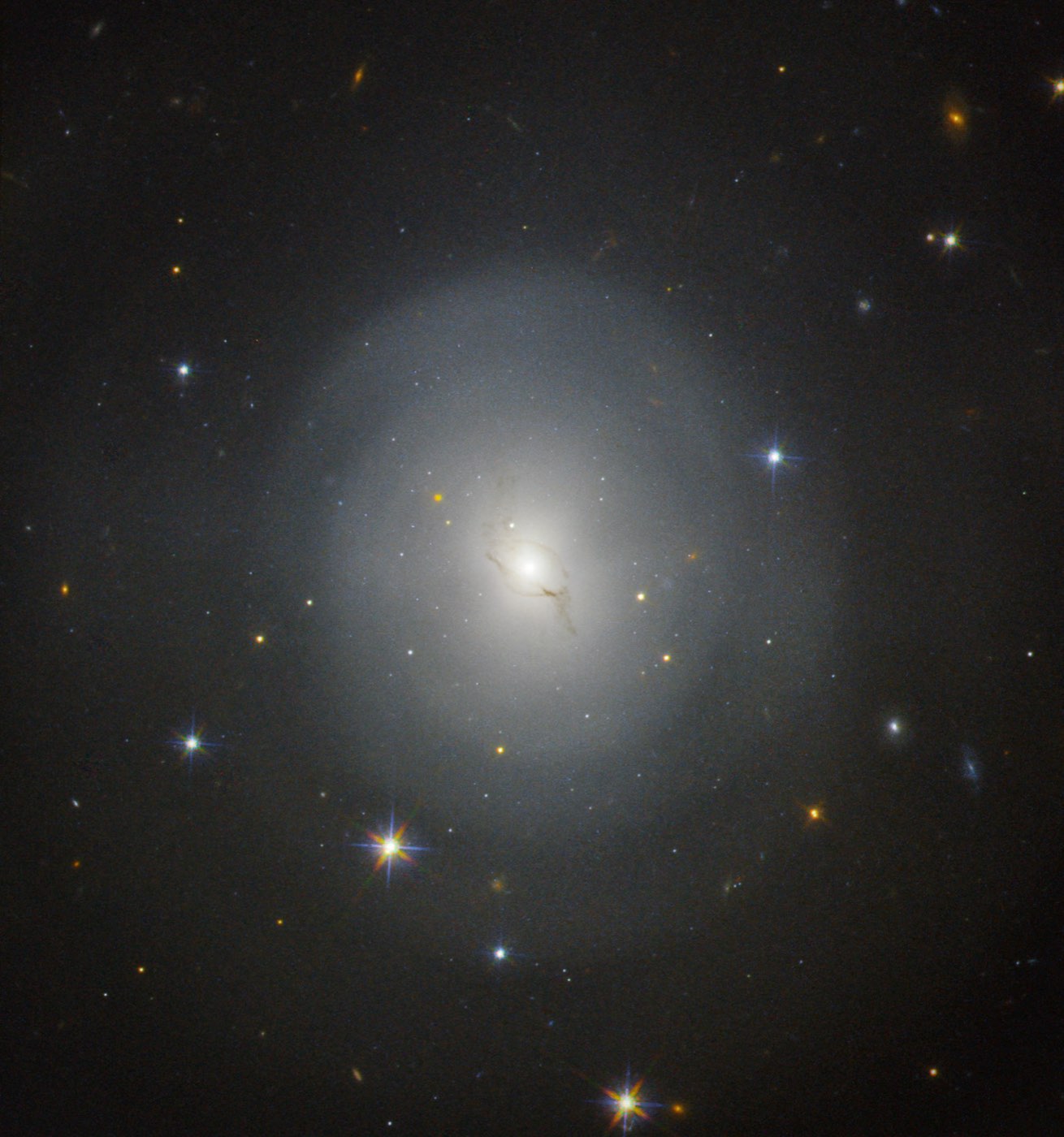
A neutron star merger is the collision of two neutron stars, the ultra-dense cores of dead stars, after they spiral together by emitting gravitational waves. The crash produces a burst of gravitational waves, often a short gamma-ray burst, and a kilonova: a glowing cloud of radioactive debris in which gold, platinum and other heavy elements are forged. The first one observed, GW170817 in 2017, was seen in both gravitational waves and light.
Neutron star mergers are rarer and quieter in gravitational waves than black hole mergers, but far richer, because they also shine. For the waves themselves, start with our gravitational waves guide.
How do neutron stars end up colliding?
Neutron stars form in pairs when both stars of a massive binary explode as supernovae and the system survives. The two remnants then orbit each other, losing energy to gravitational waves and slowly drawing closer. The first such pair, found by Russell Hulse and Joseph Taylor in 1974, is shrinking its orbit exactly as general relativity predicts (the Hulse-Taylor binary pulsar).
The final approach is fast. GW170817 stayed in LIGO’s and Virgo’s frequency band for about 100 seconds before the merger, much longer than black hole signals, because neutron stars are lighter and their “chirp” sweeps through the detectors’ range more slowly. For how the detectors work, see how does LIGO work.
GW170817: the merger that was seen
On August 17, 2017, at 12:41:04 UTC, LIGO and Virgo recorded two neutron stars merging about 130 million light-years away (40 megaparsecs), with a combined mass of about 2.74 Suns (GW170817). What followed was one of the most widely observed events in astronomy:
- 1.7 seconds after the merger, NASA’s Fermi satellite detected a short gamma-ray burst, GRB 170817A, from the same direction.
- Within 11 hours, the 1-meter Swope telescope found a new point of light, later named AT 2017gfo, in the galaxy NGC 4993; other teams found it independently within an hour.
- Over the next two days, ultraviolet light from the debris faded, while optical and infrared light turned redder over about ten days.
- About 9 and 16 days after the merger, X-rays and then radio waves appeared at the same position.
In total, about 70 observatories on the ground and in space observed the event. Three detectors had narrowed its position to 28 square degrees of sky, small enough for telescopes to search.
What is a kilonova?
A kilonova is the glow of the debris from a neutron star merger, heated by the radioactive decay of freshly made heavy elements. Brian Metzger and colleagues proposed the name in 2010, because such events should peak at about 1,000 times the brightness of a typical nova. ESO described the GW170817 kilonova the same way, and reported debris moving at up to a fifth of the speed of light.
The changing color carries the chemistry. Kasen and colleagues, writing in Nature in 2017, modeled AT 2017gfo and found two distinct components of debris: one made mainly of lighter r-process elements, with atomic mass numbers below 140, and one rich in heavier ones. They concluded that such mergers are a dominant source of these elements in the universe.
Do neutron star mergers make gold?
Yes. Kilonova spectra show elements made by the r-process, short for rapid neutron capture, in which atomic nuclei swallow neutrons faster than they can decay. A merger provides the extreme neutron-rich conditions the process needs. ESO’s spectra of GW170817 suggested caesium and tellurium, and the light curves pointed to heavy elements in large amounts.
One team, led by Mansi Kasliwal at Caltech, described the merger as “a cosmic mine” forging more than 10,000 Earth masses of heavy elements, including gold, platinum and neodymium. That figure covers all heavy elements, not gold alone. The LIGO collaboration said the observations help explain where about half of all elements heavier than iron are produced. How much other sources, such as rare kinds of supernovae, also contribute is an active research question.
Other neutron star mergers
GW170817 remains the only neutron star merger with light. The others:
| Event | Date | What merged | Distance | Light seen? |
|---|---|---|---|---|
| GW170817 | August 17, 2017 | Two neutron stars, about 2.74 Suns in total | About 130 million light-years | Yes: gamma rays, kilonova, X-rays, radio |
| GW190425 | April 25, 2019 | Probably two neutron stars, about 3.4 Suns in total | More than 500 million light-years | No |
| GW230529 | May 29, 2023 | A neutron star and an object of 2.5 to 4.5 Suns, probably a light black hole | About 650 million light-years | No (direction unknown) |
GW190425 was unusually heavy: known neutron star pairs in the Milky Way total at most 2.9 solar masses. It was seen clearly only by LIGO Livingston, so its position was spread over about 20% of the sky, too wide for a counterpart search. GW230529 was the first gravitational-wave detection of a “mass-gap” object, heavier than any known neutron star and lighter than known black holes, paired with a neutron star.
The fourth observing run, O4, has not yet added a new neutron star pair. The GWTC-4.0 catalog (O4a) found two likely mergers of neutron stars with black holes, and GWTC-5.0 (O4b, May 2026) found only black hole mergers among its 161 new events (GWTC-5.0). Candidates from the last part of O4 are still being analyzed.
Why neutron star mergers matter
A single event, GW170817, did several things at once. It confirmed that mergers power short gamma-ray bursts, identified a major source of heavy elements, measured the expansion rate of the universe as a “standard siren” independent of the Hubble tension, and showed that gravity travels at the speed of light, a result explained in do gravitational waves travel at the speed of light?.
Mergers also probe the stars themselves. In principle, how a neutron star deforms just before impact depends on how squeezable its matter is, a property measured nowhere else. For more on these objects, see our explainer on neutron stars. With LIGO-India targeted to begin observing in 2030, future mergers should be located faster and more precisely, giving telescopes a better chance of catching the next kilonova.
Questions people ask
What happens when two neutron stars collide?
They spiral together for millions of years, then merge in a fraction of a second. The collision sends out gravitational waves, can launch a short gamma-ray burst, and throws out hot, neutron-rich debris in which heavy elements such as gold and platinum form. The glowing debris is called a kilonova.
What is a kilonova?
A kilonova is the glow of radioactive debris thrown out by a neutron star merger. The name, proposed by Brian Metzger and colleagues in 2010, reflects a peak brightness about 1,000 times that of a typical nova. The first well-observed kilonova, AT 2017gfo, followed the GW170817 merger in August 2017.
Do neutron star mergers make gold?
Yes. Spectra of the 2017 kilonova showed freshly made heavy elements from the rapid neutron-capture process, or r-process. One team estimated the merger forged more than 10,000 Earth masses of heavy elements, including gold, platinum and neodymium. Such mergers may make about half of all elements heavier than iron, though other sources may contribute.
How often do neutron stars merge?
Rarely enough that LIGO and Virgo caught only two confirmed mergers of two neutron stars in their first three observing runs, GW170817 and GW190425. The first two parts of the fourth run, through January 2025, added no new ones, though they found likely mergers of neutron stars with black holes.
Can a neutron star merger affect Earth?
Not from any known system. GW170817 was about 130 million light-years away, and its gamma rays and gravitational waves passed harmlessly through Earth. A merger would have to be very close, within our corner of the galaxy, to pose a danger, and no known neutron star pair is due to merge anytime soon.
What is left after two neutron stars merge?
Either a heavier neutron star or a black hole, depending on the final mass. If the combined remnant exceeds the maximum mass a neutron star can support, a limit thought to lie a little above about 2.2 solar masses, it collapses into a black hole. The exact limit is still being measured.